Blog

  • Emporia Vue: How to Cut Energy Bills

    Emporia Vue: How to Cut Energy Bills

    At a glance

    • The Emporia Vue is a professional-grade, circuit-level energy monitor that can turn granular data into meaningful savings and smart-home automation—if you install the CT clamps carefully, configure the app thoughtfully, and understand its compatibility and cloud limits; this guide walks through setup, app mastery, accuracy testing, and ROI so you can decide whether it deserves a place in your panel.
    • Thinking about an Emporia Vue? This friendly, hands-on review shows exactly how this Emporia energy monitor turns your electrical panel into a circuit-by-circuit savings map—not just another whole-home meter. You’ll get a true step-by-step install guide, from safely opening the panel and placing CT clamps to handling 240V double-pole circuits and knowing when to call an electrician. Then we walk through the Emporia app: account setup, Wi-Fi pairing, naming circuits, tariffs, real-time and historical graphs, solar/net metering, notifications, and data export. We also test accuracy, latency, connectivity, and firmware quirks, compare Vue generations and Sense, and share real kWh case studies with payback math. Electricity prices keep climbing; every month without circuit-level visibility is money left on the table. Try the app’s demo mode today—then decide if Vue 3 belongs in your panel.
    • While most home energy monitors only show total consumption, the Emporia Vue energy monitor delivers circuit-level data that pinpoints exactly which appliances are draining your wallet—and here’s how to install and master it.
    Most energy monitors just show a total. The Emporia Vue breaks it down circuit by circuit—here’s how to install it and squeeze out real savings.

    While most home energy monitors only show total consumption, the Emporia Vue energy monitor delivers circuit-level data that pinpoints exactly which appliances are draining your wallet—and here’s how to install and master it.

    💡

    The Emporia Vue is a professional-grade, circuit-level energy monitor that can turn granular data into meaningful savings and smart-home automation—if you install the CT clamps carefully, configure the app thoughtfully, and understand its compatibility and cloud limits; this guide walks through setup, app mastery, accuracy testing, and ROI so you can decide whether it deserves a place in your panel.

    Metric Specification / Impact
    Average Savings ~10% reduction in monthly utility costs
    Sampling Rate 24,000 samples per second for high granularity
    Accuracy Within ±2% of utility-grade meters
    Monitoring Capacity Up to 16 individual branch circuits plus main lines
    Hardware Cost Starting at approximately $99 for Vue 3 units

    The reality check: While the hardware is highly affordable, installation requires physical access to the main electrical panel and the placement of sensors around live wires, which may need a professional electrician for those uncomfortable with high-voltage environments.

    Go deeper: Explore the technical specifications, installation logistics, and real-world performance of the Emporia Vue system below.

    Go Deeper

    The Convergence of IoT Hardware and Energy Analytics

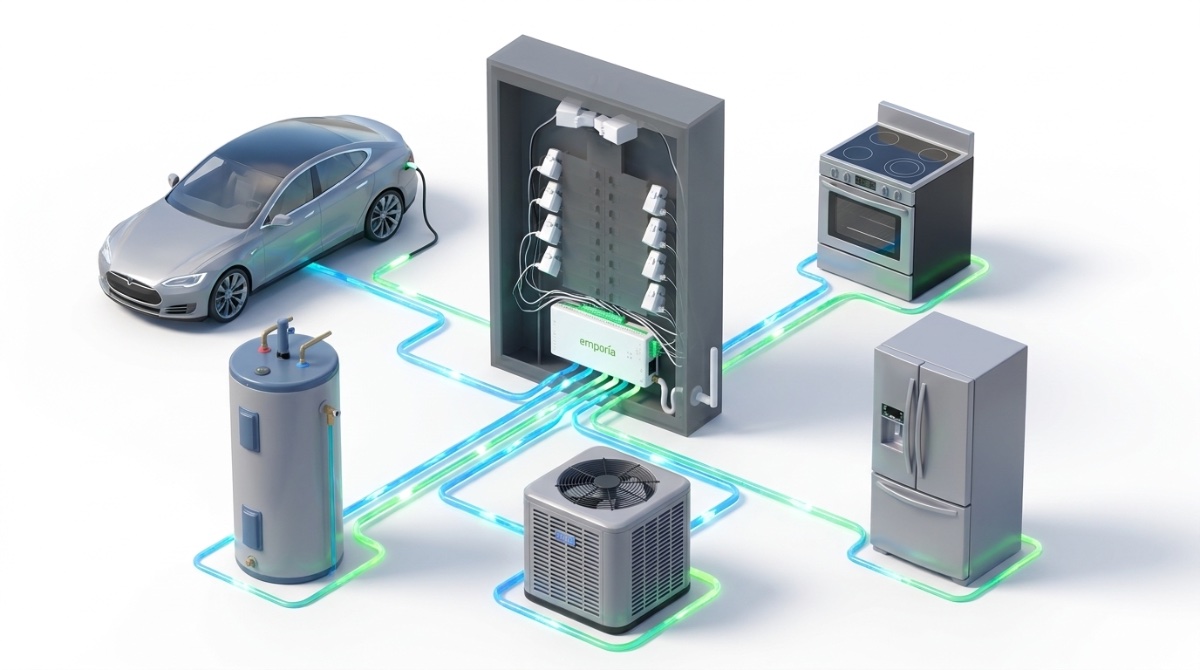
    The Emporia Vue is a two-part ecosystem designed to bridge the gap between raw electrical current and actionable digital insights. The system consists of IoT-enabled hardware that resides within your electrical panel and a sophisticated software suite that provides real-time, historical, and tariff-aware data. Unlike basic monitors that only track total house consumption, the Vue utilizes current transformers (CT clamps) to monitor up to 16 individual branch circuits simultaneously.

    This level of granularity is essential for modern professionals who need to distinguish between essential baseloads and discretionary spikes. By pairing the hardware with the Emporia app, users move beyond “pretty graphs” into a realm of diagnostic data. This information is robust enough to be used for professional energy audits or to provide electricians with specific evidence of equipment failure, such as a compressor that is drawing excessive current during startup.

    Installation Logistics and Panel Compatibility

    The physical installation of the Vue involves placing CT clamps around the main service conductors and individual circuit wires. These sensors operate via induction, meaning they do not require direct contact with bare copper; they simply “read” the magnetic field generated by the current. For a standard 200A residential panel, the process typically takes one to two hours, though the physical footprint of the sensors can make for a tight fit in older, crowded panels.

    The newer Vue 3 iteration addresses several legacy pain points by featuring a more compact design and improved terminal blocks. However, compatibility remains a critical pre-purchase check. While the system works seamlessly with standard split-phase 120V/240V systems common in North America, users with 400A service or complex three-phase commercial setups may require additional hardware or specific configurations to ensure total accuracy across all legs of power .
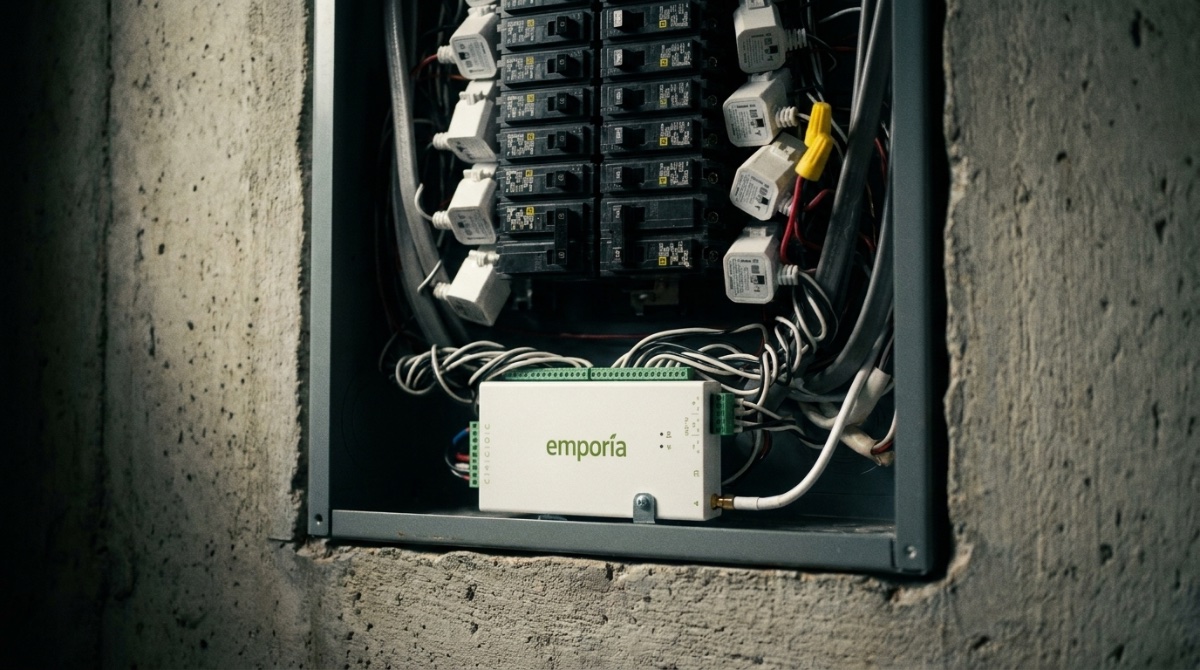
    Electrical box with Emporia Vue

    Actionable Insights: From Data to Dollars

    The true value of the Emporia Vue lies in its ability to reveal “ghost loads”—appliances that consume significant power even when they appear to be idle. Real-world applications of this data often lead to immediate behavioral or mechanical changes. For instance, many users discover that electric water heaters consume a disproportionate amount of energy during off-peak hours. By integrating an automatic switch to shut the heater off when not in use, users have reported savings of $40 per month or more.
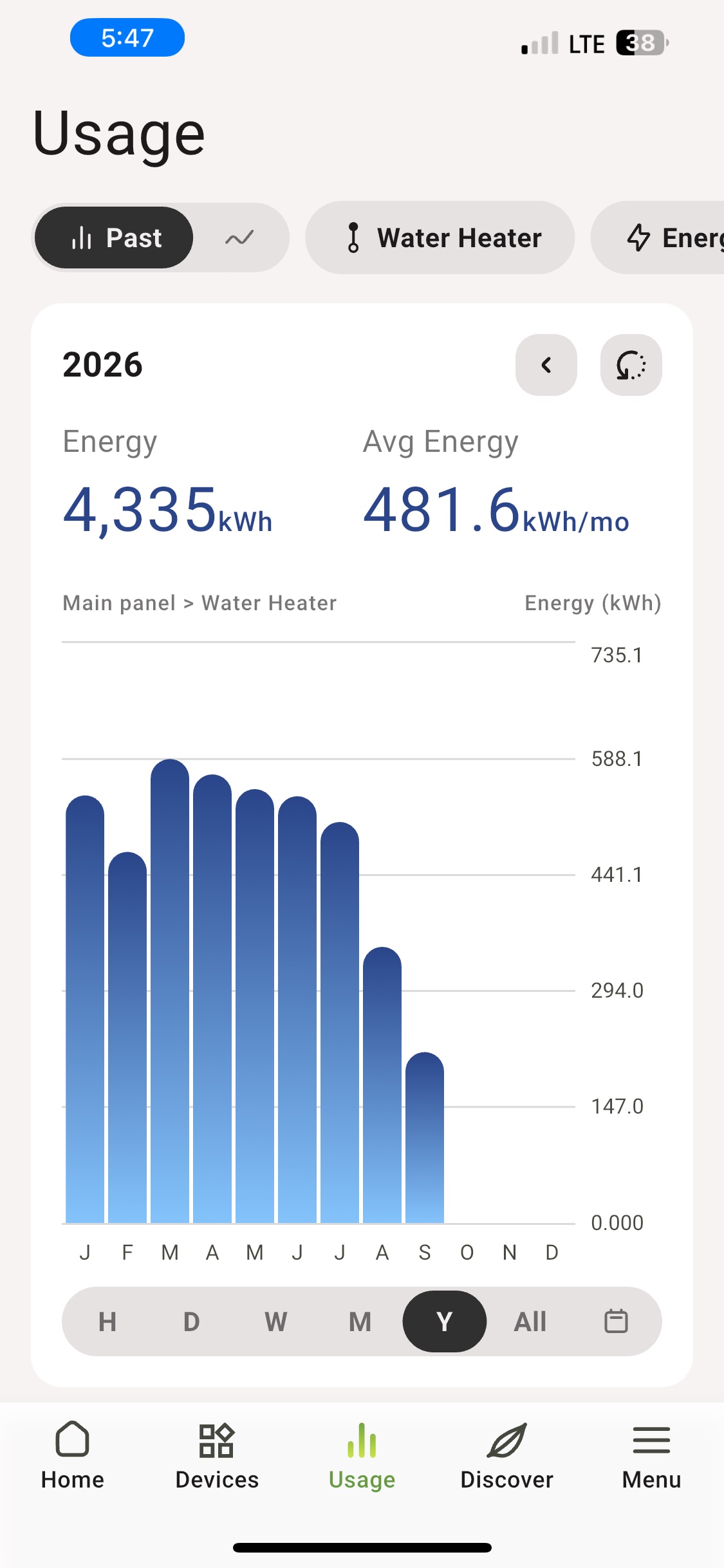
    Water heater stats

    Beyond simple automation, the Vue acts as an early warning system for mechanical failure. A common scenario involves HVAC systems that continue to run but lose efficiency due to refrigerant leaks or failing components. By monitoring the real-time wattage of the AC circuit, a homeowner can identify when a unit is consuming more energy than its rated capacity to achieve the same cooling effect. Fixing these issues early prevents catastrophic equipment failure and restores consumption to normal levels.

    • Circuit Naming: Properly labeling each CT clamp in the app is vital for accurate tracking of kitchen, laundry, and HVAC loads.
    • Tariff Integration: Inputting your specific utility rate structure allows the app to calculate actual dollar costs rather than just kilowatt-hours.
    • Solar Monitoring: For homes with renewable energy, the Vue can track both production and consumption, providing a clear picture of net metering performance .

    Accuracy, Latency, and Reliability

    In terms of performance, the Emporia Vue competes directly with more expensive “fingerprint” monitors like Sense. While Sense attempts to use machine learning to guess which appliances are running based on their electrical signature, the Vue uses direct physical connection to the circuit. This “hardwired” approach generally results in higher reliability and less “guessing” by the software. With a sampling rate of 24,000 times per second, the Vue captures transient spikes that slower monitors might miss .

    The system maintains a high level of uptime, provided the 2.4GHz Wi-Fi signal at the electrical panel is strong. Because the panel is essentially a metal Faraday cage, some installations require an external antenna (included in the kit) to be routed outside the box. Once connected, the latency is minimal, allowing users to flip a switch and see the corresponding jump in the mobile app’s “Real-Time” view almost instantly.

    Frequently Asked Questions

    Do I need an electrician to install the Emporia Vue?

    While many DIY-savvy homeowners install the Vue themselves, it requires working inside a live electrical panel. If you are not comfortable working around main service lugs that cannot be turned off, hiring a licensed electrician for the 60-90 minute installation is highly recommended for safety.

    Can the Vue monitor 240V appliances like EV chargers?

    Yes, the Vue can monitor 240V circuits using two CT clamps (one on each “leg” of the circuit) or by using a single clamp and doubling the reading in the app settings, depending on the specific circuit configuration and available space.

    Does the Emporia Vue require a monthly subscription?

    No, one of the primary advantages of the Emporia ecosystem is that there are currently no subscription fees for accessing your data, viewing real-time stats, or exporting historical usage via CSV files.

    What is the main difference between the Vue 2 and Vue 3?

    The Vue 3 features a more compact design, easier-to-use screw terminals for the sensors instead of 3.5mm jacks, and improved accuracy for solar net-metering setups, making it the preferred choice for new installations .

    References

    Emporia Energy. “Real-world savings and case studies.”
    Solar Reviews. “Monitoring solar production with Emporia.”
    Tech Gear Lab. “Emporia Vue Review: Best Energy Monitors.”
    Energy Sage. “Home Energy Management Systems (HEMS) Overview.”
    PCMag. “Emporia Vue Gen 3 Review.”
    Emporia Technical Documentation. “CT Clamp Accuracy and Sampling Rates.”
    Wirecutter. “The Best Home Energy Monitors.”
    Professional Electrician Magazine. “Diagnostic tools for residential energy efficiency.”



  • Benefits of Living in the City: 2026 Pros and Cons

    Benefits of Living in the City: 2026 Pros and Cons

    At a glance

    • The benefits of living in the city—from accelerated career mobility to unmatched cultural and social capital—still outweigh the trade-offs, but only when the decision is anchored in a clear-eyed cost-benefit analysis of your specific priorities. This article breaks down the real pros and cons of city living with 2025–2026 data to help you determine whether an urban move will optimize your career trajectory and quality of life—or quietly erode both.
    • The benefits of living in the city have never been more nuanced—or more decisive—for mid-career professionals. In 2026, with hybrid work reshaping where talent lives, the urban advantage remains powerful: denser job markets, higher earning potential, walkable transit, world-class culture, and diverse networks. Yet smaller spaces, noise, and costs demand honest math. Our guide cuts through outdated advice, a side-by-side urban-suburban-rural comparison, and an interactive cost-of-living calculator. You’ll also find a personalized decision framework scoring your priorities—career, space, schools, budget—plus real personas from remote workers to growing families. The pros and cons of city living are not abstract. Run the numbers, take the quiz, and decide before your next lease or offer expires. This is your 2025 reality check.
    • What if the most underrated career move for a 35-to-45-year-old professional isn’t a certification or a side hustle, but a move to the city?
    The benefits of living in the city extend well beyond salary—career access, culture, and convenience—yet the trade-offs are real. What mid-career professionals should weigh first.

    What if the most underrated career move for a 35-to-45-year-old professional isn’t a certification or a side hustle, but a move to the city?

    💡

    For young professionals navigating in a hybrid-work era, the benefits of living in the city—from accelerated career mobility to unmatched cultural and social capital—still outweigh the trade-offs, but only when the decision is anchored in a clear-eyed cost-benefit analysis of your specific priorities. This article breaks down the real pros and cons of city living with 2025–2026 data to help you determine whether an urban move will optimize your career trajectory and quality of life—or quietly erode both.

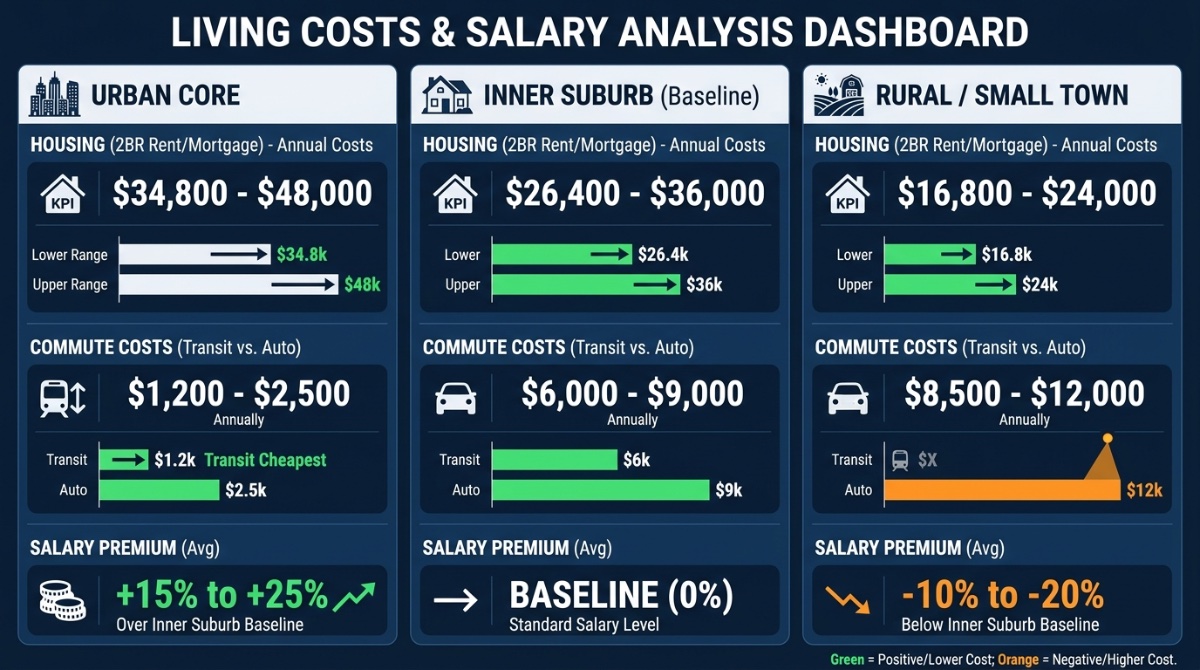
    Annual Line Item (2026 Est.)

    Urban Core

    Inner Suburb

    Rural / Small Town

    Housing (2BR Rent/Mortgage)

    $34,800–$48,000

    $26,400–$36,000

    $16,800–$24,000

    Commute Costs (Transit vs. Auto)

    $1,200–$2,500

    $6,000–$9,000

    $8,500–$12,000

    Salary Premium (Avg)

    +15% to 25%

    Baseline

    -10% to -20%

    The reality check: While cities offer unmatched career acceleration and cultural access, they demand a “quiet cost” in the form of chronic environmental stressors and the erosion of acoustic privacy that can impact long-term cognitive focus.

    Go deeper: Explore the evolving economic and lifestyle frameworks that define the modern urban advantage for established professionals.

    Go Deeper

    Career Capital in a Remote-First Era

    In the 2026 labor market, the concept of “urban career capital” has transitioned from a vague preference for city life into a quantifiable economic asset. Economists now define this capital through three distinct lenses: the salary premium, network density, and the frequency of spontaneous collaboration. Proximity to major employers and industry-specific clients creates a measurable spread between metropolitan compensation and the pay for identical roles in secondary markets.

    The value of this capital extends far beyond the monthly paycheck. It encompasses the “optionality” afforded to professionals who remain physically reachable when firms make rapid decisions regarding hiring or internal promotions. Being present when strategic acquisitions are discussed often places a professional at the center of the transition team, a position rarely offered to remote staff.

    Infographic: Data Visualization - Housing (2BR Rent/Mortgage): Annual housing costs are highest in the Urban Core, ranging from $34,800 to $48,000. The Inner Suburb is moderately price

    For mid-career professionals, particularly those in the 40-year-old demographic, this optionality compounds at an accelerated rate. In a dense urban environment, competing employers frequently bid for the same specialized skill sets. This concentration of opportunity fundamentally strengthens a professional’s negotiating position during annual reviews or contract renewals.

    Market analysts suggest that this density transforms the process of job switching from a high-friction event involving relocation into a local transition. A professional can often secure a new role and complete the onboarding process within weeks while remaining in the same residence . This stability is a significant advantage for families with school-aged children who wish to avoid the disruption of moving.

    The Access Dividend: Culture and Convenience

    Urban density functions as a sophisticated economic mechanism that converts physical proximity into tangible value. For the modern professional, much of this value is not reflected in a standard salary but manifests through a high concentration of specialized assets. These include world-class galleries, medical sub-specialists, robust transit infrastructure, and dense professional networks .

    These assets are situated within a constrained geographic radius, creating what economists call a localized economy of scale. As global populations continue to shift toward metropolitan centers, the ability to leverage these proximity-based assets has become a primary driver of quality of life. This is particularly true for mid-career professionals who must balance high-stakes roles with complex personal lives .

    For households headed by individuals in their late thirties and forties, the primary advantages of urban residency often materialize as recovered time. In this specific life stage, professional responsibilities and family obligations frequently peak simultaneously. This creates a state of “time poverty,” where the margin for logistical error is razor-thin .

    art-gallery-featuring-peach-fuzz-abstract-paintings-white-walls

    The efficiency of a dense city acts as a buffer against this logistical friction. Hours saved through efficient transit and localized services compound over weeks and months into significant gains in career flexibility and domestic stability. These gains often outweigh the direct increases in gross income found in less dense, car-dependent environments.

    Space, Privacy, and the True Cost of Density

    Urban residency has evolved into a high-stakes transaction where professionals increasingly swap square footage and acoustic privacy for the one commodity they cannot manufacture: time. For a 38-year-old managing a multi-national portfolio, the value of a home is no longer calculated solely by rent per square foot. Instead, it is measured by the degree to which the immediate environment preserves or drains their health and cognitive focus.

    The benefits of the urban core are easily quantified. Shorter commutes, walkable access to essential services, and proximity to specialized medical facilities offer a clear logistical advantage . However, these perks often come with “quiet costs” that rarely appear on a standard lease agreement. Systemic stressors, including chronic noise and air pollution, are frequently omitted from the financial calculations made by those relocating to high-density areas.

    Density offers unmatched efficiency but charges a significant premium in the form of personal space. Many mid-career professionals now categorize a quiet, private room as a non-negotiable asset rather than a discretionary luxury. High-density living environments expose residents to elevated levels of particulate matter and persistent noise . For a remote worker in a compact apartment, these environmental factors can turn the home into a space where mental resources must be strictly rationed.

    Raising Children in the City vs. the Suburbs

    For mid-career parents, the choice of where to plant roots is a complex, multi-variable calculation involving residential stability, career trajectory, and the evolving developmental needs of children. While the suburban landscape remains the traditional default, offering a predictable ratio of square footage to cost, the modern family must weigh these benefits against the high-density advantages of urban living.

    two-cheerful-little-girls-go-school-holding-hands

    Suburbs historically provide a buffer against the friction and unpredictability of high-density environments. They offer reduced noise levels, lower traffic volumes in residential zones, and a sense of permanence. For a parent managing a demanding professional life, the quiet of a cul-de-sac often represents a necessary sanctuary from the pressures of the office or the digital workplace.

    However, urban centers maintain a distinct competitive edge that suburban developments cannot easily replicate. Cities function as high-density hubs of professional and educational opportunity, providing a concentration of resources that are often unavailable in the periphery. This geographic tension forces families to choose between the controlled, curated environment of the suburbs and the resource-rich nature of the city.

    The Structural Shift: From Requirement to Discretion

    The fundamental value proposition of the modern metropolis is undergoing a structural transformation. For decades, the concentration of labor and capital in urban centers made city living a prerequisite for high-trajectory careers. In sectors like finance, media, and technology, physical presence was the price of admission. To reach the upper echelons of these industries, professionals had to be “in the room where it happened.”

    Today, while urban environments continue to offer unparalleled career density and cultural access, the nature of the “urban premium” has fundamentally changed. For the burgeoning class of remote-first professionals, the decision to reside in a major city has shifted from a career requirement to a discretionary lifestyle purchase. This transition marks a significant departure from the industrial and early information ages.

    In previous eras, geographic proximity to a central business district was the primary determinant of economic opportunity. Now, the city must compete as a product rather than a mandatory platform. This evolution from a production hub to a consumption hub suggests that the benefits of density are no longer distributed equally across all professions. The high cost of urban residency—once viewed as a necessary investment in professional human capital—is increasingly scrutinized as a personal consumption choice.

    Frequently Asked Questions

    Is the urban salary premium still relevant in a remote-work economy?

    Yes, while remote work is common, “urban career capital” still commands a 15-25% premium due to network density and the “optionality” of being physically present for high-stakes executive decisions and acquisitions.

    How does city living impact the “time poverty” of mid-career professionals?

    City living acts as a strategic buffer by reducing commute times and providing localized access to services, effectively “buying back” hours that would otherwise be lost to car-dependent logistics in suburban areas.

    What are the primary “quiet costs” of urban density?

    The primary quiet costs include chronic exposure to noise and air pollution, as well as the loss of acoustic privacy, which can increase cognitive load and blur the boundaries between professional and domestic life.

    Does raising children in the city provide a long-term competitive advantage?

    Urban environments offer children greater exposure to diverse social networks and specialized educational resources, though this is often balanced against the stability and increased physical space found in suburban settings.

    References

    City living offers career opportunities, cultural diversity, and convenience, making it ideal for.

    The benefits of city living range from the obvious, like more job opportunities, to the unexpected,.

    In short, city life opens doors to better employment opportunities, higher incomes, and stronger car.

    United Nations Population Division. (2024). World Urbanization Prospects.
    Glaeser, E. (2011). Triumph of the City: How Our Greatest Invention Makes Us Richer, Smarter, Greener, Healthier, and Happier.
    Florida, R. (2017). The New Urban Crisis.
    World Health Organization. (2023). Environmental Noise Guidelines for the European Region.
    Bureau of Labor Statistics. (2024). Occupational Outlook Handbook: Metropolitan Area Estimates.
    Moretti, E. (2012). The New Geography of Jobs.


    References

    [1] – City living offers career opportunities, cultural diversity, and convenience, making it ideal for.

    [2] The benefits of city living range from the obvious, like more job opportunities, to the unexpected,.

    [3] In short, city life opens doors to better employment opportunities, higher incomes, and stronger car.

  • NY Heat Pump Rebate: Double Payouts for Sealed Homes

    NY Heat Pump Rebate: Double Payouts for Sealed Homes

    At a glance

    • Built after 2010: Modern codes require tight insulation, so the program assumes your home passes. Show property records or a move-in permit to prove the build year.

    • Built after 2010: Modern codes require tight insulation, so the program assumes your home passes. Show property records or a move-in permit to prove the build year.
    • Past utility work: You qualify if you already finished a weatherization job under a known program. That list includes Con Edison’s Weather Ready & Sealed, National Grid’s Total Home Comfort, and the New York State Energy Research and Development Authority (NYSERDA) Comfort Home.

    • Past utility work: You qualify if you already finished a weatherization job under a known program. That list includes Con Edison’s Weather Ready & Sealed, National Grid’s Total Home Comfort, and the New York State Energy Research and Development Authority (NYSERDA) Comfort Home.
    • Test your home: This route measures the heating load — how hard the furnace works per square foot of living space. A home under 1,000 square feet passes at 30 or less on the program’s scale (27 in New York City). Between 1,000 and 2,000 square feet the bar is 25 (22 in the city), and above 2,000 it drops to 20 (16 in the city). Con Edison checks it with a HomeBoost Pro home visit that includes heat photos; upstate utilities want a standard heat-load calculation backed by photos.

    On September 1, 2026, New York began paying up to double for heat pumps in homes that seal and insulate first. In 20 months, this step stops being a bonus and becomes a hard rule.

    On September 1, 2026, New York began paying up to double for heat pumps in homes that seal and insulate first.

    💡

    In 20 months, this step stops being a bonus and becomes a hard rule.

    How to qualify for the ny heat pump rebate

    What to do: You can reach the higher rebate tier through one of three paths . None of them need a big remodel.

    • Built after 2010: Modern codes require tight insulation, so the program assumes your home passes. Show property records or a move-in permit to prove the build year .
    • Past utility work: You qualify if you already finished a weatherization job under a known program . That list includes Con Edison’s Weather Ready & Sealed, National Grid’s Total Home Comfort, and the New York State Energy Research and Development Authority (NYSERDA) Comfort Home .
    • Test your home: This route measures the heating load — how hard the furnace works per square foot of living space. A home under 1,000 square feet passes at 30 or less on the program’s scale (27 in New York City). Between 1,000 and 2,000 square feet the bar is 25 (22 in the city), and above 2,000 it drops to 20 (16 in the city) . Con Edison checks it with a HomeBoost Pro home visit that includes heat photos; upstate utilities want a standard heat-load calculation backed by photos .

    The bigger “with decommissioning” rebates carry one rule: the program wants proof the old gas or oil furnace is actually retired before it pays the higher amount .

    By the numbers: The upgrade pays real cash. The national grid heat pump rebate doubles the standard payout from $4,000 to $8,000 . Con Edison bumps its cold-climate rebate from $7,000 to $10,000 when you remove the old furnace , and raises its geothermal (ground-source) whole-home rebate from $25,000 to $30,000 outside lower-income zones . In lower-income zones, Con Edison’s cold-climate rebate rises from $8,000 to $11,000, and its geothermal rebate from $35,000 to $40,000 .

    The play is the order: seal and insulate first, then claim the higher heat pump payout. You win twice — lower energy bills from the tight house, and a fatter rebate on the equipment.

    The hidden costs

    The catch: This is one state, and an early sign. If you don’t live in New York, none of this touches your rebate yet. But it is the clearest hint of where rebate design is heading.

    Even inside New York, the test route isn’t free. It means contractor time and paid checks before you see a single rebate dollar .

    And “insulate first” is a bigger, slower project than a straight heat pump swap. The higher rebate helps pay for it, but it does not turn a full retrofit into pocket change.

    • The ny heat pump rebate now pays up to double ($4,000 to $8,000 on National Grid) to sealed homes as of September 1, 2026.
    • Sealing and insulating becomes a strict rule for any Clean Heat rebate on March 1, 2028.
    • Homeowners qualify through a post-2010 build year, past utility work, or a home heat test.

    References

    [1] New York State Clean Heat Heat Pump Program Manual, Version 3 — NYS Dept. of Public Service (filed Sept 1, 2026).

    [2] New York State Clean Heat Heat Pump Program Manual, Version 2 (March 5, 2026).

    [3] Rewiring America — 25C Heat Pump Federal Tax Credits.

  • Swapping your gas furnace for a heat pump tax credit 2026 just died

    Swapping your gas furnace for a heat pump tax credit 2026 just died

    TL;DR

    • As of September 1, 2026, the federal HEAR rebate no longer funds gas-to-electric appliance swaps, following the December 2025 expiration of the 25C heat pump tax credit 2026 applicants previously relied upon.
    • Surviving incentives include the HOMES whole-home rebate for modeled savings, HEAR rebates for electric-to-electric upgrades (up to $8,000 for space heating), and the 30% 25D geothermal credit.
    • Check your state’s current program and verify your home’s insulation and air sealing before purchasing a heat pump, as new federal rules prioritize the building envelope.
    • At 5:30 p.m. Central time on August 31, 2026, the window closed for Wisconsin homeowners to claim a federal rebate for replacing a fossil-fuel appliance with an electric one . The very next morning, the federal High-Efficiency Electric Home Rebate program officially stopped funding gas-to-electric swaps across every participating state . The subsidy is gone. If you planned to pull a gas furnace, water heater, or range and cover the upgrade with a federal heat pump tax credit 2026 incentive, that path quietly vanished.
    • This marks the second major funding cut in less than a year. The 25C Energy Efficient Home Improvement tax credit expired on December 31, 2025, taking with it up to $2,000 in heat pump incentives .
    Central time on August 31, 2026, the window closed for Wisconsin homeowners to claim a federal rebate for replacing a fossil-fuel appliance with an electric one. The very next morning, the federal High-Efficiency Electric Home Rebate program officially stopped funding gas-to-electric swaps across every participating state.

    Central time on August 31, 2026, the window closed for Wisconsin homeowners to claim a federal rebate for replacing a fossil-fuel appliance with an electric one.

    💡

    The very next morning, the federal High-Efficiency Electric Home Rebate program officially stopped funding gas-to-electric swaps across every participating state.

    Navigating the Heat Pump Tax Credit 2026 Landscape

    Federal money still exists. It just carries new conditions.

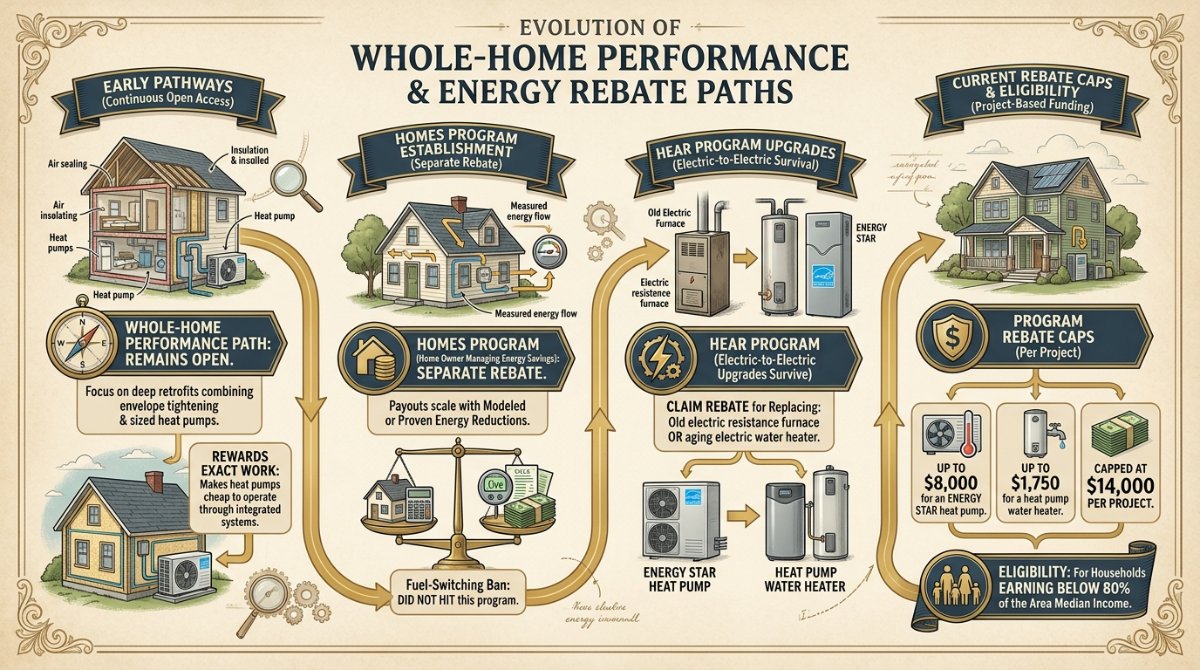
    The whole-home performance path remains open. The HOMES program (Home Owner Managing Energy Savings) is a separate rebate where payouts scale with modeled or proven energy reductions . The fuel-switching ban did not hit this program. If your project involves a deep retrofit—combining air sealing, insulation, and a heat pump sized to a tighter envelope—this route still pays out. It rewards the exact work that makes a heat pump cheap to operate .

    Electric-to-electric upgrades also survive under HEAR. You can still claim a rebate for replacing an old electric resistance furnace or an aging electric water heater. The program offers up to $8,000 for an ENERGY STAR heat pump and up to $1,750 for a heat pump water heater, capped at $14,000 per project . For households earning below 80% of the area median income, the rebate covers the total project cost. Between 80% and 150% of the median income, it covers half .

    By rule, the building envelope now dictates the timeline. Notice 26-2 mandates that homes use rebates for insulation and air sealing before touching heating and cooling upgrades, unless the house is already properly sealed. The program demands this baseline work first because it actually cuts the utility bill.

    Geothermal systems retain a separate federal lifeline. The 25D Residential Clean Energy Credit remains untouched, covering 30% of a ground-source heat pump’s installation cost through 2032 . This provides a larger check than the 25C credit ever did. However, drilling a ground loop is a vastly different job with a much larger budget than an air-source swap.

    Infographic: Timeline Historical - The whole-home performance path remains open. The HOMES program (Home Owner Managing Energy Savings) is a separate rebate where payouts scale with mod

    Stop pricing your project on the 2024 incentive sheet. Pull your state’s current program page. Check whether your home falls under the electric-to-electric or whole-home category, and run the payback math on the actual rebates available today.

    This funding shift does not make electrification a bad investment. A heat pump still beats a gas furnace on operating costs in most climates. The equipment itself continues to get better and cheaper. The federal government simply stopped subsidizing the switch itself.

    If your gas furnace just died and you needed a rebate to afford a like-for-like swap, that specific federal check is gone. You might need to pivot to the whole-home retrofit route. Alternatively, check your local state and utility incentives. Several states still run conversion rebates independent of the Department of Energy .

    The rebate landscape changed with a pen stroke in May and a calendar deadline in September. The payback math changed right alongside it.

    • As of September 1, 2026, the federal HEAR rebate no longer funds gas-to-electric appliance swaps, following the December 2025 expiration of the 25C heat pump tax credit 2026.

    • Surviving incentives include the HOMES whole-home rebate for modeled savings, HEAR rebates for electric-to-electric upgrades (up to $8,000 for space heating), and the 30% 25D geothermal credit.

    • Check your state’s current program and verify your home’s insulation and air sealing before purchasing a heat pump, as new federal rules prioritize the building envelope.


    References

    [1] U.S. Department of Energy, “Home Energy Rebates Program Notice 26-2: High-Efficiency Electric Home Rebate (HEEHR) Program for States and Territories,” effective May 29, 2026..

    [2] Focus on Energy (Wisconsin), “Home Electrification and Appliance Rebates (HEAR).”.

    [3] Energy Saver North Carolina, “HEAR Updates and Program Changes.”.

    [4] Rewiring America, “25C Heat Pump Federal Tax Credits: A Guide” (citing the IRS)..

    [5] U.S. Department of Energy, “Home Energy Rebates Program Notice 26-1: Home Owner Managing Energy Savings (HOMES) Rebate Program,” effective May 29, 2026..