Author: kotechile@gmail.com

  • Your Battery Snow Blower’s $1,650 Depth Gap

    Your Battery Snow Blower’s $1,650 Depth Gap

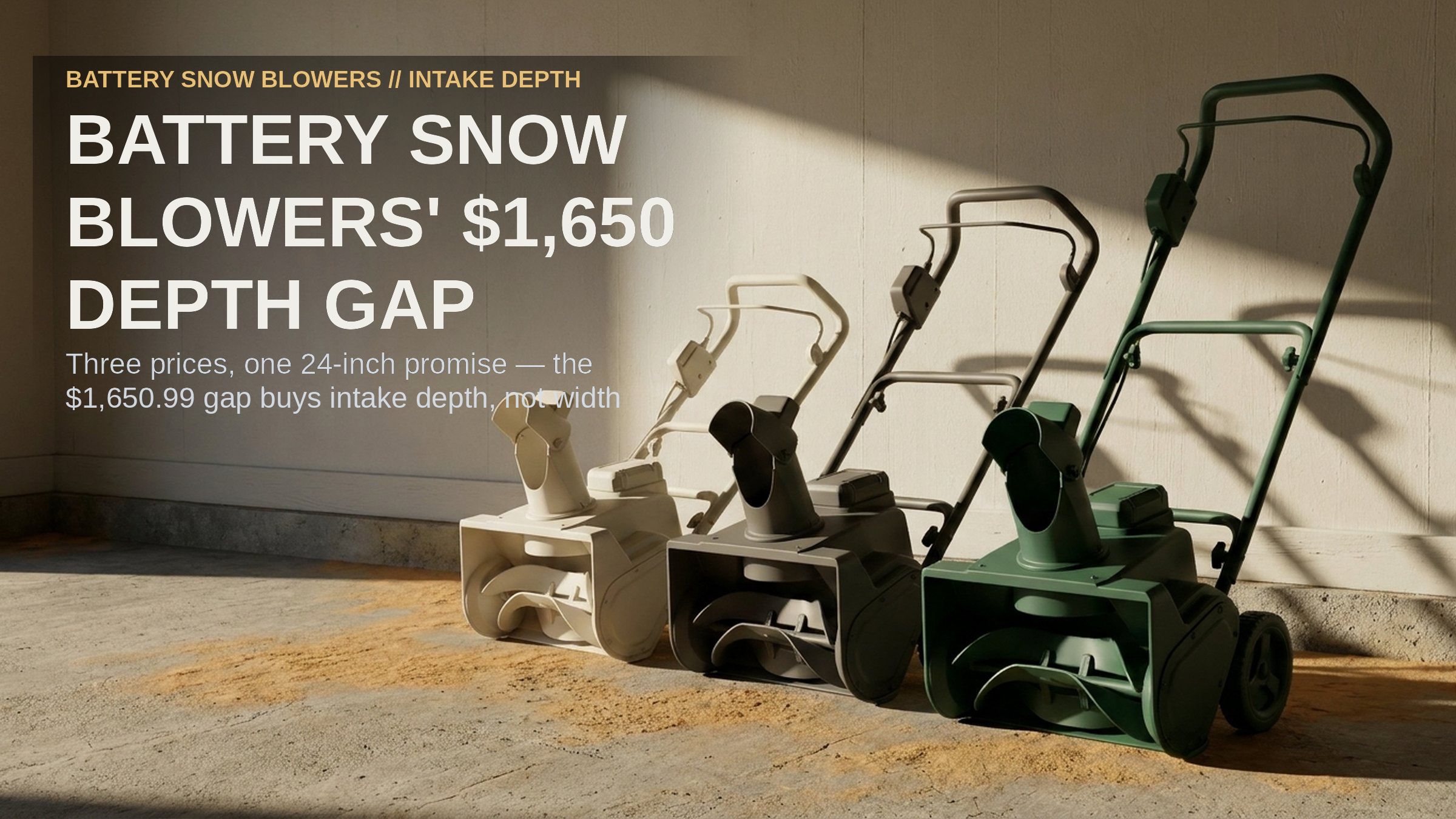
    The battery snow aisle carries three prices for roughly one 24-inch promise, and the gap between the cheapest and the dearest is $1,650.99. The Ryobi 40V HP (the brand’s high-performance line) 21-inch kit (RY40HPSN02K2) lists at $849.00 [1]. The Toro 24-inch Power Max e24 60V kit (model 39925) sits $750 above it, at $1,599.00 [2]. The Greenworks 80V MAXIMUS (the brand’s flagship line) 24-inch kit closes the set at $2,499.99 [3] — three prices as of 2026-11-22, and a $1,650.99 spread between the ends. Width does not explain that spread, because all three machines cut within three inches of each other. Intake depth does, and it is the number every box leads away from.

    At a glance

    This comparison prices the three battery snow blowers a large-driveway buyer meets first and finds the deciding spec is intake depth, not width — with the mid-tier Toro delivering the class promise for $900 less than the flagship.

    The big picture: width is the decoy spec

    All prices here are the makers’ listed prices, and the widths are close. Ryobi cuts 21 inches [1]. The Toro and Greenworks machines both cut 24 — three inches more for $750 and $1,650 more respectively [2]. At $849.00 for the first machine and $2,499.99 for the third, the arithmetic runs the wrong way for the premium: $40.43 of price per inch of cut against $104.17. I did that division twice before accepting it, because it inverts the usual story that the top of a class buys scale.

    The intake depths are not close, and that is where the money goes. Ryobi takes 11.5 inches per pass [1]. Greenworks takes 18 [3]. The Toro housing is the deepest of the three, at 20 [2]. That is the number a February storm meets. In a 10-inch fall the Ryobi takes one pass and a sweep for the remainder. In a 16-inch fall it needs two full passes where either two-stage takes one. Passes are the winter’s actual labor, and depth sets them.

    Throw is the second gate. Ryobi rates 35 feet [1]. Both two-stage machines rate 50 [2]. A 21-inch path throwing 35 feet ends near the driveway edge on a wide lot, and the machine can only clear what it can throw within its own arc. The two-stage pair throws a whole strip farther.

    Unit Price, 2026-11-22 Width Intake depth Rated throw Where it loses
    Ryobi 40V HP 21″ kit (RY40HPSN02K2) $849.00 21 in 11.5 in 35 ft Two full passes in any storm over 11.5 inches, and the shorter arc [1]
    Toro Power Max e24 60V (39925) $1,599.00 24 in 20 in up to 50 ft The maker’s page routes to retailers, so a dealer may price above $1,599.00 [2]
    Greenworks 80V MAXIMUS kit (MSN240TN3) $2,499.99 24 in 18 in up to 50 ft 176.4 lbs to steer, and $900 more than the Toro for one inch less of intake [3]

    By the numbers

    • $79.95 per inch of intake: the Toro’s price divided by its 20-inch intake [2].
    • $138.89: the Greenworks figure on the same arithmetic — depth per dollar is nearly flat up to the Toro, then doubles on the flagship.
    • $329.99: the price of one spare 80V pack on the maker’s own store [4] — the platform tax on an evening of February clearing.

    What I’d watch: where each machine wins

    What I am watching in this set is which driveways the two-stage premium actually pays on, and the answer is wherever snow arrives in bulk — plow windrows, end-of-driveway piles, anything deeper than a foot. The Toro’s 20-inch intake swallows a plow’s leavings in one pass [2]. So does the Greenworks’ 18 [3]. The Ryobi’s 11.5 requires the operator to break the pile first or take it twice [1]. The class’s own reference point is the EGO (the battery outdoor-tool brand) 56V two-stage, which Pro Tool Reviews priced at “$799.99 bare, $1299.99 kit” at review time and measured clearing the same driveways on 20 to 30 percent of its battery charge in light snow [5]. That is the two-stage pitch working as designed, and it is what the $849 single-stage is measured against — not a machine this desk handled.

    The Ryobi wins on the axis nobody quotes: weight. It carries 59.4 pounds [1]. The Greenworks carries 176.4 [3] — a difference you feel every time the blower turns. A single-stage at that weight is a machine a person walks at a pace; a 176-pound two-stage is equipment the driveway pushes back on. Both two-stages are self-propelled, which converts mass into traction. The maker’s own copy for the Toro reads “Self-Propelled” [2]. Pro Tool Reviews lists the Greenworks as self-propelled with power steering [5]. The machine still has to be turned at the end of every pass.

    The warranty ladder is quiet but real. Greenworks carries the battery 4 years and the tool 5 [3]. On a platform where the pack is the consumable that costs $329.99 [4], that fourth year is a line item, not a footnote. The battery configurations differ too: Ryobi runs two 8Ah 40V packs [1]. Toro runs one 10.0Ah with two empty slots [2]. Greenworks runs two 4.0Ah [3] — three answers to how much capacity rides in the box.

    The situation The pick
    A large drive with plow windrows and storms past 16 inches The Toro Power Max e24: 20 inches of intake takes the windrow in one pass, and three battery ports extend the evening
    A buyer who will pay for the longest battery warranty and dealer service The Greenworks 80V MAXIMUS kit: 4 years on the pack, 5 on the tool, bought direct
    A short drive, lighter storms, budget as the deciding constraint The Ryobi 40V HP 21-inch kit: at $849.00 it is the class floor, if the 11.5-inch intake is enough for your storms

    The rest of this vertical’s equipment math, including the cold-weather limits no specification sheet carries, sits in outdoor power equipment. The buy-window angle is already covered on this front — the EGO kit discount that expires November 30 is the same aisle’s calendar risk. For the money side, the true cost of ownership calculator takes a purchase price and a service life and returns a yearly figure to hold against a plow contract.

    The catch

    Coverage claims are not measured on a shared yardstick, and the class’s own pages prove it. Toro speaks in car spaces — “clear up to 20 car spaces on one charge” [2]. Ryobi speaks in car spaces too — “Clears up to 25 Car Spaces Using Included (2) 40V 8Ah Batteries” [1]. The Greenworks publisher row speaks in inches of snowfall and feet of throw [5]. And the 24-car EGO claim Family Handyman retells is a publisher’s phrasing of the maker’s claim, not a shared measurement [6]. A car space is a shape, not a measurement. Nothing here can rank the three machines on a single coverage number, so the comparison above rests on intake depth and pass counts instead.

    My reading, held loosely: most of the price argument rests on figures the makers rate and nobody measures per machine. Every throw distance and car-space count in this piece is a vendor rating under vendor conditions, except where a publisher is named. The pass arithmetic assumes straight full-width passes on a flat apron — the best case no driveway quite is. The Ryobi single-stage and the two-stage pair also sell different jobs; a buyer whose heaviest storm is six inches is overserved by all three, and the honest cheapest answer to that winter is the machine the box actually prices, not the class its aisle sits in.

    What we did not test

    One more thing the reader should hold: this desk did not run, push or measure any of these machines. The EGO figures belong to Pro Tool Reviews and Family Handyman, cited as the class reference rather than a current buy, because the EGO kit had no fetchable live price on the day this comparison was built. And the Toro page lists $1,599.00 but routes the buyer to retailers, so a dealer may price it differently on the day you shop.

    Related reading

    Sources

  • Your Snow Cores Are $1,300 Apart, One Blower

    Your Snow Cores Are $1,300 Apart, One Blower

    Yarbo sells the same 24-inch snow blower on two base units, and the base unit sets the bill. The Y40 Core with the Snow Blower Module Gen 2 lists at $4,899. The Y40P Core with the identical module lists at $6,199 as of 2026-11-22 [2]. That $1,300 buys brushless hub motors, 1,000 extra square feet of range per charge and faster mapping [1]. The snow hardware does not change. So your mapped area — not the marketing — should pick the Core.

    At a glance

    This is a comparison of Yarbo’s two snow setups for homeowners weighing a buy before the season starts: the $4,899 Y40 Core and the $6,199 Y40P Core, both wearing the identical blower module. The finding is that the gap is motors and range, so map size decides it.

    Why the gap exists at all

    The order of events matters here, so it comes first. Yarbo listed the Y40 Core with its snow module at $5,599 on October 25, when this desk swept the same store page. The price then fell $700 inside 30 days, and the setup now lists at $4,899, under a Black Friday banner, as of 2026-11-22 [1]. The Y40P Core with the identical module has held at $6,199 [2]. A $700 swing in under 30 days is itself a decision input: quote yesterday’s page and you overpay.

    What the step-up buys is stranger than the price tags suggest. Yarbo’s own comparison table concedes the point an ad never would: on the rows that describe snow, the two Cores match line after line [1]. Both cut a 24-inch two-stage path. Both take a 12-inch intake and throw snow up to 40 feet [7]. Both stop at the same slope, rated 36% — a 20-degree grade — and both carry the same cold rating [5]. The rows that differ are the drive system, the range per charge, the mapping speed, and one box: the Y40 ships with a Data Center in the carton, and the Y40P does not [1]. I read that table three times before accepting that the entire premium is chassis, not clearing hardware.

    By the numbers

    • The chassis step: the whole $1,300 difference between the two snow setups, none of it spent on the blower module [1].
    • 1,000 ft² — The range step: 6,000 against 7,000 square feet of one-inch clearing per charge, as the maker states it [1].
    • The visit Yarbo replaces: contractor-side pricing puts a residential plow visit at $50-$150, so the Y40’s tag equals 33 to 98 visits [9].
    • 1.5 hrs — The recharge loop: dock refill time behind both range ceilings, with automatic resume from where the unit stopped [8].
    Unit Price (2026-11-22) Claimed Measured Fails at
    Y40 Core + Snow Blower Module Gen 2 $4,899 24 in two-stage cut, throw up to 40 ft, 36% (20°) slope 6,000 ft² per charge at 1 in of snow (maker-claimed) long maps past its charge range, which turn into more dock stops; clogs in heavy wet snow, where owner reports point to the optional plow blade
    Y40P Core + Snow Blower Module Gen 2 $6,199 same module, same throw, same 36% (20°) slope 7,000 ft² per charge at 1 in of snow (maker-claimed) small lots that never leave second gear — its hub motors and range are paid for and idle

    Every figure in the table is a maker claim except the plow-visit range, which is contractor list pricing [9]. The runtime row is a spec entry from an independent dealer guide [8]. No unit was handled for this piece.

    What actually decides it

    The people closest to this decision — the owners posting maps and storm logs on the Yarbo forum and r/Yarbo — all converge on the same first move: measure the hard surface before opening the store page. Both range ratings are stated in one inch of snow, and both shrink as depth grows. A heavier storm cuts the working range, and the machine answers by docking and resuming — that costs time, not cleared area [8]. The dock refill is fixed for both Cores: about 80% back in roughly 1.5 hours [1]. If your full map fits inside one charge of the cheaper Y40, you would pay the step-up for a battery band you never leave.

    The hardware the gap does buy still matters in one common case: a long sloped drive where the surface glazes. Brushless hub motors hold grip and turn more smoothly on packed ice — a maker claim, not a test result — and the Y40P’s faster mapping suits a lot with more zones [1]. The slope limit does not move. Both Cores stop at the same 36% grade, so a steeper drive rules out both machines at once [7].

    Owner reports set the honest floor on what autonomous means in a storm. Yarbo’s own setup guide allows that curb piles left by street plows may need an extra pass or a shovel, and that heavy wet snow is best handled with the optional plow blade [1]. That matches the docking-and-coverage behavior this desk traced in October: the robot clears the storm, not the plow company’s leavings. What I am watching next is whether the December storms push any owner past the 6,000-square-foot band on a single charge, because that report settles the range question faster than any spec page.

    Two purchase notes. The Y40 Core with Snow Blower Gen 2 and Lawn Mower Pro lists at $6,499 — $1,600 over the snow-only setup — and that is this same choice stretched across a year, one Core carrying two modules [6]. The winter tracks ship studded, and the Gen 2 module’s metal chute is rated to take stray gravel on an unpaved drive, in the maker’s own words rather than a reviewer’s [1]. For the payback side of either setup, the true cost of ownership calculator runs the plow-visit count against the price tag, and the yard robotics coverage hub holds the rest of the field.

    The situation The pick
    Driveway, walks and paths inside one Y40 charge Y40 Core — same blower, the step-up held back
    Long or multi-zone map, glazing ice, hub-motor grip Y40P Core
    Slope past 36% (20°) Neither — walk behind the machine
    Snow plus next season’s mowing, one machine Y40 Core + Lawn Mower Pro bundle

    What we did not test

    This piece is built from Yarbo’s live store pages, one independent dealer’s spec guide and a contractor pricing guide, plus owner reports on the Yarbo forum and r/Yarbo. No unit was handled here, nothing was installed, and this desk did not clear a storm. Every range, slope, throw and runtime figure is a maker or dealer claim, labeled as such; the plow-visit range is contractor pricing, not a quote this desk obtained. The Y40P’s smoother turning on ice is a maker claim no source here has measured.

    My reading, held loosely: the verdict survives that gap in evidence, because the choice does not rest on an untested number. Both setups list the same clearing hardware, so the buyer’s own map size decides against a published range band. Measure what you actually map — the drive, the walks, the path to the bins — and let it pick. Under 6,000 ft², the $4,899 Y40 Core is the buy. Above it, or on glazing ice, pay the step-up for the Y40P.

    Related reading

    Sources

  • Your Gas Mower’s 90-Day Fuel Trap

    Your Gas Mower’s 90-Day Fuel Trap

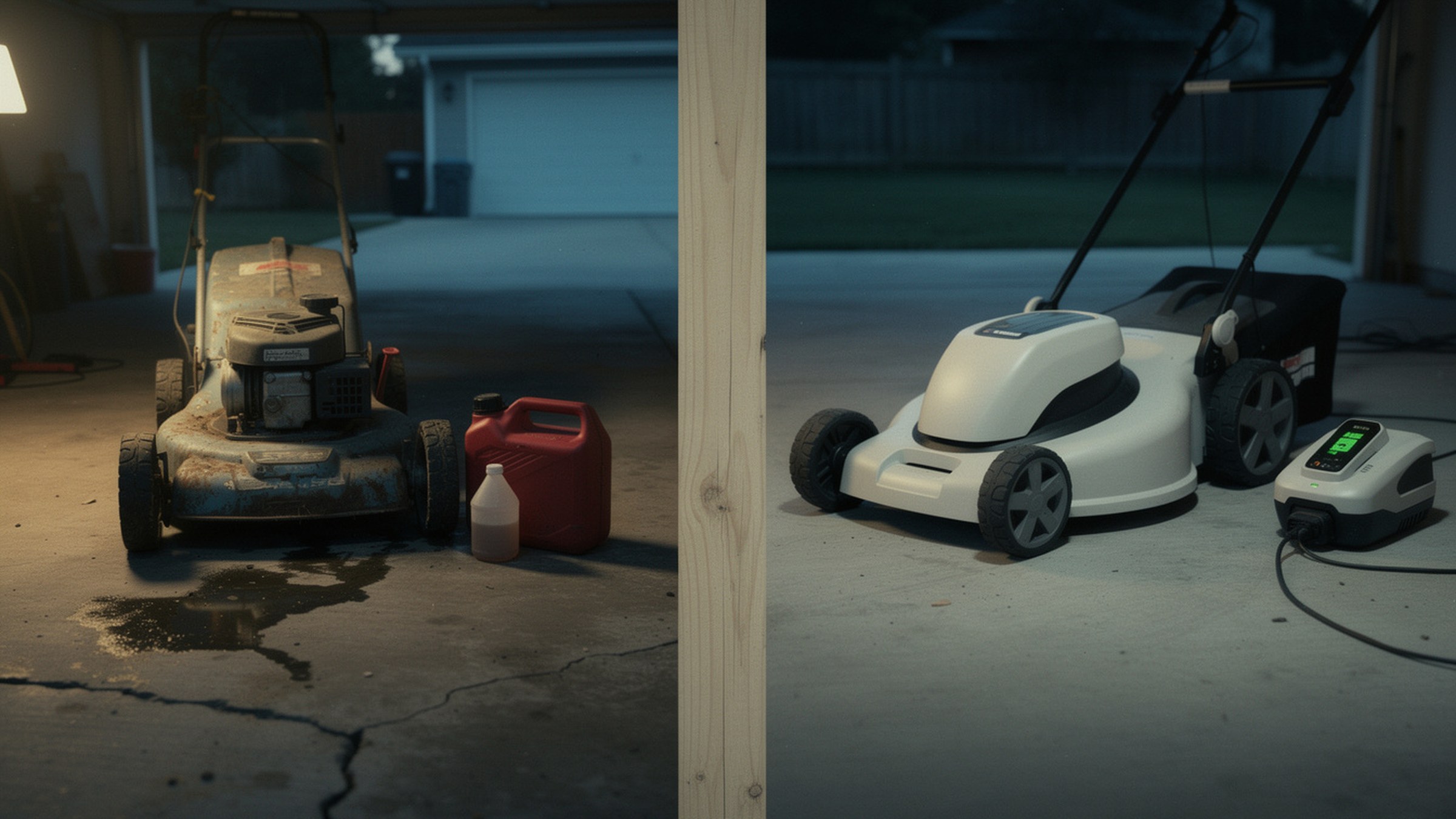
    The engine maker prints the bill most buyers never add up. Briggs & Stratton, the small-engine manufacturer, says to change the oil after the first 5 hours of use, then every 50 hours or yearly, whichever comes first [1]. A Honda dealer’s storage guide adds a fuel rule: gas left in the tank has to be treated inside 30 days and drained within 90 [2]. The battery mower next to it in the aisle has no oil and no tank. Consumer Reports measured its class average at 45 to 50 minutes of cut per charge, enough for a quarter acre [3]. So the trade is a 45-minute ceiling against a service list that never hits zero.

    At a glance

    For homeowners choosing a gas or a battery mower, this piece compares the gas side’s printed upkeep — oil at 5 hours, then every 50 hours or yearly, plus fuel that decays in storage — with a cordless that finishes a quarter acre on one charge and carries none.

    The schedule you inherited

    The 50-hour rule is not advice. It is a condition the maker attaches to the engine. Briggs & Stratton wants the first oil change after the first 5 hours, then a change every 50 hours or once a year, whichever comes first [1]. A small suburban lot runs a mower 20 to 30 hours a season. The calendar triggers the work, not the hour meter. Every spring brings oil, a spark plug, an air filter, and an engine that must start or be diagnosed.

    The fuel rule is the part owners skip until spring exposes it. Nichols Equipment, a Honda outdoor-power dealer, splits storage into windows. Gas in the tank for 30 to 90 days needs a stabilizer mixed into fresh fuel, then a 10-minute run to push the treated gas through the system [2]. Past 90 days, the whole fuel system must be emptied, tank included [2]. The same page is blunt about one thing: a stabilizer cannot fix fuel that has already gone stale [2]. I have watched enough neighbors curse a mower in April to believe this is the single most common failure in the class. The fuel aged on a clock nobody saw, and the carburetor kept score.

    By the numbers

    • Briggs & Stratton prints an oil change every 50 hours of use or yearly, whichever comes first, after a first change at 5 hours [1].
    • Gas may sit in a stored mower for no more than 90 days before the entire fuel system must be drained [2].
    • Consumer Reports measured the average battery walk-behind at 45 to 50 minutes of cut per charge [3].

    What the cordless actually removes

    Buyers price the wrong side of this comparison, and my reading, held loosely, is that the sticker gap hides it. The usual worry is what the cordless gives up: run time, peak torque, the freedom to refill and keep going. But the gas mower charges its price after the sale. It asks for oil on a 50-hour or yearly clock, a new filter and a plug [1]. It also asks for fuel rotated inside a 90-day window [2]. The battery mower asks for planning instead. Consumer Reports found two-thirds of the electric walk-behinds it rated could finish a quarter acre on one charge [3]. A 7.5 amp-hour pack holds 420 watt-hours of that work [5]. If your lawn fits inside one charge, the upkeep line goes away. No oil to change, no tank to drain. Nothing on the gas side’s list has an equivalent on the cordless side, and that absence — not the cut quality — is what you are paying for.

    The running cost is easy to state. A charge or two a season draws from the wall, at a national grid intensity of 0.81 pounds of carbon dioxide per kilowatt-hour [4]. No jerry can, no mixed fuel, no oil bottle in the garage. The same trade runs through the rest of our outdoor power and snow equipment coverage, because every machine in this class carries either a service list or a charge cycle.

    The catch

    The upkeep tax is small in dollars, and honesty about that matters. A season’s oil, plug and filter run a few tens of dollars and one working hour. A battery mower often costs hundreds more at the till. The schedule alone does not close that gap in year one. What it changes is the character of owning the machine. The gas mower degrades when it is ignored, and it starts with the fuel first, per the 90-day rule [2]. The cordless wears through use and years of charge cycles, a slower and kinder clock [5]. Power still belongs to gas: Consumer Reports’ testers call it unbeatable there [3]. A cordless that bogs in tall, wet grass has not lost a service race. It has hit the limit it was bought around.

    What I would tell a neighbor is the honest rule. If your lawn is a quarter acre or less and one charge finishes it, the cordless deletes a recurring chore, not just a price. If your lot takes several charges or your grass is heavy, the gas machine’s upkeep is the salary you pay for its torque — and the service list is the least of what you owe it.

    Related reading

    Sources

  • Your Robot Mower’s Hidden $313 Bill

    Your Robot Mower’s Hidden $313 Bill

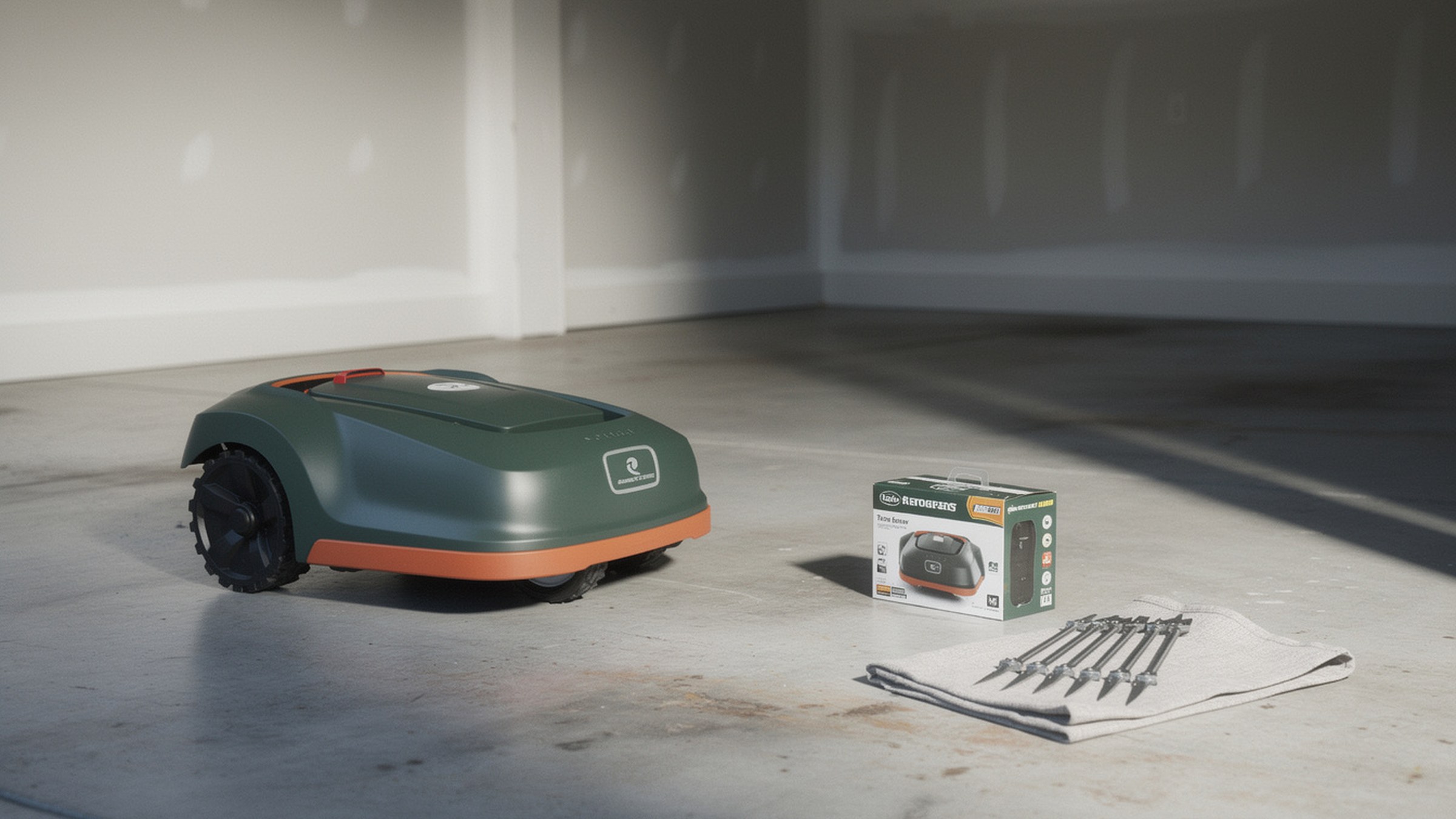
    Husqvarna sells its 420 iQ robot mower for $2,599.99 in a current sale [6]. The same maker says the battery “typically lasts between 2 and 5 years” [1]. A genuine replacement battery kit for the recent generations lists at $313.36 [5]. The sticker price buys the machine; the upkeep is a second bill nobody advertises.

    At a glance

    Husqvarna’s own maintenance pages put two consumption costs inside a robot mower’s sticker price: blades that wear out in weeks and a battery that dies in years. This piece prices both against the $2,599.99 machine, for any buyer running payback math before ordering.

    The clocks nobody prices

    The payback math that sells robot mowers is one division: machine price against the lawn crew’s annual bill. I have run that division with regional season lengths, and it holds as far as it goes. What it never includes is the wear schedule the maker prints in plain sight.

    The blade clock is the fast one. Husqvarna’s guidance prints the whole sentence: “Husqvarna Long Life Safety Blades should be replaced every 6-8 weeks and Husqvarna Endurance Safety Blades every 3-4 months” [2]. Assume a 28-week mowing season and that works out to two or three blade changes a year on the Endurance schedule, up to four on Long Life. The Endurance six-pack lists at $26.99 [3]. The Classic pack lists at $64.99 [4].

    The battery clock is the slow one, and it lands inside the years you own the machine anyway. Husqvarna’s support article puts it plainly: “The battery life of Automower® typically lasts between 2 and 5 years” [1]. A buyer who keeps the machine four years should expect to buy one battery, maybe two on daily duty. The kit for the 430X/440/450X generation lists at $313.36 at one mower-parts dealer — currently sold out there, which is itself a signal about demand [5].

    By the numbers

    • $313.36: One genuine battery kit for the 430X/440/450X generation, listed while marked sold out [5].
    • 6-8 weeks: Husqvarna’s published replacement window for Long Life blades [2].
    • $26.99: The Endurance blade six-pack’s list price, against $64.99 for Classic [4].

    Where this bites

    The people closest to these machines treat the battery as planned service, not a failure. Husqvarna’s support article tells owners to have a dealer swap the battery, and points at the app’s statistics screen — running distance, charging cycles — as the way to watch for the early sign: the mower “returning to the charging station too often” [1]. That is a wear signal you can read at home, years before the machine stops on the lawn. Before I trusted any second-hand robot mower, I would read those counters myself.

    The blade side costs less but is easier to get wrong. Each change wants new screws, because Husqvarna says to swap them every time and never reuse them [2]. The Endurance pack’s pitch is “more than twice the lifetime compared to classic blades” [3], which is why the cheaper-looking pack wins on anything but the lightest duty.

    The catch

    I read that 2-to-5 band as the maker saying one thing clearly: nobody can quote your battery’s death year in advance. The band is a spread across duty cycles — a small lawn mowed twice weekly ages a battery far slower than a one-acre lot mowed daily — so one owner buys a battery in year four and another never does [1]. The blade windows are product-specific too: 6-8 weeks belongs to Long Life, 3-4 months to Endurance, and gravel or sand in the lawn shortens both [2]. Divide your own mower’s duty into those windows rather than quoting anyone’s four-year total.

    My read of the two spec pages, held loosely: four years of ownership costs a quarter of the machine price again in blades and battery — more if the battery dies twice inside the window. A middle case with three or four blade packs a year lands near $330 of blades. Add one battery kit inside those four years and the upkeep total runs near $640 to $745 against a $2,599.99 machine. That is the line the shopping guides never print, and the year-four battery bill makes it too big to ignore.

    Planning tools price the machine, not its life support — the same gap the payback article left open.

    Related reading

    Sources

  • Your $109 Camera’s Missing Verdict

    Your $109 Camera’s Missing Verdict

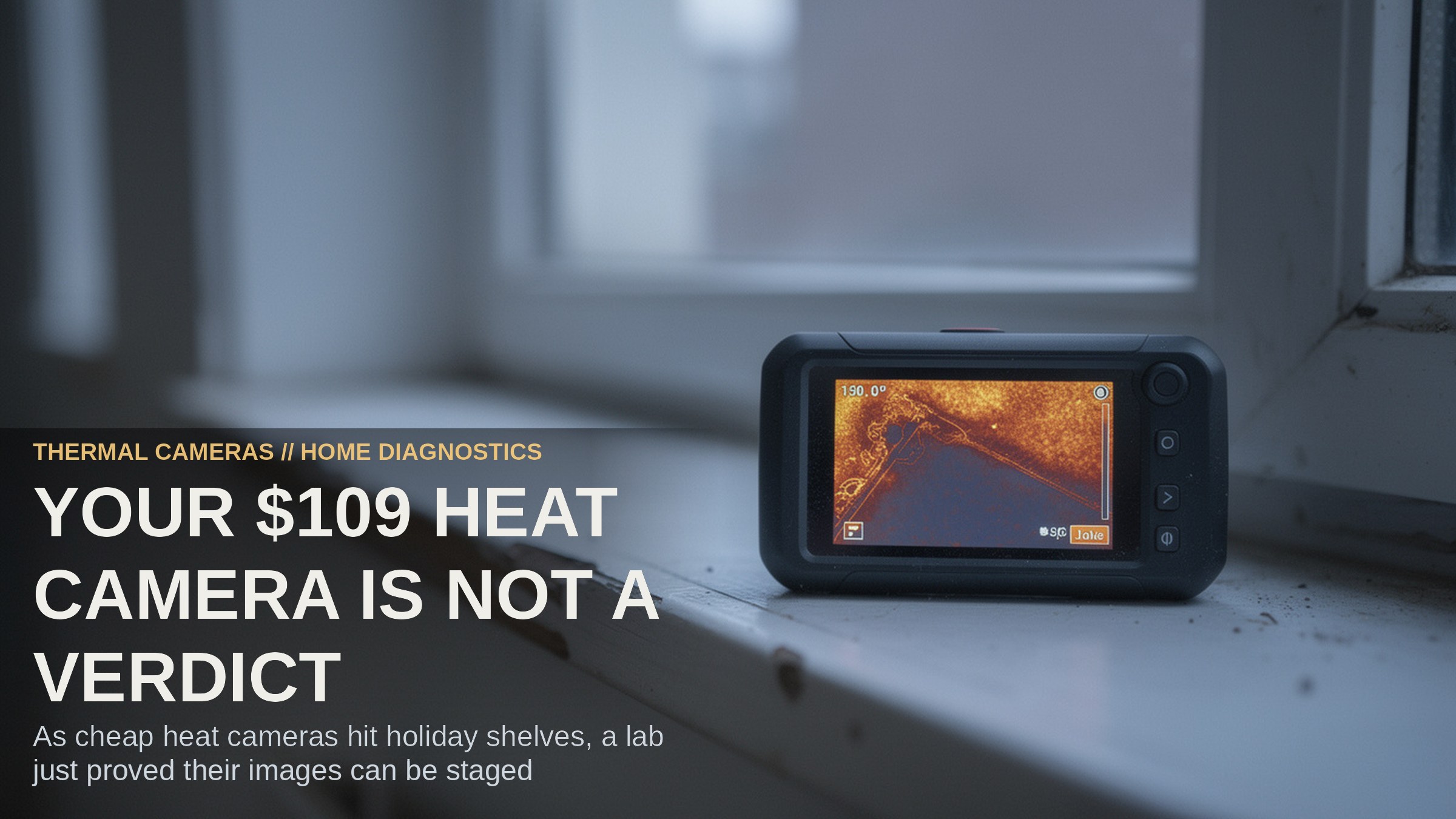
    On 19 November, a heat camera dropped to $109, pitched as a holiday gift for owners chasing heat loss this winter [2]. Twelve days earlier, engineers in Illinois and Denmark published the first 3D heat cloak: a printed shell that steers warmth around an object so an infrared camera sees the wall behind it, as if nothing were there [1]. And in between, a camera maker’s own home guide put the limit in plain words. A thermal image “shows temperature patterns, not a confirmed diagnosis” [3].

    At a glance

    This article is for homeowners weighing a cheap thermal camera this holiday season. It covers a $109 Black Friday price drop, a lab-built heat cloak that can fool infrared imaging, and why the camera’s own maker says its pictures are clues rather than verdicts.

    The big picture: a cheap camera, a staged image

    The month’s timeline runs in one direction. On 26 October, the Illinois team published its cloak in Nature Communications [1]. On 19 November, the brand Rision cut its whole thermal camera line for a sale running to 30 November [2]. And on 21 November, the maker’s own advice page still refused to call the image a diagnosis [3]. Cheap camera, staged physics, cautious maker — in that order.

    The cloak is not a software trick. The team 3D-printed an aluminum lattice that carries heat well, then cast a rubbery material into the gaps that carries heat badly. Together they steer warmth around whatever sits inside, and the camera reads the surface “much as it would if no object were present” — from almost any angle [1]. Earlier cloaks were flat or worked from one direction only. This one works in three dimensions, in metal.

    I read the team’s framing twice before taking it, because it is broader than the device. Shelly Zhang, the Illinois engineer who led the work, said the point is “hiding and protecting information that is carried by heat” [1]. An infrared picture is news about surfaces, not truth about structure. The cloak lives in a lab, built to hide equipment from sensors. Nobody is hiding your missing insulation. But this month it became formal fact: what a thermal camera draws can be staged on purpose, in metal, from any side.

    The sale makes that fact matter more. Rision’s release sells the cameras straight at winter fear, as gifts for spotting “areas to check for air leaks or gaps in insulation” around windows, doors and exterior walls [2]. Cheap cameras mean more of these pictures in more hands, held by people with no training in what moves a surface reading. Even the firm selling them says an odd cold area “may suggest where to investigate, but further checks may be needed,” and “a cold spot alone doesn’t prove that insulation is missing” [3].

    The professionals hit the same wall. Buyer guidance posted this month restates what Britain’s new-home warranty body has long said: a thermal image is a “map of surface temperature,” useful only when indoor and outdoor air are far apart [4]. That guidance also documents a homeowner who sealed the attic leaks the scan flagged, then found the infrared image looked barely different afterwards [4]. The picture cannot even score its own repairs.

    By the numbers

    • Rision’s plug-in camera, 24 grams, reads from −4°F to 1,112°F; its sale price is 45% below list [2].
    • The standalone handheld, with a built-in 2.8-inch screen, is $149 for the sale window [2].
    • Ireland’s energy authority puts a home’s heat loss through the roof at up to 30% [3].

    What I’d watch: the second tool

    What I am watching is whether buyers follow the inspectors rather than the ads. The working method that the warranty body and the camera maker’s own guide converge on is simple: the camera nominates, a second tool convicts. A smoke pencil at the draft, a paper slip at the window, a pin meter where a stain shows — the touch confirms what the image only suggests [4]. The guides are also blunt about the conditions. A scan on a mild day tells you little, because the picture needs a real gap between inside and outside air [3]. And the roof, where the Irish energy authority says up to 30% of a home’s heat can escape, is beyond any casual scan of a bedroom [3].

    The open question is whether the $109 price changes behaviour or just ownership. The guides already warn that sun-warmed walls and furniture against exterior walls repaint the surface picture — staging by accident, the same way the cloak does on purpose [3]. More cameras in untrained hands means more cold patches read as verdicts. The next signal worth having is whether inspection bodies update their guidance for a market where the tool costs about as much as a nice dinner.

    The catch

    I would take this week’s deal at its word and no further. $109 is a fair price for a clue generator, and that is all the image has ever been. What changed this month is not the price. It is that physics now shows the picture can be erased with a printed shell, while the maker’s own guide refuses to call it a diagnosis. A heat camera earns its keep the day it flags a cold bay you would never have guessed. It fails as an audit the day you let it skip the second tool. The trade-offs these tools force — scan first, verify second — are the standing subject of the home diagnostics tools hub.

    Related reading

    Sources

  • $220 Off Your EGO Kit — If It’s Still There

    $220 Off Your EGO Kit — If It’s Still There

    The snow-blower aisle has an expiry date this month, and the maker’s banner caps the season’s discount at $220 off your EGO kit. The $899 price on the EGO (the battery outdoor-tool brand) 21-inch kit, with two 6.0Ah batteries in the box, runs out on November 30, 2026 — nine days from the November 21 reading of the maker’s own page. The footnote that sets that date ends on the words “Subject to availability,” which means the same stretch of days can decide whether the kit is still there at all [1].

    At a glance

    This article covers EGO’s early-Black-Friday snow-blower discounts for homeowners weighing a battery kit this month. The finding: the maker’s own footnote gives the offer nine days and warns that stock may not last that long.

    One deadline, two calendars

    1. The price calendar. It comes from EGO’s snow-blower page, where the promotion runs as a banner and the operative detail sits one line below it [1]. The footnote reads, verbatim: “1-Offer valid through 11/30/26 on select EGO tools at participating retailers. Subject to availability. U.S. Only.” A second offer on the same page runs two days longer, to December 2, so the ladder has more than one cutoff [1]. I read that footnote twice before noticing the two deadlines were different dates — the maker has printed both halves of the trade in one sentence, because the price cut expires on a date and the stock it applies to may already be gone.
    1. The stock calendar. It is being reported from the field. A best-electric-snow-blower guide, re-checked on November 11 and updated November 20, pulled two of its own prior picks because they were hard to find: a 22-inch corded Snow Joe whose Amazon listing had moved to a third-party seller, and an 18-inch SENIX (a budget cordless-tool brand) two-battery kit shown as limited stock [2]. The guide also passes along Consumer Reports’ buying calendar, which names February, October, November and December as the best months to buy, and adds the clause that matters: “battery kits with packs in the box can sell out once a forecast turns, so check the listing on the day you buy” [2]. The machines easiest to buy are the ones a storm can empty out of the aisle first.

    The price side opened before the season did. A deals piece published October 26 already listed the same EGO 21-inch kit at $899 against $999.99, framed as what to buy “before you wake up to a buried driveway” [4]. The fuller ladder followed on November 8 on the same deal page:

    Kit Price Was
    21-inch, two 6.0Ah batteries $899 $999.99
    21-inch Peak Power, two 4.0Ah $699 $749.99
    24-inch two-stage, two 7.5Ah $1,599 $1,749.99
    24-inch two-stage, two 6.0Ah $1,499 $1,599.99

    By the numbers

    • A 10% cut on the entry kit: the $899 price of the EGO 21-inch with two 6.0Ah batteries [3].
    • $220: the ceiling of EGO’s own banner across select tools, more than any verified kit markdown [1].
    • 9 days: from the November 21 reading of the vendor page to its November 30 deadline [1].

    What to watch

    The gap between the banner and the per-kit markdowns is the tell. The verified kit discounts run from $51 to $151 [3]. The vendor’s “up to $220” must attach to higher-priced setups that no deal piece has verified [1]. My reading, held loosely: a homeowner buying this week is buying at the top of the season’s discount curve, and the four kits in the table above are the part the discount actually pays for. What the packs in the box are worth is its own arithmetic; the desk sized a battery-only purchase last month in Your $550 Battery Spare Is Wrong. The forward trigger is weather. The guide’s own warning is that a named storm turns the remaining stock into a queue, and the vendor’s printed deadline sits in the same stretch of weeks when forecasters start naming storms [2].

    The catch

    None of this is a prediction that kits vanish on the deadline. The vendor’s stock clause is a hedge, not a countdown, and the guide’s sellout warning concerns storm-driven rushes, which nobody schedules. It is also possible the discount renews in December — the January 2026 clearance wave took the same 21-inch machine’s tool-only body to $449.94, and that trough arrived too late for the first storm. What the evidence supports is narrower than a buying rule. The discount window and the stock risk close on the same kind of day, and I would put the weight on that overlap rather than on any single date. The buyer who wants one particular setup, not just any machine at a price, is the one whose choice the deadline binds.

    Sources

  • Your Robot Costs $775 a Month

    Your Robot Costs $775 a Month

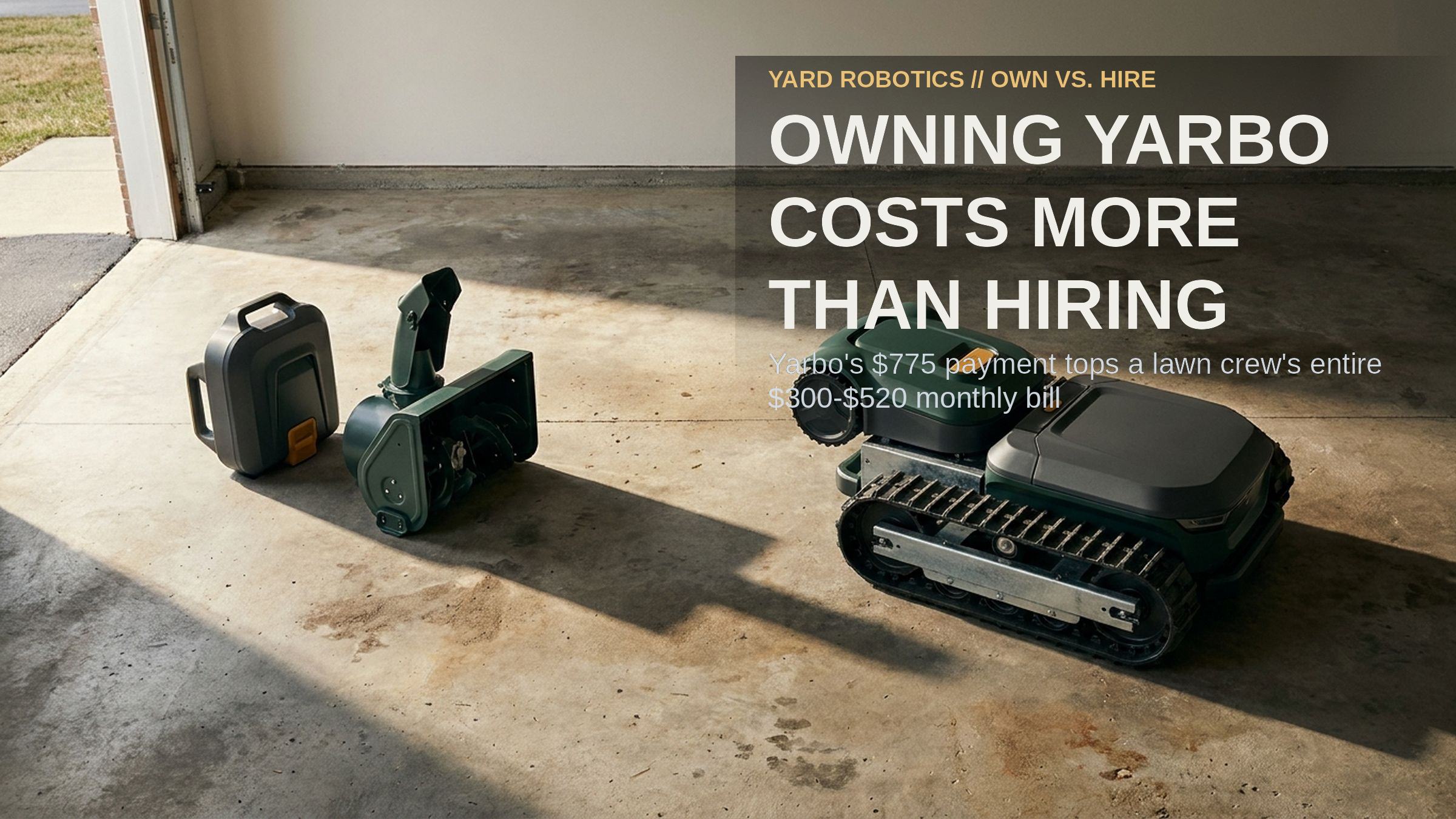
    Yarbo (a maker of modular yard robots) will finance its full four-module bundle at $774.92 a month for a year [1]. The landscaping crew it is sold to replace bills a one-acre lawn just $300 to $520 a month [2]. Put those two printed numbers side by side and the vendor’s own financing terms put year one of owning above year one of hiring. This is not a critique of the machine. It is arithmetic from two price tags. Call the monthly payment $775 a month, and the gap is the whole story. A buyer weighing the swap deserves to see that number next to the crew’s invoice before signing anything.

    At a glance

    This article compares two printed prices for the same one-acre yard: Yarbo’s monthly robot payment and a landscaping crew’s monthly invoice. It finds that owning costs more than hiring in year one, and payback waits for year two.

    Why year one loses on paper

    The two documents were never meant to meet. Yarbo’s storefront, fetched November 21, lists the top bundle at a regular price of $9,299 [1]. That bundle pairs the Y40 Core (the robot’s wheeled base unit) with its snow blower, mower and blower modules, and the page finances it at 0% APR (annual percentage rate) — $774.92 a month for a year [1]. MowBook’s lawn-care pricing guide, refreshed on November 3, prices a one-acre lawn at $75 to $130 per weekly visit [2]. Four of those visits sum to $300 to $520 on the guide’s own monthly billing line [2]. I read both pages twice before accepting the size of the gap: the robot’s monthly payment alone exceeds the crew’s entire monthly bill.

    One fairness note before the count hardens. MowBook’s monthly figure is mowing-season billing — four weekly visits [2]. The robot’s payment runs flat across all twelve months instead. Even granting that mismatch, the payment still tops the crew’s whole bill. Yarbo’s site is also mid-Black-Friday sale right now, and some product pages print lower sale prices against the same regular prices [1]. This article uses the regular ladder throughout. The sale prices narrow the gap; they do not close it.

    By the numbers

    • $774.92 a month: the printed 12-month payment on Yarbo’s full bundle at 0% APR [1].
    • $520 monthly: the top of MowBook’s range for a one-acre lawn on monthly billing [2].
    • $7,299 entry bundle: Yarbo’s cheapest rung — core, snow blower and blower, no mower [1].

    What I’d watch

    The payback story depends on what the machine replaces, and the owner record is mixed on that point. An owner review posted in November 2026, drawn from Yarbo users, reports owners clearing 80 to 90 percent of snow storms [3]. The same review records that the robot does not clear the street-plow berm left at the end of the driveway [3]. My reading, held loosely: the snow module partly replaces a plow service, not fully, and a buyer still pays for the heavy pushes.

    The bundle ladder matters just as much. Yarbo prices the entry bundle at $7,299 and the mower-added tier at $8,199, before the $9,299 top rung [1]. Each step up the ladder adds a module and raises the payment a buyer locks into. The mower tier sits between the rungs, which makes it look like the modest upgrade; the installment math says otherwise.

    Timing is the open question. The Core itself ships “Late Nov – Early Dec 2026,” while other items leave in days [1]. A robot financed now may mow nothing until the core lands, and whether the sale prices hold through that shipping window is what I am watching next.

    The catch

    I keep the test blunt: would I still write the check in month fourteen, when the financing ends and the crew’s contract resumes? The purchase only pays if two conditions hold at once. The machine has to survive into year two and beyond, and it has to replace both the mowing contract and the plow visits. Miss either one and the monthly math never closes, because a partial replacement stretches the payback that the 0% APR framing hides. The honest question is not whether the robot works. It is whether one machine can absorb two separate bills. Homeowners weighing the robot against the crew can start with the yard robotics hub, where these payback questions have been tracked piece by piece.

    Related reading

    Sources

  • Your 3rd Claim Counts, Storm Doesn’t

    Your 3rd Claim Counts, Storm Doesn’t

    The claim that can cost you the policy is the water one, not the wind one. Texas lets a carrier count claims that are not weather losses, three of them inside three years on the same house [1]. A storm loss doesn’t count at all, because a policy cannot be refused on losses caused by natural causes [5]. So the roof that fails in hail leaves the ladder untouched, and the pipe that bursts in a wall climbs it.

    At a glance

    This piece covers how a Texas homeowners policy is repriced: carriers count non-weather claims — water damage most of all — and a third counted claim in three years lets the carrier refuse the next year’s policy, while storm losses never count.

    Where the count begins

    A policy year starts the clock. A water loss is reported, adjusted and paid, and the carrier’s file records a claim rather than a dollar amount [1]. The count then runs on a rolling three-year window. What the carrier counts is how many claims it paid, not how large they were. A small repair that clears the deductible counts the same as a gutted kitchen.

    Two levers sit inside that rule, and both are paper. After a second counted claim, the company must tell the owner in writing that a third one puts the policy in danger [2]. That letter is a notice of possible nonrenewal, which means the carrier may decline to write another year. A company that never sent it cannot refuse to renew because of the third claim [2].

    The second lever is a forgiveness clause. The first two water claims caused by an appliance do not count at all, but only if the damage was fixed and the repair passed an inspection by a qualified inspector [3]. Two documents do the work there, and neither is a form the owner has to invent.

    I went looking for this rule in the policy forms and found it in the state’s consumer guide instead [1]. That placement says something about the product. The form sets out what is covered, and the state sets out how many covered losses a carrier may hold against the house.

    By the numbers

    • $17,240 average water claim: the mean cost of a water damage and freezing loss, 2020 through 2024 [7].
    • 22.2 percent of claim costs: water damage and freezing’s share of what carriers paid out in 2024 [6].
    • Two refusals: the number of companies that must turn an owner down before a state plan will insure him [4].

    The letter that decides

    At renewal the carrier prices a file, and what that file holds is a count of claims. The warning letter is the paper that matters most, because it carries a date [2]. If it never arrived, the owner holds proof that the third claim was not the reason his policy ended.

    The inspection report is the other document. Once the work is done and a qualified inspector signs off, an appliance water claim stops counting [3]. That makes an invoice and a signed report the cheapest paper in the file, and the only paper that can take a claim back off the count.

    Where the ladder ends has a price too. A refusal to renew sends the owner to a market that needs at least two licensed companies to have said no first [4]. That plan writes a basic policy, and it costs more than a standard company charges. The gap lands on the mortgage as much as on the premium.

    What I’m watching next is whether carriers actually send the letter that says a repair passed, because the forgiveness is worth nothing if it reaches the owner after the renewal date.

    Where the count stops

    The honest limit is the state line. The three-in-three count and the warning duty are Texas rules, set out by the Texas Department of Insurance as of its 1 June 2026 revision [1]. Every state writes its own version of the ladder, so a reader in Florida or California is counting against a different number of steps. No federal agency publishes a national count, and any figure sold as one is a state figure with a bigger label.

    The second limit is that the count is not the money. A deductible of $2,500, which the reader swaps for his own number, leaves $14,740 of an average water claim [7]. That makes the average loss worth filing on the cash and still a step on the count. A loss below that deductible closes without payment, and those claims are not counted at all [5]. The deductible arithmetic settles that half of the decision before the ladder is ever consulted.

    I’d want to see a second state’s ladder before treating three as the national number, and no source in this file draws one.

    Related reading

    Sources

  • Your 6 Fixes, One Hidden Code

    Your 6 Fixes, One Hidden Code

    Texas now publishes, area by area, why insurers refused to keep a home policy. Each reason arrives as a code [1]. The state’s own written rules say who those codes were built for: they exist for the numbers insurers file, not for explaining a decision to a homeowner [3]. That leaves the six fixes you can actually make hidden inside one line of the public record, while the one cause nobody can fix gets a line of its own.

    At a glance

    • The shift: Texas publishes why home policies end, area by area, in reason codes.
    • The number: 289,218 reason lines across four notice months, the newest from July.
    • The risk: six fixable flaws share one code, so the file cannot say which.

    What one line absorbs

    A state law passed in 2025 created that record. A carrier must now say in writing why it refused an application, ended a policy early, or declined to renew [1]. It must also send the state a quarterly report of those reasons, sorted by area [1]. The Texas Department of Insurance (TDI) put the updated reporting plan in force in February, for use from April [3]. Its lookup page now returns those numbers by postal code [1]. A Houston news station walked readers through the same lookup in October [4].

    The list of reasons is where the story lives. One reason, “Condition of property,” covers “insufficient defensible space; maintenance, occupancy, or vacancy issues; roof condition; or tree overhang” [1]. Those are six separate jobs. You clear the strip beside the wall, you keep the house in repair, you keep living in it, you avoid leaving it empty, you replace the roof, you cut the tree back. The file records all six as one reason.

    Then there is the split. A company that turns down a home because it does not insure certain kinds of roof must code that as “Other, Insurer’s Action” instead [1]. So the cause you cannot touch gets a box of its own, and the six you can touch share one. Credit cannot stand alone either; a carrier that blames credit must also name another reason [1].

    I read the state’s reason list three times before I believed the split. Money you spend hardening the house is the only lever you hold at renewal, and the one code that would credit it cannot tell your hardened house from a neglected one two doors down. The state built openness that stops where your decision starts.

    By the numbers

    • 289,218 reason lines: The rows in the public home file, each a reason a carrier attached to a decision [2].
    • Four notice months: April through July, with July the newest month the page carries [2].
    • Six flaws, one code: Defensible space, repair, occupancy, vacancy, roof and tree overhang, counted from the state’s own wording [1].

    Where this bites

    The reporting is still growing, which shows how much weight the state puts on the reason itself. TDI has proposed extending it to business property from October, with the same area summaries [3]. One field on that form already asks whether a decision rested on “aerial imagery versus other types of third-party information” [3]. That is the photograph of your roof, scored by a model you never see.

    What I am watching is whether the business-property form keeps the same coding split. If it does, a strip-mall owner and a homeowner will face the same blind spot: the file will say “condition of property” and neither will know which of six jobs the carrier meant.

    Agents who handle these letters read them against the state’s list. The list is the only public statement of what a lawful reason looks like. The letter itself is meant to be a plain description rather than a code, which is the line the state’s rules draw [3].

    The wider market runs the same way. In 2024 insurers ended more than two million home policies at renewal, about 61% more than the year before [5]. The West carried the highest rate at 25.1 per 1,000 policies, according to data from the National Association of Insurance Commissioners (NAIC) reported this month [5].

    The catch

    The file counts reasons, not homes. One policy can carry several reasons. The state says outright that the reasons report “isn’t the total number of declinations, nonrenewals, and cancellations” [1]. So those rows measure paperwork rather than families.

    A second limit decides whether you can look up your own street. The public file gives reasons without the company that gave them, and its short letter codes have no published key that names them [2]. The words above come from the state’s own page for homeowners, not from the data rows.

    My reading of both limits is that they push the same direction. The letter matters more than the lookup page because it is the only document that names one reason for one address, and the law gives you the right to have it in writing [1]. Keep it, and keep your own note of the fixes it lists. A refused renewal is a clock you can count as well as a decision.

    Related reading

    Sources

  • Your 80 PSI Trap: A Valve and a Tank

    Your 80 PSI Trap: A Valve and a Tank

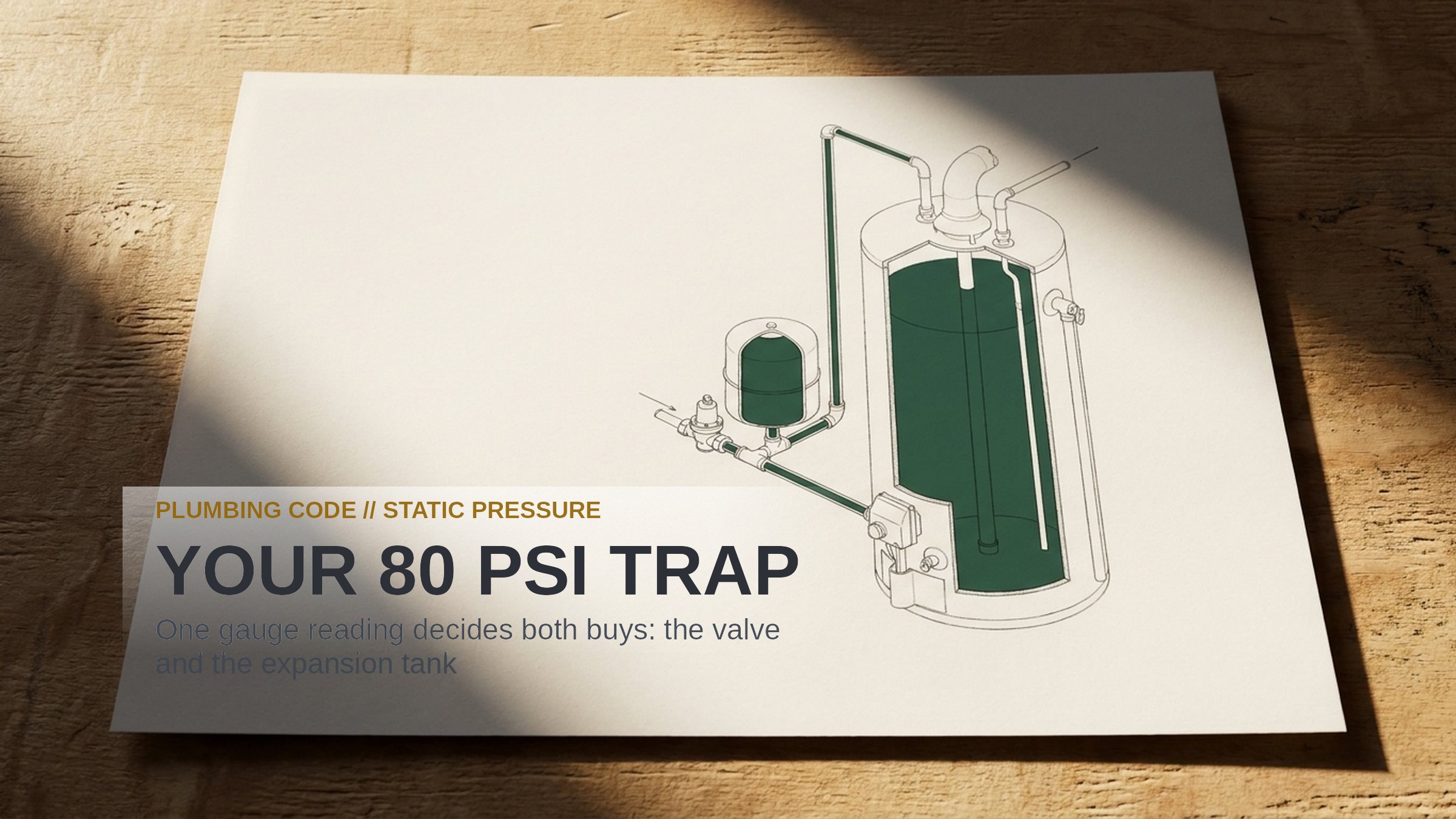
    Your house has one plumbing number with a hard ceiling, and almost nothing you can buy reports it. Static pressure is the pressure in the pipes when nothing is running. Above 80 psi (552 kPa) of it, the model plumbing codes stop treating a pressure-reducing valve as optional and require one, with a strainer, set to bring the building’s pipes back under that line [1]. That is why the trap is not the valve but what the valve drags in. Once the system is closed, the water heater has nowhere to put the water it expands, so the same family of codes requires an expansion tank downstream of the regulator [2]. One gauge reading decides both buys.

    At a glance

    • The shift: Pressure above 80 psi now means a valve, not a preference.
    • The number: 1.29× is the flow multiplier at 100 psi against a 60 psi rating.
    • The risk: The valve closes the system, so the heater needs a tank.

    Why the ceiling exists

    The rule is old, and its age is the argument. The same section sits in the 2011 Ohio code [1]. It survives, in substance, in the 2021 Hawaii code [2]. It also appears in the 2024 residential code Texas uses for windstorm-rated building [3]. Code text that lasts across three publishers for more than a decade is not a vendor’s taste. It is the settled view of the people who inspect the work.

    The reason behind it is math. Fixtures carry a top flow rate, stated against a stated pressure, and the code’s own table prints them that way: a private lavatory at 2.2 gallons a minute at 60 psi [1]. Water pushed through a fixed opening speeds up with the square root of the pressure behind it. A house at 100 psi therefore moves about 1.29 times as much water through that opening as one at 60 psi, and a house at 120 psi moves 1.41 times as much. None of that extra water shows up as a pressure reading on any app. It just arrives faster, hits the shutoff harder, and works the supply hoses and valve seats past the rate the fixture was built for.

    What I find hard to square is how far this sits from the dashboard. A local-first home can chart a hundred values and still not know the pressure in its own pipes, because the meters sold for the job measure flow. A flow meter answers whether water is moving, which is the leak question, and a leak monitor’s flow threshold is the right tool for that. Pressure answers a different question: what the pipes are being asked to hold while nothing moves.

    By the numbers

    • 80 psi static: The pressure above which a regulator is required rather than recommended [2].
    • 2.5 gallons a minute: The top flow of a standard showerhead, against 2.0 for a labeled one [4].
    • 82 gallons a day: What one American uses at home, on the agency’s citation of federal survey data [5].

    What the valve drags in

    The valve is the narrower half of the code. Where pressure runs over the ceiling, the valve must be a listed type with a strainer ahead of it, so grit from the main does not chew the seat [1]. It must also fail open. The section asks for a design that keeps water flowing if the valve’s own parts give out, which is the gap between a house with a pressure problem and a house with no water at all [1].

    Then the second half shows up. A regulator blocks flow in both directions in practice, so the pipes below it become a closed system, and water heated in a tank expands with nowhere to go. The fix is written in the same family of codes. An approved expansion tank goes in the cold line below each regulator, placed to keep thermal growth from lifting the regulator’s setting [2]. Where a backflow device, a check valve or anything similar sits on a system with a storage water heater, a pressure-control device is required again, on the same logic [3]. A plan stamped by a registered design professional can swap a relief valve for the tank, but only with the relief setting held at 100 psi or less [2], which is a narrower path that needs a signature on it.

    Two details decide whether the job is sound or merely present. The first is place. The tank belongs below every check valve between the regulator and the heater, which is the step a rushed install misses when a shutoff sits between them [2]. The second is size, because the code tells the pipe tables to use 80 percent of the reduced pressure, so a plumber who sizes the branches off street pressure and then fits a valve has sized the job twice [2].

    I read the temperature-and-pressure relief valve on the heater as the part that reports on all of this. It is set to open before the tank fails, so a relief valve that weeps is not a bad valve. It is the one pressure gauge in the system that talks, and on a closed system with no tank, that weep is the tank’s absence saying so.

    The catch

    Three limits keep this from being a clean rule. The ceiling is model code, and cities and states amend model codes, so the number that governs a house is the one printed in the edition its permit is issued under. Aerators and flow limiters blunt the square-root multiplier, which means the flow math gives the direction and the rough size of the effect, not the exact gallons a faucet will pour. And a gauge on a hose bib reads static pressure only when nothing in the house is running, so a reading taken at mid-morning with a dishwasher going is a different quantity from one taken at 3 a.m.

    The gauge is the cheap part. A hose-bibb gauge and a phone photo of it before the house wakes up tells an owner more about this value than any product I could confirm this round. No maker of valves, tanks or gauges, and no contractor page I probed, would answer a plain fetch with a real spec. What the valve costs, and what the tank adds, is a quote the owner gathers, not a figure this piece can hand over honestly.

    That leaves the choice where it belongs. The reading is free and takes a minute. The valve is a plumber’s afternoon. The tank is the part that decides whether the valve was worth doing at all, and a house that gets the valve and skips the tank bought half a fix and moved the failure onto the heater.

    Related reading

    Sources