Author: kotechile@gmail.com

  • Why 37,667 Snow Throwers Failed Winter

    Why 37,667 Snow Throwers Failed Winter

    The outdoor power maker STIHL (of Virginia Beach) put a number on winter on 2026-10-21. Its first snow thrower, the company said, is rated for use in outdoor air as cold as -4°F when paired with a new professional pack that carries a cold-start function [1]. Five days later, on 2026-10-26, Health Canada recalled 37,667 Benchmark corded throwers sold through Home Hardware, because the power cord “may break when exposed to extreme cold weather, causing a potential electric shock injury” [2]. One notice sells the cold as a spec you can read. The other shows what the cold breaks, and it is not the battery.

    The big picture:

    The battery pack is where this industry has an answer. A cold-start function, a stated -4°F operating point (about -20°C) and a charger that reaches 80% in under ten minutes are the words of a solved problem [1]. The cord on a 15-amp thrower has no such words, and the recall never says what temperature breaks it [2]. I keep coming back to that gap, because it tells a buyer which half of the machine the market has actually built for winter.

    Cold does real damage inside a cell. A Department of Energy merit review from Argonne National Lab reports that discharge capacity falls by as much as 65% between room temperature and -40°C [3]. That work used vehicle cells, not a cordless tool pack in a driveway, but the direction is not in doubt. The review describes lost run time, while the recall describes a cracked cord jacket and the shock risk that follows it.

    By the numbers

    • 37,667 — Units recalled: Benchmark model YF6022, a 22-inch, 15-amp electric thrower sold in Canada from November 2020 to May 2026 through one chain [2].
    • 19 — Cord failures reported: as of 2026-10-05, with no injuries logged, across those 37,667 units [2].
    • -4°F (-20°C) — Rated cold point: STIHL’s first snow thrower, paired with a new pro pack whose cold-start function carries the rating [1].
    • Up to 65% — Capacity lost to cold: lab cells measured from 25°C to -40°C, in a Department of Energy battery review [3].

    What I’d watch:

    The open question is whether -4°F stays one company’s talking point or becomes a line every maker prints. No one in this category competes on an operating temperature today. The sheets sell volts, amp-hours and a count of car driveways cleared, and none of those numbers moves when the mercury drops [1]. I am watching for the first rival to answer with a figure of its own, since that is the moment cold turns into a spec.

    • The platform split: the rated machine runs on STIHL’s pro battery line, which fits more than 60 existing tools, while its homeowner tools use a separate system [1]. A buyer who wants the rating is buying into the pro line.
    • The pack numbers: the same pack claims up to 60% more peak power and 20% longer run time than the model it replaces, plus 3,000 charge cycles [1]. Those decide what a spare costs in year three.
    • The remedy: Health Canada tells owners to stop using the thrower and contact the retailer to destroy it for a refund [2].
    • The cord: the notice names a 22-inch, 15-amp machine and a cord that breaks in extreme cold, and gives no degree value [2].

    The clearing width on the box deserves the same doubt that the snow robot piece on this site applies to rated area. The remedy itself is harsher than a repair kit, because owners are told to destroy the thrower rather than fix it [2]. Canada’s product safety law bars a recalled item from being redistributed, sold or even given away, and the notice is posted to an international recall portal [2]. A machine sold across five and a half years of winters does not get a new cord; it gets scrapped.

    The catch

    Both records are thin in the same spot. STIHL’s -4°F is a maker’s claim tied to a tool-and-pack pair, and the release names no test method behind it [1]. The recall says “extreme cold weather” and stops, so any degree value quoted for that cord was invented [2]. The 65% drop comes from vehicle cells run to -40°C, colder than most driveways get and a different battery from the one on the shelf [3].

    I could be wrong about where this lands, but the rate argues for calm. Nineteen cord reports against 37,667 units is a small share, and a report is not a failure count. What the week does settle is narrower: the part of an electric snow machine built for cold is the part with a spec, and the part without one is the part that reached a safety agency.

    At a glance

    The shift: Snow gear now prints a cold rating; corded machines are recalled for cords that fail in it. The number: 37,667 throwers pulled in Canada, five days after a rival’s -4°F rating. The risk: The rating covers a tool-and-pack pair with no stated test.

    Related reading

    Sources

    [1] STIHL, “STIHL Powers Into Its Next Century with New Battery Technology, New Mowers, and Its First-Ever Snow Thrower,” 2026-10-21 — https://www.stihlusa.com/en/support-events/about-stihl/press/equip-expo-2026

    [2] Health Canada, “Benchmark-branded 22 inch, 15 amp electric snow thrower recalled due to electric shock hazard,” 2026-10-26 — https://recalls-rappels.canada.ca/en/alert-recall/benchmark-branded-22-inch-15-amp-electric-snow-thrower-recalled-due-electric-shock

    [3] Argonne National Laboratory, “Fluorinated Solvent-Based Electrolytes for Low Temperature Li-Ion Batteries,” DOE Vehicle Technologies Office Annual Merit Review, Project ID BAT520, June 2021 — https://www.energy.gov/sites/default/files/2021-06/bat520_zhang_2021_p_5-13_307pm_LR_TM.pdf
  • Why Your Mower Needs 4 Approvals

    Why Your Mower Needs 4 Approvals

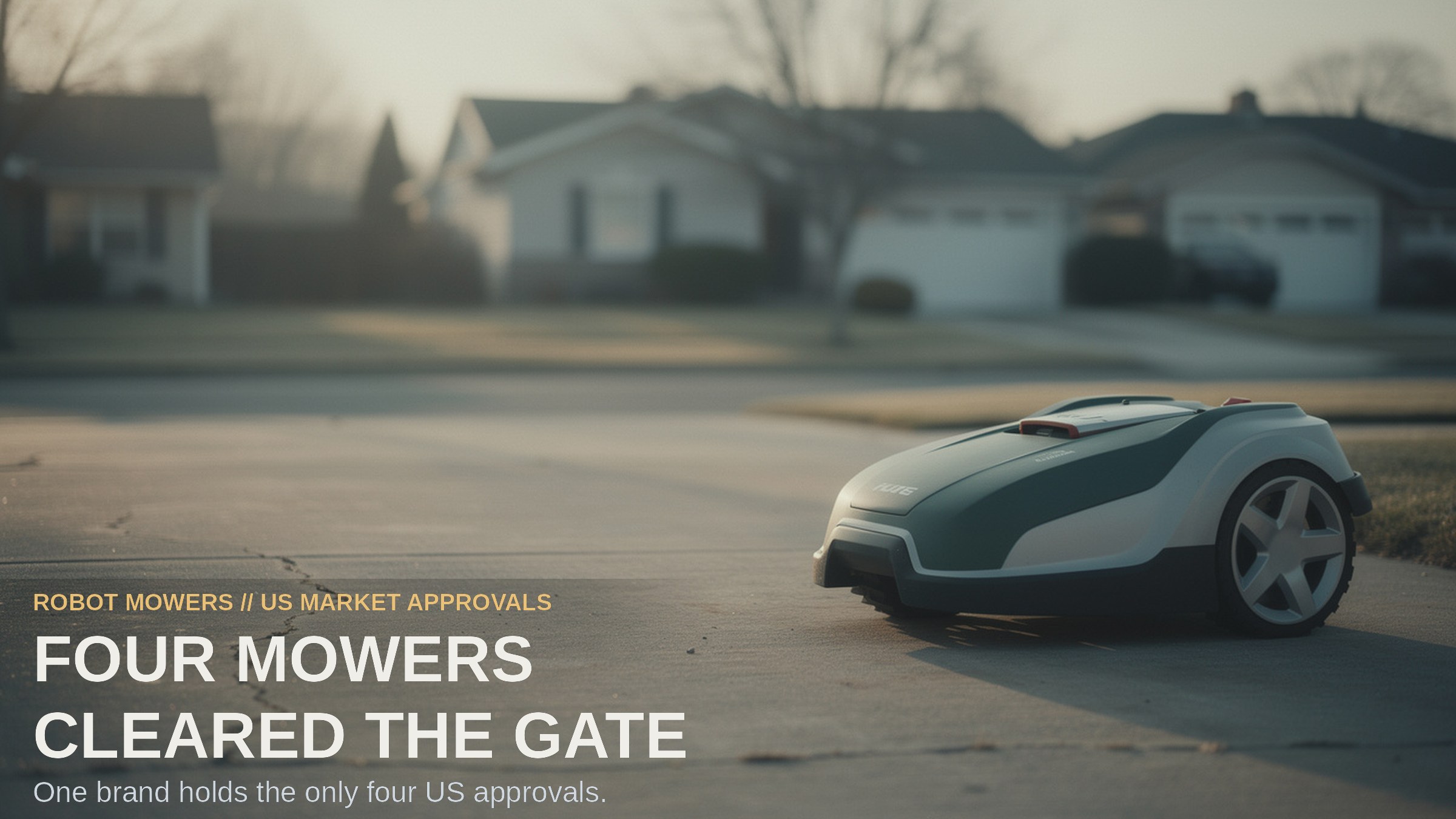
    Four robot mower models hold the only federal approval granted to a consumer yard machine for the 2027 American market, and all four belong to one company. Husqvarna lost 334 million krona last quarter, after foreign-made robots went onto a national-security list in July, and your next mower needs one of those approvals before a store can sell it. The list is public, so the queue can be read.

    The big picture:

    Husqvarna sells into both markets, so its latest results read as a split screen. Sales fell 5 percent organically in the quarter, and the forest and garden arm dropped 10 percent [1]. The group blamed bad weather, “competitive headwinds”, and dealers holding far too much stock across Europe, then answered with “targeted price increases” [1]. That is the classic defense of a market leader squeezed on price.

    The picture in America looks different. On 28 July the Federal Communications Commission (FCC) put “advanced robotic devices” built abroad on a list of gear barred from the US market unless it wins an exemption [2][3]. A maker can escape that block with a conditional approval from the Department of War, and the agency posts each one it grants [2]. The rule catches any moving yard helper over 4.4 pounds, if it carries a sensor, a network link of at least 200 kilobits a second, and software that steers it [3]. New designs are blocked, while models approved before the change keep selling [3].

    I read the table three times. It lists seven robot approvals, and a single entry covers the yard: Husqvarna’s 305v iQ, 310v iQ, 420v iQ and 440v iQ, granted on 9 September for a 2027 launch in the US market [2][4]. The rest are floor cleaners and factory carts. Four of the seven arrived on or after 16 October, so the queue moves quickly, but it bypasses the mower aisle. The same page carries twenty drone approvals and twenty-three for routers against seven for robots, so the queue is not slow in general; it is slow for machines that drive themselves around a yard [2]. In the month the leader admitted it cannot hold price in Europe, its four platforms stood alone with approval in America.

    By the numbers

    • 334 million krona — Quarterly loss: the group operating result fell to a loss of 334 million krona from income of 141 million a year earlier, a -3.7 percent margin against 1.5 percent [1].
    • 4 of 7 — Yard models approved: the FCC lists seven robot approvals, and Husqvarna’s four mowers are the only home garden gear among them [2].
    • 65 percent — US content bar: a mower dodges the list if it counts as domestic: local parts above 65 percent of cost through 2028, and 75 percent from 2029 [3].
    • $800 to $2,500 — What buyers pay: the mowers in Consumer Reports’ current ratings run from about $800 to more than $2,500, against $400 to $800 for its top battery walk-behind mowers [5].

    What I’d watch:

    The public record changes by notice, so the next entry is the signal. The agency also lets a maker apply for a whole class of devices, which is how four models landed in one entry [3]. An approval for a second brand would mean 2027 brings a real choice, rather than four takes on a single design.

    • The next name on the register: a new brand appears there before it reaches a store [2].
    • A premium on the four: a market with one approved supplier is the easiest place to hold a price [1].
    • Stock of older models: everything approved before 28 July can still be imported and sold, which is where this season’s deals sit [3][5].
    • Any move against old approvals: the agency can also halt the import of gear it already approved, using a process in its own rules, last used in June 2026 for older covered gear [2].

    The market leader is hardly finished. The group still expects 3 billion krona of gross savings by the end of 2028, with about 935 million booked so far [1]. America is also where it already sells the most robot mowers to golf courses, with more than 500 of them on its platforms and 24 percent of group sales booked there in 2025 [4]. What I am watching is narrower: whether a rival ever joins a list that currently holds one name.

    The catch

    Consumer Reports tells readers the government “banned the sale” of robots built abroad, then adds that it skips mowers already owned or already approved [5]. The agency is narrower: new models cannot get approval, while older models keep flowing to stores [3]. If you own one today, none of this reaches you.

    So the shortage sits in next year’s models, not in the aisle. I keep coming back to what the list leaves out: it records approvals, not applications, so nobody outside the agency knows how many rivals asked and were turned down. No source in this run publishes a rival price either, so the claim that the price war will not arrive on schedule is a judgment about a queue, not a forecast. The rated acreage on a spec sheet is already a best case, which makes the gap between rated and usable area the other place a buyer’s math goes wrong.

    At a glance

    The shift: New robot mowers built abroad need their own US approval, and the public register holds one home yard brand. The number: Seven approvals granted, four of them since 16 October, and only Husqvarna’s four mowers. The risk: Waiting for a cheaper 2027 model is a bet on a queue you cannot see.

    Related reading

    Sources

    [1] Husqvarna Group, “Interim report January – September 2026”, 2026-10-21 — https://www.husqvarnagroup.com/en/press/interim-report-january-september-2026-2490517 [2] Federal Communications Commission, “List of Equipment and Services Covered By Section 2 of The Secure Networks Act” (Covered List and Conditional Approvals, updated 2026-10-23) — https://www.fcc.gov/supplychain/coveredlist [3] Federal Communications Commission, “FAQs on Recent Updates to FCC Covered List Regarding Foreign-Produced Advanced Robotic Devices and Power Inverters” (updated 2026-10-27) — https://www.fcc.gov/covered-list-faqs-robots-inverters [4] Husqvarna Group, “Husqvarna Group first to receive FCC Conditional approval for foreign-manufactured advanced robotic lawn mowers in the U.S.”, 2026-09-09 — https://www.husqvarnagroup.com/en/press/husqvarna-group-first-receive-fcc-conditional-approval-foreign-manufactured-advanced-robotic [5] Consumer Reports, “Best Robotic Lawn Mowers of 2026, Tested and Reviewed” — https://www.consumerreports.org/home-garden/lawn-mowers/best-robotic-lawn-mowers-a2310984432

  • Your Class 4 Roof: Ten Times Riskier

    Your Class 4 Roof: Ten Times Riskier

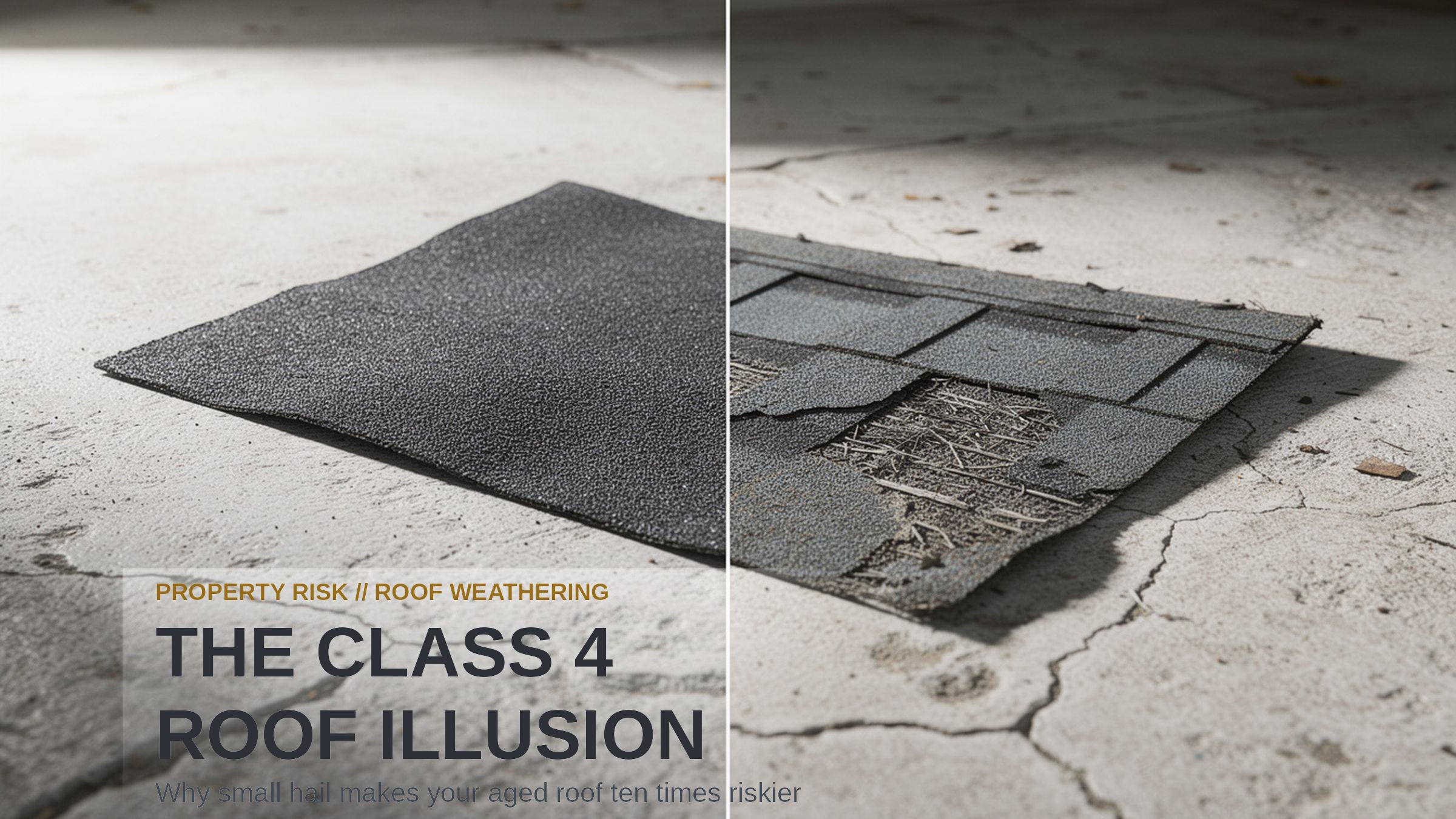
    After two seasons of small hail, an aged roof is up to ten times more likely to be damaged by the next big stone than a new one, because every test behind the label looks at a brand-new shingle [2]. Class 4 is the top grade from the Underwriters Laboratories (UL) 2218 test, and it only records how a fresh sample holds up [1]. Texas requires that same test to grant a discount on the bill, yet the roof on the house is an older, weathered object [1].

    The big picture:

    Asphalt covers roughly 80% of US home roofs, which makes the shingle the main shield against a storm [3].

    A roof gets picked once and then sits outside for fifteen years taking damage from ordinary weather. The UL 2218 test looks at a clean sample, while the Insurance Institute for Business & Home Safety (IBHS) notes that current rules skip how goods age [2]. What I cannot get past is that almost no owner ever sees this gap.

    The wear adds up quietly, because small stones under an inch wide fall far more often than the huge chunks that make the news [2]. Each pass knocks off the granules that block the sun, and two simulated small-hail events on top of normal weather left aged panels far more fragile than new ones [2]. The class printed on a box and the real state of a roof answer two different questions.

    None of that makes the class useless, which is the part that gets lost in both directions. A carrier still sets the test it will accept, and the class is the only label it names, so it stays the entry ticket for a credit even where the credit is small [1]. The argument is about what the ticket is worth, not whether it gets you in.

    By the numbers

    • 2218 — UL test standard: this impact test decides whether a covering earns a Texas discount, and it is keyed to the standard rather than to a brand or a retail price [1].
    • 2.8% — wind-and-hail claim rate: wind and hail is the largest single cause of home claims, with that share of insured homes filing such a loss in 2018-2022, against an average $20,062 paid per claim in 2023 [6].
    • 902 — Texas hail events: hail an inch or more across was logged 902 times in Texas in 2025, more than any other state, against 244 in Colorado and 5,432 nationally, up from 5,373 in 2024 [5].

    What I’d watch:

    What I’ve been watching is the paperwork. That is where a qualifying product turns into money, and it is the step homeowners meet last.

    • The five label items: since 1999, a maker has had to print the UL label, the class, its own name, the year made, and the brand on the shingle [1].
    • The installer’s form: once the roof sits on the house, a contractor files Texas Department of Insurance (TDI) form PC068 to turn a passing product into a real bill credit [1].
    • The side-by-side rating: IBHS buys shingles at the store and ranks them so buyers can see the performance gaps between brands and product years [3].
    • The aged-panel question: the 2026 field season ran new shingles and one-year-aged modified shingles through repeated hail to track wear over time [4].

    The catch

    The huge jump in risk comes from a lab test between worn panels and fresh new shingles, rather than a recorded failure rate on a real house [2]. What I find hard to square is that no maker prints a true long-term rating for their goods. A buyer weighing two Class 4 products has no measured facts to lean on beyond the store-bought tests that IBHS runs.

    A second limit cuts against the case for a pricey upgrade, and it is the one that decides the money. The bill discount gets priced by the carrier, so the payback hangs on a rate filing rather than on the physical shingle. When that credit comes in small or missing, the label protects the house instead of lowering the premium — which is the same split I found on the discount side of a roof file.

    At a glance

    The shift: Roofing is sold by impact class, which measures a new sample, not the aged roof hail hits. The number: Up to ten times — IBHS’s weathered, twice-hit panels against new shingles. The risk: No test certifies how a Class 4 product ages, and carriers price the credit.

    Related reading

    Sources

    [1] Texas Department of Insurance, “Products qualifying for impact-resistant roofing credits” (As of February 24, 2023) — https://www.tdi.texas.gov/company/roofing-discounts.html [2] Insurance Institute for Business & Home Safety, “Impact Testing of High Concentrations of Small Hail” — https://ibhs.org/hail/impact-testing-of-high-concentrations-of-small-hail/ [3] Insurance Institute for Business & Home Safety, “Relative Hail Impact Resistance of Asphalt Shingles” — https://ibhs.org/hail/relative-impact-resistance-of-asphalt-shingles/ [4] Insurance Institute for Business & Home Safety, “Hailstones: Field Research” (2026 season) — https://ibhs.org/hail/hailstones/ [5] Insurance Information Institute (Triple-I), “Facts + Statistics: Hail” (NOAA Storm Prediction Center counts, 2025) — https://www.iii.org/fact-statistic/facts-statistics-hail [6] Insurance Information Institute (Triple-I), “Facts + Statistics: Homeowners and renters insurance” (ISO claim data) — https://www.iii.org/fact-statistic/facts-statistics-homeowners-and-renters-insurance

  • Your Battery Gap Is 85%

    Your Battery Gap Is 85%

    On the morning of 14 October, Pacific Gas and Electric (PG&E) added 25,000 homes to a wildfire shutoff list and took 7,300 off it. By that afternoon, 88,000 customers across 29 counties faced a four-day outage as dry offshore winds reached the coast, and nearly 5,500 of them rely on power for medical needs [1]. Household power here costs 29.75 cents a kilowatt-hour, third-highest in the country [2]. That price points to a gap in the backup plan. About 85 percent of California’s grid batteries sit on the utility’s side of the meter, where they cannot save your house [3].

    The big picture:

    A wildfire shutoff targets a line, not a house. Southern California Edison (SCE) warns that a customer can stand in calm air and still lose power. The line feeding the block crosses “a windy, high fire risk area before reaching their address” [4]. So “one block or neighborhood may have power while others don’t” [4]. Crews then walk the route and check the poles before power returns.

    I read the fleet count twice before the gap made sense. The California Energy Commission (CEC) counts 21,112 megawatts of battery storage, and most of it sits in big utility plants [3]. Nearly 16,000 megawatts come from 310 big sites here, and 2,000 more from plants in Nevada and Arizona [3]. Those systems move bulk power around the wider grid. They cannot push power into a local line the utility just opened.

    What is left is small, and it is the only gear that keeps a fridge cold. It counts about 3,000 megawatts spread over more than 300,000 systems at homes, schools, farms and shops, and notes those units “can provide backup power during outages” [3]. The division puts about 14 percent of the fleet on your side of the meter, right where a shutoff lands.

    Price explains the split. The U.S. Energy Information Administration (EIA) puts August’s household rate at 29.75 cents. The national average is 18.16, so local power costs 64 percent more [2]. Only Hawaii and Maine charge more [2].

    A grid battery earns capacity payments and a set return, while a wall-mounted one earns only what its owner avoids paying, under a tariff the state’s regulator calls “usually lower than the retail rate” [5].

    By the numbers

    • 88,000 — Homes put on notice: The 14 October list covered 29 counties, about 5,500 Medical Baseline customers and six Tribal governments, and PG&E opened more than 40 help centres across 23 counties [1].
    • 10,410 — Cut three days earlier: The utility cut 10,410 customers inside a 12,200-customer, 17-county zone, then warned that restored homes “could experience another outage” [6].
    • 29.75 cents — The household rate: The August figure ranks third-highest in the country and sits 64 percent above the 18.16-cent U.S. average [2].
    • 21,112 megawatts — The battery fleet: Nearly 16,000 megawatts sit in 310 big in-state plants and 2,000 more arrive from out of state, leaving about 3,000 in 300,000 small systems [3].

    What I’d watch:

    The gap between a notice and a dark house is where the money hides. A list is not an outage, and only a cut empties a freezer. I am watching the post-event reports for how many homes ran the full four days.

    • The household share: 3,000 of 21,112 megawatts is the sum that decides whether a shutoff is bearable on a normal street.
    • The missing credit: the federal clean energy credit stopped applying to spending after 31 December 2025. The install date controls it, so a 2026 job gets nothing even if the owner paid earlier [7].
    • The export rate: sales back to the grid usually fetch less than retail, which means a battery earns its keep mostly by running the house [5].
    • Medical Baseline homes: about 5,500 of them sat inside one week of notices, and those are the homes where four dark days become a health event [1].

    The rest comes down to plain math. A bank sized against a year of bills instead of critical loads runs out first. Two houses on one line get different results from the same kit.

    The catch

    The honest check is that the state’s price eased even as its outage risk held firm. August’s 29.75 cents is 3.8 percent below the 30.92 cents of a year earlier, while the U.S. average rose 3.4 percent [2]. My reading is that the cost story here is thinner than the resilience story, and I could be wrong about how much of that dip lasts the winter.

    Shutoffs also work. A line that stays live in a severe wind event can start a fire, and the utility taking public anger is the one that dodged the spark. What the record lacks is a household plan that treats the small battery as basic gear, not an optional extra.

    The three levers stay separate. A retail rate, an export credit and an expired tax break are read side by side, never added up, and none of them offsets another.

    At a glance

    The shift: The state built 21,112 megawatts of batteries; about 85 percent sits on the grid’s side, where it cannot cover a shutoff. The number: 88,000 customers were in line for a four-day outage in October. The risk: The household share lost its federal credit in 2026, so the fix now costs full price.

    Related reading

    Sources

    [1] Pacific Gas and Electric, “With Change Statewide Fire Weather Forecast, Planned PG&E Public Safety Power Shutoff Event Now Includes 88,000 Customers in Portions of Twenty-Nine Counties,” 2026-10-14 — https://investor.pgecorp.com/news-events/press-releases/press-release-details/2026/With-Change-Statewide-Fire-Weather-Forecast-Planned-PGE-Public-Safety-Power-Shutoff-Event-Now-Includes-88000-Customers-in-Portions-of-Twenty-Nine-Counties/default.aspx [2] U.S. Energy Information Administration, Electric Power Monthly, Table 5.6.A, “Average Price of Electricity to Ultimate Customers by End-Use Sector, by State, August 2026 and 2025,” released 2026-10-23 — https://www.eia.gov/electricity/monthly/epm_table_grapher.php?t=epmt_5_6_a [3] California Energy Commission, “California surpasses 21,000 megawatts of battery resources supporting the state’s electric grid,” 2026-08-07 — https://www.energy.ca.gov/news/2026-08/california-surpasses-21000-megawatts-battery-resources-supporting-states [4] Southern California Edison, “Public Safety Power Shutoff (PSPS)” — https://www.sce.com/outages-safety/outage-preparedness/outage-types/public-safety-power-shutoff-psps [5] California Public Utilities Commission, “Net Energy Metering and Net Billing” — https://www.cpuc.ca.gov/industries-and-topics/electrical-energy/demand-side-management/customer-generation/net-energy-metering-and-net-billing [6] Pacific Gas and Electric, “All customers impacted by the PSPS event have been restored,” 2026-10-12 — https://www.pge.com/en/newsroom/currents/safety/potential-public-safety-power-shutoff-could-impact-small-portion.html [7] Internal Revenue Service, “FAQs for modification of sections 25C, 25D, 25E, 30C, 30D, 45L, 45W, and 179D under Public Law 119-21,” — https://www.irs.gov/newsroom/faqs-for-modification-of-sections-25c-25d-25e-30c-30d-45l-45w-and-179d-under-public-law-119-21-139-stat-72-july-4-2025-commonly-known-as-the-one-big-beautiful-bill-obbb

  • 11 Degrees Kills the Compressor Quote

    11 Degrees Kills the Compressor Quote

    The coil was giving up just 11 degrees when a tech called the compressor dead and quoted $7,500 for a full swap. A second look found a stuck expansion valve and a filter packed shut, and both were fixed for $180. The same system then moved 19 degrees. The number at the heart of that price gap is the split, which tracks the heat drop across the cooling coil. That single reading separates a cheap fix from a total swap, but techs often measure it in the wrong spot.

    The big picture:

    The cooling trade has no single target for that gap. One training site notes that blower type and heat load shift the math, calling the old 20-degree rule too simple to be a strict standard [1]. A smart thermostat maker lists the best range at 16 to 22 degrees, while admitting the exact target changes depending on who you ask [2]. An owner holding a report with just one number is looking at a reading with no firm baseline.

    Both sources assume the tech put the probe right across the coil. The training site clearly warns against taking this reading at the room vents, because heat is gained and lost in the ducts before the air ever reaches a room [1]. Vents are the wrong place to look. Leaky ducts alone add 15 to 20 percent to the energy a system burns, even in a new house [3], and a vent reading includes whatever the duct lost or gained on the way. A split above that 22-degree ceiling can point to a lack of air, from a dirty filter or a fouled coil [2].

    A split below 16 degrees opens a list of eight suspects, and a bad compressor sits way down at number six [2]. What strikes me is that the compressor is the costliest item on the list. It is the only suspect that turns a basic service visit into a giant sales quote.

    By the numbers

    • 14 to 23 degrees — The split band: A trade training site gives this broad range for healthy cooling, warning that fixed rules fail because blower type and load move the number [1].
    • 350 cfm per ton — Air before charge: The inspection standard requires indoor coil airflow to clear 350 cubic feet per minute (cfm) per ton before a tech can check the refrigerant charge [3].
    • 15 percent — Low charge frequency: Field studies find both new and working systems run low on refrigerant by about this much, and units often arrive that way on day one [5].
    • $72 to $144 — Cost of a weak system: That is what a 10% to 20% efficiency loss adds to a summer of cooling, priced against the 2024 average household bill of $719 [5].

    What I’d watch:

    What I am watching is the paper that comes with a verdict. The numbers a tech writes down say much more than the final price at the bottom. A split logged with exact probe spots, an airflow figure, and a refrigerant charge reading turns a sales call into a real checkup. A single temperature on a work order does neither.

    • The coil-side number: A split read right before and after the coil, far enough out for the air to mix, is the only version that compares well with published bands [1].
    • The airflow proof: Refrigerant charge cannot be judged until airflow clears the required baseline, which is a step a rushed service call tends to skip [3].
    • The charge figure: The ticket needs to show superheat for a fixed metering device or subcooling for a thermostatic expansion valve (TXV), written down rather than just spoken [3].
    • The replacement floor: A new split-system condenser manufactured on or after January 1, 2023 must clear 13.4 Seasonal Energy Efficiency Ratio 2 (SEER2), and a heat pump needs 14.3 SEER2 with 7.5 Heating Seasonal Performance Factor 2 (HSPF2) [4].
    • The wasted kilowatt-hour: At the 2025 average home price of 17.30 cents per kilowatt-hour, a system missing its rated output pays that gap back every month it runs [6].

    The catch

    Wet air is the honest snag in these checks. When indoor air holds more moisture, the coil spends its power pulling that water out. The cooling split then drops for a reason that has nothing to do with a broken part [1]. That is physics, not a fault.

    One summer reading is just a quick look at one afternoon’s heat load. That is exactly why the thermostat maker suggests tracking the number over time rather than trusting a single glance [2]. A split that lands right inside the band is not a clean bill of health either. A mild day can easily hide a charge fault that a hot afternoon would expose.

    Where I have landed is that the split is a sorting tool rather than a final ruling. It narrows eight suspects down to two or three, and it makes a compressor pitch something you can check. The case for a new compressor needs a set of numbers read together, spanning airflow, gas charge, and the split across the coil. An owner must demand that the reading came from the right place, and that the airflow and charge numbers exist at all. The same caution applies to the tools themselves: a thermal image is a pointer, not an answer, and a reading taken at a distance deserves the same suspicion.

    At a glance

    • The Big Shift: The reading that decides between a basic fix and a total compressor swap is a temp split taken across the coil, making the probe spot more vital than the number itself.
    • Why It Matters: A compressor is the most costly part on the low-split suspect list, meaning a reading taken at a vent can turn a small valve repair into a huge quote without anyone lying.
    • What I’d Watch: Whether a service ticket carries the three numbers a true checkup needs, and how the federal output floor shows up on a new quote.
    • Temperature split: The gap between the air going into the cooling coil and the air coming out, read right at the coil rather than at a room vent.
    • Superheat and subcooling: The refrigerant charge readings taken at the lines, one metric for a fixed device and another for a valve.
    • Airflow floor: The minimum air volume per ton of cooling that must move through the system before a charge reading means anything.
    • The Catch: Wet indoor air lowers the split on its own, making a single reading just a snapshot of one afternoon that cannot clear a system of a charge fault.

    Sources

    [1] HVAC School, Bryan Orr, “What should the Air Delta T be? (Air Temperature Split),” 2019-10-16. https://www.hvacrschool.com/videos/what-should-the-air-delta-t-be-air-temperature-split [2] Resideo, “Why Delta T is the magic number for proactive diagnostics and problem-solving,” 2021-05-03. https://www.resideo.com/us/en/corporate/newsroom/featured-articles/why-delta-t-is-the-magic-number-for-proactive-diagnostics [3] InterNACHI, “HVAC” (inspection article and standards commentary). https://www.nachi.org/hvac.htm [4] Electronic Code of Federal Regulations, 10 CFR 430.32, Energy conservation standards (edition current 2026-10-29). https://www.ecfr.gov/current/title-10/section-430.32 [5] RMI, “Why Refrigerant Matters More Than You Think for AC (or Heat Pump) Efficiency.” https://rmi.org/resources/why-refrigerant-matters-more-than-you-think [6] U.S. Energy Information Administration, “Electricity explained: Prices and factors affecting prices” (2025 annual averages). https://www.eia.gov/energyexplained/electricity/prices-and-factors-affecting-prices.php

  • Your Two Backyard Homes, $1,000 Risk

    Your Two Backyard Homes, $1,000 Risk

    Starting early next year, a city must approve your second backyard home. The state will require cities to clear two separate cottages on a single lot, checking the plans against fixed rules and passing them without a public hearing. Three weeks after the governor signed that law, the state contractor board announced that prosecutors had charged two brothers behind a failed builder with 35 felonies. More than 200 consumers across 18 counties had complained about the firm. The risk the board leaves in place is the payment rule it chose to repeat: a down payment cannot exceed $1,000, and later progress payments cover only work already done or goods already delivered.

    The big picture:

    Assembly Bill (AB) 956 does not add a fifth home to a California lot; the promised total stays four. What changes is the mix, because two detached cottages can now replace the in-law suite inside the house [4]. From January 1, the state guarantees two detached new builds that each respect four-foot side and rear setbacks. Once both stand, a city no longer has to permit a junior accessory dwelling unit (JADU) on that lot.

    On paper, this swap looks like a minor footnote. On the ground, it is a different job. A JADU is a room inside the house with a small kitchen, while the new version creates two distinct buildings that each need their own slab, power panel, water line, and set of checks. The pace surprises people: the state housing department counts 30,354 permits in 2024 against 1,336 in 2016, and these units made up over 26.6% of all homes permitted in the state that year [3].

    What strikes me is that none of this touches the money. The bill amends three code sections, all of them about deed limits and local approval, and none about payment [4]. The newest by-right project in the state still runs on a rule written for a kitchen remodel, and the board used its October release to remind builders what that rule says [1].

    By the numbers

    • $1,000 — Deposit cap: The Contractors State License Board (CSLB) repeated the rule as a lesser-of pair. The limit is no more than $1,000 or 10% of the total cost, with later draws capped at the value of work done or goods delivered [1].
    • 35 felony counts — Alleged theft: Colton and Austin Paulhus each face 33 counts of diverting construction funds, one of conspiracy, and one of wage theft after a probe that led to a criminal case [1].
    • 200+ complaints — 18 counties: The board’s account lists abandoned jobs, unpaid subs, and payments made ahead of work that was performed, or often never performed [1].
    • 26.6% — Share of permits: These units ran from 1,336 permits in 2016 to 30,354 in 2024, and were over a quarter of all homes permitted in the state in 2024 [3].

    What I’d watch:

    The gap this case shows is not a missing law. It is a rule that shows up after the money is gone. The board pulled the company’s license in November 2024, but the charges surfaced on October 9, nearly two years later. The next court date is Jan. 12, and an owner who pays a deposit in March is not waiting on that clock [1][5]. What I am watching next is how cities use the local control they still hold.

    • The first city rules: A city may cap each unit at 800 square feet of living space, and many will, because the cap is the cheapest way to stop a two-unit lot from turning into a small apartment block [4].
    • Fire walls, not state law: The statute sets four-foot setbacks and says nothing about the gap between two buildings. Fire-rated walls and fire-truck access still decide whether a plan fits, for instance, a lot 50 feet wide and 120 feet deep.
    • What a builder asks for at signing: The board’s own sample schedule starts at 5% for start-up and ends at 2% on key handover, a useful yardstick for any request that lands before the first site check [2].
    • Unpaid subs: Suppliers went unpaid while owners had already paid, the pattern that puts a lien on a house whose owner did nothing wrong. The lien clock behind remodel payments is the part of that failure that outlives the builder.

    The catch

    Two things cut against the scary reading. The first is that this is one firm, and the charges are just charges. No plea had been entered at the October 14 hearing, and the brothers are presumed innocent while the case runs [6]. The second is that a deposit cap is not a test of whether a builder has money. A firm that cannot carry two units to the first draw is exactly the firm that wants a big down payment, and no statute turns a thin balance sheet into a thick one.

    Where I’ve landed: the useful control here is about order, not law. A draw schedule tied to site checks, a licensed general contractor with enough cash to reach them, and a written deal that names each step do more than a complaint filed after the fact. The state has spent a decade making the permit easier and has not made the money safer. AB 956 pushes more backyard work into the version of the job with the most cash out before the first check.

    At a glance

    • The Big Shift: From Jan. 1, 2027, cities must clear two detached backyard homes on a single-family lot, trading the promised in-house junior unit for a second structure [4].
    • Why It Matters: The payment rule did not change, so a two-building job still runs on a down payment capped at $1,000 or 10% and later checks tied to finished work [1].
    • What I’d Watch: How the first city rules use the 800-square-foot cap, what builders ask for at signing, and the Jan. 12 court date in the state’s largest backyard-home fraud case.
    • Ministerial process: A decision made against fixed rules, with no hearing and no room to weigh a neighbor’s protest.
    • Draw schedule: The list of payments tied to finished stages, the tool that keeps money behind work.
    • Construction fund charge: The count filed when cash meant for one job is used for something else.
    • The Catch: The case is one firm and the charges are unproven, a deposit cap cannot make a weak builder solvent, and a two-unit lot adds fire-wall and utility costs that no state statute models.

    Related reading

    Sources

    [1] Contractors State License Board, “Former Contractors Behind Anchored Tiny Homes Face 35 Felony Charges,” CSLB #26-02, 2026-10-20. https://www.cslb.ca.gov/Resources/PressReleases/2026/Anchored%20Tiny%20Homes.FINAL.pdf [2] Contractors State License Board, “Fast Facts: Tips for Building a Residential Accessory Dwelling Unit (ADU),” rev. 11/2025. https://www.cslb.ca.gov/Resources/GuidesAndPublications/2025/FastFacts_ADU.pdf [3] California Department of Housing and Community Development, “Accessory Dwelling Unit Handbook,” March 2026. https://www.hcd.ca.gov/sites/default/files/docs/policy-and-research/adu-handbook-update.pdf [4] California Legislative Information, “AB-956 Accessory dwelling units and junior accessory dwelling units,” Chapter 791, Statutes of 2026, chaptered 2026-09-29. https://leginfo.legislature.ca.gov/faces/billTextClient.xhtml?bill_id=202520260AB956 [5] KCRA 3, “Sacramento County DA’s Office files charges against Anchored Tiny Home co-founders,” updated 2026-10-09. https://www.kcra.com/article/sacramento-county-da-files-charges-anchored-tiny-homes/74096522 [6] NBC Bay Area, “Defunct tiny home builder’s customers say prosecutors are ‘angry for us,’” 2026-10-14. https://www.nbcbayarea.com/investigations/tiny-home-builders-customers-prosecutors-angry/4158224

  • Your Adjuster Hides a 25% Gap

    Your Adjuster Hides a 25% Gap

    A public adjuster’s fee comes from the insurer’s whole check, not from the extra dollars the adjuster wins [1]. So a 20 percent deal only breaks even when the offer grows by 25 percent, a gap the contract hides. Florida, New York and Louisiana each cap what an adjuster may take, and the caps are built on different ideas [1][2][3]. The trade group that tracks these claims says adjusters charge up to 15 percent, but state limits vary [4]. The cap is not the whole story, because your deductible comes off the check before any share applies [1].

    The big picture:

    Public adjusting is a licensed trade with one job: argue a loss up with the insurer that owes it.

    What strikes me here is how these three states handle the conflict, because the owner pays the adjuster direct [1][2][3]. Florida uses a ladder that shifts based on how fast the insurer pays and whether the governor declared an emergency. New York treats the fee as a flat rate, with a narrow break for claims reopened later. Louisiana kills the conflict by paying the adjuster by the hour if the insurer moves fast [1][2][3].

    Cap What it is charged on Timing rules
    Florida 20 percent, and 10 percent for claims from an event under a governor’s emergency order during the year after it Claim payments to the owner, less lawyer fees and costs, and less the deductible One percent where the insurer pays the policy limit and does so within 14 days of the loss or 10 days of the contract; nothing at all on a part of the claim paid or promised before the contract was signed
    New York 12.5 percent The money paid out, for work done Up to 20 percent on a claim reopened later, but only while the whole fee stays at or below 12.5 percent of the full payment
    Louisiana A share of each payment, under a written fee deal Each check the insurer issues Where the insurer pays or promises in writing to pay the policy limit within 72 hours of the loss being reported, the adjuster is paid for time and costs rather than a share

    Two details in the Florida rules matter more than the cap. The fee cannot rest on the deductible part of a claim. It also cannot rest on hotel or rental money unless the owner signs a separate form [1]. Both rules shrink the base the share is counted on.

    By the numbers

    • 25 percent — The required lift: An owner who keeps 80 cents of each dollar needs the offer to hit 1.25 times the old one before the fee pays for itself [1].
    • $4,012 — Average claim fee: A fifth of the $20,062 average paid per home claim in 2023 goes to the adjuster under a standard contract [1][5].
    • $2,508 — New York cap: That state’s rate on the same average claim leaves about $1,500 more in the owner’s pocket [2][5].
    • 14.3 percent — New York lift: One divided by 0.875 is 1.1428, so under the lower cap the offer must grow by about a seventh to pay the adjuster [2].

    What I’d watch:

    I am watching three clauses that decide what the contract is worth, because only one of them is the rate.

    • The base pool: A fee on money the insurer was always going to pay acts like a tax on your own claim, so what the adjuster counts as his share is the first question [1].
    • The prior offer: Florida bars a fee on any part of the claim the insurer had already paid or promised before the contract date [1]. An adjuster who shows up after the first quote cannot bill for money already on its way.
    • The exit window: A no-questions cancel right runs for 10 days after signing [1]. A written quote that fails to arrive within 60 days also lets the owner walk away at no cost.

    The catch

    My read is that the caps are fair, but the math still favors one side. The adjuster gets paid whether or not his work moved the number.

    The break-even assumes the lift is real and down to the adjuster. None of the three states prints a figure for the average lift a public adjuster wins, and no source behind this piece puts a number on it [1][2][3]. So your own first offer is the only start point the math can run against.

    A policy-limit payout is the clearest case. When the insurer has already promised the full limit, there is nothing to argue up. This is why Florida drops the fee to one percent and Louisiana pays for time only [1][3]. Those rungs exist because a share deal would otherwise charge well for a payout that was never in doubt.

    Timing decides which rule applies at all. Louisiana counts from the moment the loss is reported, so the same contract can pay hourly on one claim and a share on the next [3].

    What none of this measures is a denied claim being reopened. A claim closed with no pay is where a share deal is easiest to defend, because the other choice is nothing. The deductible sets what the insurer pays before any cap applies, making it the first thing to price beside the fee. You can run that break-even math in the deductible half of the declarations page.

    At a glance

    • The Big Shift: A public adjuster takes a fee from the whole insurance check rather than the extra money they win, so the deal is priced against the whole payout.
    • Why It Matters: At a normal cut the payout has to grow by more than the fee itself before the owner is whole, and the deductible and the hotel money sit outside the base the share is counted on.
    • What I’d Watch:
    • The base pool: What the share is counted on, and whether the deductible and living costs are inside or outside it.
    • The prior offer: Money already paid or promised before the contract date, because one state allows no fee on it.
    • The exit window: The cancel window and the written-quote deadline that make the contract reversible.
    • The Catch: No printed figure measures the average lift an adjuster wins, and the caps differ enough that one claim carries three prices.

    Related reading

    Sources

    [1] Florida Statutes § 626.854, “Public adjuster defined; prohibitions” (2026 edition). https://www.flsenate.gov/Laws/Statutes/2026/626.854 [2] New York Codes, Rules and Regulations, Title 11 § 25.7, “Maximum compensation” (Cornell Legal Information Institute). https://www.law.cornell.edu/regulations/new-york/11-NYCRR-25.7 [3] Louisiana Revised Statutes § 22:1704, public adjuster contract requirements (Louisiana State Legislature). https://www.legis.la.gov/legis/Law.aspx?d=508702 [4] Insurance Information Institute (Triple-I), “What is a public adjuster?”. https://www.iii.org/article/what-is-a-public-adjuster [5] Insurance Information Institute (Triple-I), “Facts + Statistics: Homeowners and renters insurance” (industry loss data, 2023). https://www.iii.org/fact-statistic/facts-statistics-homeowners-and-renters-insurance

  • Your Flood Gap Has 44 Days

    Your Flood Gap Has 44 Days

    The window to close your flood gap has 44 days in it [3]. A federal flood policy does not start for 30 days, so the last day to buy one that is in force before that window shuts is Nov. 11 [3][6]. The math stayed abstract until October, when two storms in two states split a single damage bill into a half that gets paid and a half that does not. Florida’s Office of Insurance Regulation (OIR) now counts about 55,000 claims and $582 million of losses from Hurricane Isaias, which came ashore near Destin on Oct. 9 with 105 mph winds [1][2]. Only the half with a payer ends up in that figure.

    The big picture:

    A standard home policy covers wind and leaves out flood, so water is a separate buy [7][8]. What a state counts after a landfall is therefore a property-and-auto ledger: wind damage, car repairs, lost business, the harms with a payer at the end of them [1]. Moody’s, the risk analytics firm, put flood-program claims from the same storm at $250 million, in a count kept apart from the state’s [1].

    What strikes me is that both numbers describe the same weather event, and only the wind half reaches an official tally. Storm Rachel’s remains crossed Southern California and southern Nevada in the same week, pushing surf into Long Beach homes and setting a rain record in Las Vegas [8]. That harm came from the exact perils those standard home policies leave out.

    By the numbers

    • $582 million — Florida losses: about 55,000 claims from Isaias, roughly 47,000 of them on homes, in the state’s Oct. 25 snapshot [1].
    • 8,500 against 3,500 — claims closed: nearly 8,500 closed with no money, against just over 3,500 that closed with some, and another 1,454 open claims had paid [1].
    • 86 in 100 — at-risk properties with no cover: the share of at-risk properties without federal flood cover as of April 2026, per a Government Accountability Office (GAO) report, with policies down from 5.5 million in 2010 to 4.5 million in 2026 [5].
    • $250,000 and $100,000 — federal caps: the most the program pays for a house and for what is inside it, on a policy that waits a month to start [5][6].

    What I’d watch:

    • The Dec. 11 vote: the flood program has run on short extensions, 36 since 2017, and its last gap lasted 43 days with no new policies sold or renewed [3][4]. The next vote decides if a gap is a few weeks or a season.
    • What a gap stops: sales and renewals stop, cover in force carries on, and claims keep getting paid from cash on hand, though the Treasury line fell from more than $30 billion to $1 billion during the last lapse [3][4]. The harm lands on a sale or a closing.
    • FEMA’s counter-move: the Federal Emergency Management Agency (FEMA) announced online quotes and sales at floodsmart.gov on Oct. 20, across almost 22,700 communities in the program [5]. What I am watching is whether self-serve checkout shortens the run from a decision to cover, or just makes the wait more plain.

    The catch

    A gap sounds worse than it tends to be, since Congress has extended this program 36 times and claims on live policies keep paying [4]. Private flood firms keep selling while the federal door is shut, taking $784 million in net premiums in 2025 [7]. Where I’ve landed is that Nov. 11 is my own subtraction rather than a published rule: Dec. 11 minus one month [3][6].

    The claim counts have limits of their own. The snapshot is about two weeks old, so a claim closed with no money in late October is not the same as a claim turned down, and those closures cover every line the state counts rather than water alone, so the flood bill never shows up in the early math [1]. Hurricane Michael’s settled Florida record, $9.1 billion on nearly 159,000 claims with almost 130,000 paying something, is a final tally next to a storm still being worked [1]. The sum behind a gap this size, with its deductible, its limit and what a policy leaves out, is what a coverage-gap calculator exists to make plain.

    At a glance

    • The Big Shift: Two October storms split one bill into wind, which a home policy covers, and water, which it does not, just as the federal flood program’s authority runs down to Dec. 11.
    • Why It Matters: A new federal flood policy takes 30 days to start, so the last buy that is in force before the authority ends falls around Nov. 11, a date no forecast contains.
    • What I’d watch:
    • The extension vote: the program runs on short extensions, so Dec. 11 is a habit rather than a cliff.
    • The gap itself: sales and renewals stop, cover in force carries on, and the Treasury line shrinks from $30 billion to $1 billion.
    • Online sales: the new FEMA checkout shortens the buy but not the 30-day wait after it.
    • The Catch: extensions have been routine, private flood firms keep selling, and the Nov. 11 date is my own subtraction, not a rule anyone published.

    Related reading

    Sources

    [1] WUSF, “Hurricane Isaias claims top $580 million in Florida,” Oct. 25, 2026 — https://www.wusf.org/weather/2026-10-25/hurricane-isaias-claims-top-580-million-in-florida [2] National Hurricane Center, Hurricane Isaias Tropical Cyclone Update, Oct. 9, 2026 — https://www.nhc.noaa.gov/archive/2026/al09/al092026.update.10100129.shtml [3] Federal Emergency Management Agency, “Congressional Reauthorization for the National Flood Insurance Program” — https://www.fema.gov/es/flood-insurance/rules-legislation/congressional-reauthorization [4] Insurance Journal, “National Flood Insurance Program’s Authority to Expire in December,” Oct. 7, 2026 — https://www.insurancejournal.com/news/national/2026/10/07/888293.htm [5] Insurance Journal, “FEMA Launches Online Purchasing for Flood Insurance Policies,” Oct. 23, 2026 — https://www.insurancejournal.com/news/national/2026/10/23/890151.htm [6] Insurance Information Institute, “Do I need flood insurance for my home?” — https://www.iii.org/article/do-i-need-flood-insurance-for-my-home [7] Insurance Information Institute, “Facts + Statistics: Flood insurance” — https://www.iii.org/fact-statistic/facts-statistics-flood-insurance [8] Insurance Business, “Storm Rachel’s wave and flash flood damage could fall outside many home policies,” Oct. 12, 2026 — https://www.insurancebusinessmag.com/us/news/catastrophe/storm-rachels-wave-and-flash-flood-damage-could-fall-outside-many-home-policies-593234.aspx

  • Your Camera Eats 66 GB: The Hidden Cost

    Your Camera Eats 66 GB: The Hidden Cost

    Dropping a cloud plan moves the true cost of a camera straight to a hard drive in your closet, because the camera ships writing 6,144 kilobits a second for a vendor’s remote servers rather than for your own disks [1]. At that shipped rate, one ultra-high-definition (4K) camera writes roughly 66 gigabytes (GB) of video every single day [1]. That hidden volume drives your whole budget, since the size of the disks you buy must match a rule the phone app skips.

    The big picture:

    A home camera does not grab plain numbers like a smart plug; it sends a steady stream of data that a local box must unpack to decide what to keep.

    The camera in this example ships at 3840×2160 pixels and takes 25 frames a second in a dense format known as High Efficiency Video Coding (H.265) [1]. Its code rate ships at 6,144 kilobits a second inside a stated range of 4,096 to 8,192 [1]. That single number sets the size of the whole purchase.

    A cloud plan hides this data weight, since the brand keeps the physical disks on their end. Keep the video yourself and you inherit the bill in bytes, which means one lens at the shipped rate fills about 66 GB a day [1]. Frigate, the free, open-source recorder, splits the job into three clear streams for finding motion, saving footage, and live viewing [2].

    Detection does not need the full data rate to spot a person in the yard. The base rule is five frames a second, which the project calls correct for almost all cameras [2]. That job runs on a lighter copy of the stream that ships at 256 kilobits a second [1]. Saving the video is the heavy job, and Frigate suggests setting that recording feed to 15 frames a second inside the device’s own settings [2]. The guide gives this tip to keep playback smooth and reduce network strain [2]. That detail matters, because the trick often travels online as a storage fix rather than a speed fix.

    The recorder carries its own printed frame limit, and the maker does not state it as a simple camera count. The two-bay box in this example lists a hard cap of 17 channels and 170 total frames a second at 4K in the older Advanced Video Coding (H.264) format [4]. That limit rises to 20 channels with 200 frames a second in the newer H.265 format [4]. It also ships with two free camera licences, and the product page says adding more cameras means buying extra licences [4]. My read is that this frame limit and the software rules are the real walls a buyer hits at the third camera.

    By the numbers

    • 66.4 GB — Daily camera volume: At the shipped 6,144 kilobits a second, a single 4K camera writes about 66 GB a day [1], so four lenses kept for a month reach 7.96 terabytes (TB).
    • 44 to 88 GB — Code-rate range: The exact same hardware can be set anywhere from 4,096 to 8,192 kilobits a second [1], which shifts the daily file size by a factor of two.
    • 194.2 hours — Seller card capacity: A 512 GB memory card holds 194.2 hours, or roughly eight days for one camera [1], which works out near 63 GB a day and lets a buyer test any claim.
    • 170 frames — Recorder speed cap: The two-bay box publishes a 4K limit of 17 channels and 170 frames a second [4], so four cameras running at 25 frames a second eat 100 of those 170.

    What I’d watch:

    What I keep coming back to is that the settings matter far more than the shopping list, and every one of them is visible before the carton is open. A buyer can sketch the whole storage footprint from the public sheets.

    • The recording rule: A stated Frigate setup keeps every frame for three days, motion video for seven, and alert video for 30 [3], which buys a month of the events that matter rather than an empty driveway.
    • The detection stream: Detection runs on the light copy at the base rate [2], so the heavy stream is paid for once, at the moment it is recorded.
    • The licence count: The recorder ships with a couple of free licences and the rest are bought one at a time [4], a cost that turns up at the third camera rather than in the first quote.
    • The math check: Any seller’s space table can be divided by the code rate it prints next to it [1], and a table that disagrees with its own math is worth a second look.

    The real cost lands on the third and fourth cameras rather than the first one you hang up. One lens recording to a memory card is a simple weekend project. Four cameras kept for a full month force a disk choice made with real money, and the math above is the only honest way to make it.

    The catch

    My read starts with two numbers the seller prints about its own product, because they do not quite agree. The code rate implies 66.4 GB a day, while the memory card table implies 63.3 GB [1]. That gap near 5% comes from rounding plus hidden guesses the page never states. Treat that pair of figures as a budget band, and expect a real camera to land inside it rather than exactly on one hard number.

    The frame cap belongs to that box’s own recorder app, tested with specific drives fitted under nonstop recording [4]. It says nothing certain about a different recorder app running on the exact same hardware. It also says nothing at all about a laptop doing the same job. Where the software path changes, the speed number changes right along with it.

    A separate network and a blocked cloud account are worth doing, but neither changes the heavy volume of bytes a camera writes on a Tuesday afternoon. The same trap shows up in the breaker box, where a printed threshold gets read as your own constant load, which is the argument behind the 80% test for your electrical panel.

    At a glance

    • The Big Shift: Managing your own security footage turns a monthly cloud plan into a physical disk purchase. The size of that disk is set by the camera’s code rate and the recorder’s frame ceiling, not by the brand on the box.
    • Why It Matters: A local camera project usually gets planned from a hardware list and an app, then meets the storage bill when the fourth camera arrives and the drives are already installed.
    • What I’d Watch:
    • The code-rate setting: It decides the daily data volume, so it belongs in your purchase notes rather than hidden in a settings menu nobody opens twice.
    • The recording rule: Keeping every frame for a few days and motion events for a month costs far less than keeping everything for a full month.
    • The recorder ceiling: Frame throughput and licences are printed separately, and both run out long before the box looks full.
    • The Catch: The vendor’s own two storage estimates differ by a few percent, the frame ceiling applies to one specific recorder app, and none of this math makes a camera fully private.

    Related reading

    Sources

    [1] Reolink, RLC-810A security camera specifications (code rate, frame rate, resolution, microSD capacity table) — https://reolink.com/product/rlc-810a/ [2] Frigate 0.18 documentation, “Camera setup” (detection frame rate, recording and viewing streams) — https://docs.frigate.video/frigate/camera_setup/ [3] Frigate 0.18 documentation, “Recording” (retention policy: continuous, motion, alerts and detections) — https://docs.frigate.video/configuration/record/ [4] Synology, DiskStation DS224+ specifications (Surveillance Station licences and maximum IP cameras with total frames per second) — https://www.synology.com/en-us/products/DS224+

  • Your Hub’s 4,292-Project Blind Spot

    Your Hub’s 4,292-Project Blind Spot

    This November your Home Assistant hub adds 4,292 unaudited projects to a menu it now owns, and the blind spot is written into the release notes [1][5][6]. The community store, the Home Assistant Community Store (HACS), folded into the core system on 2026-10-01, after years as a separate download [1]. From release 2026.11 the catalog opens under Settings behind a warning box and nothing else [5]. A day before the HACS maintainer announced the move, Consumer Reports published its third yearly check of the makers behind this kind of code and found 11 of 80 with no security contact at all [8].

    The big picture:

    The store kept the same goods, but it changed who owns the shelf.

    The catalog is still the exact same list of GitHub code projects, sorted through one file in the HACS system [6]. Each project still lands in the same folder inside your hub’s setup [6]. What moved is the software sitting between you and that folder. HACS used to be a community tool you installed and managed on your own, but it is now a built-in feature that Home Assistant stops you from adding yourself [4].

    That shift brings a gain in one direction and a loss in another. The move carries your current installs across on the first restart, leaving just one way to get new versions instead of two [4]. It also drops two kinds of content from its care. AppDaemon apps and Python scripts stay on your drive and keep running, but they stop getting fresh code and leave a repair notice as your only warning [4].

    My read is that the interesting part is the line the platform wrote next to the move. The new guide says nothing in the catalog is audited or supported by the Home Assistant project [5]. The content can access your house, your data, and the system, so anything you install is used at your own risk [5].

    The security page is even blunter. Attacks that require a user to install a malicious third-party integration are listed as out of scope, meaning the core project will not treat them as its problem [7]. The install button now belongs to the platform, but the security check belongs entirely to the homeowner.

    That gap is what the second leg measures. Consumer Reports asked 80 smart-home makers about the layer meant to catch bad code before it reaches a stranger’s house [8]. It found 84% offering an easy way to report a flaw, 11 with no dedicated contact, and 27 with no formal process for handling a report [8]. Only a third were clearly tracking a flaw across their product lines once one turned up, and 21% published the standard contact file that researchers look for [8].

    By the numbers

    • 4,292 — Catalog projects: the exact count in the catalog file on 2026-10-27, plus 957 dashboard cards and themes [6].
    • 11 of 80 — No security contact: makers with no set route for a researcher to report a flaw, up from 10 the year before [8].
    • 27 of 80 — No reporting process: firms with no formal way to handle a report, including 16 with a contact but no process [8].
    • 25 of 80 — Answered the survey: replies fell from 52 the year before, after a 15-day window and a two-week nudge [8].

    What I’d watch:

    What strikes me is how much defense already exists but remains switched off. Home Assistant has shipped an alerts tool since 2022 that pulls a list of known problems from the foundation [9]. The foundation’s own plan carries an open request from June asking for the power to centrally turn off bad add-ons [9]. The request notes that a repairs badge sitting unread for three weeks is not a real fix [9].

    • The kill switch: whether remote shutoff ships soon, since that bridges the gap between a notice and an action when a project turns hostile [9].
    • The catalog check: whether the store adds any signal past a basic code list and simple submission checks [5].
    • The vendor list: whether the 16 firms with a contact but no process close that gap [8]. I want to see if buyers start reading a maker’s track record the way they read a star count [8].
    • The awkward exception: Home Assistant itself sits in the strongest group with both a contact and a formal process, which complicates any read of this as plain neglect [8].

    The catch

    I could be wrong to read the warning box as the whole story. One fair point is that the move cuts a third-party way to get new versions, putting the catalog inside the same release train as the platform’s own code. That shift creates a simpler supply chain. Nobody in this window showed proof of a hostile project in the catalog doing harm, and Consumer Reports measured paperwork rather than actual attacks [8]. A missing process is a warning sign, not a body count.

    The sample size is the other limit, since twenty-five firms replying out of eighty is a thin rate [8]. The survey authors record the drop from 52 without claiming the field got worse [8]. Yet the narrower point still holds: what an owner can check before adding a project is thin, and the platform now says so in writing. This layer has failed quietly before in the same house, when a vendor firmware update took a fridge offline with no warning, and a review is the only thing that catches that class of surprise.

    At a glance

    • The Big Shift: Home Assistant folded the community store into its own release in October, so 4,292 third-party projects now install from one screen under a warning that none are checked. A day earlier, Consumer Reports found 11 of 80 makers with no security contact at all [1][5][6][8].
    • Why It Matters: Local-first ownership used to mean owning the hardware, the data, and the routines. It now also means checking the code supply chain, because the platform considers hostile add-ons outside its scope [7].
    • What I’d Watch: whether the built-in alerts list gains the power to disable something, and whether a project’s track record becomes visible before you install it.
    • Kill switch: a central instruction that switches off an installed add-on remotely, which currently exists only as a repairs notice [9].
    • Catalog check: the basic tests a project passes before it appears in the store, which do not act as a real security review [5].
    • Track record: whether a maker publishes a contact route and a handling process, the two benchmarks Consumer Reports scores [8].
    • The Catch: the survey measures process rather than attacks, and the reply rate was 25 of 80. The move itself simplifies how you get new versions even as it drops care for AppDaemon apps and scripts [4][8].

    Related reading

    Sources

    [1] Home Assistant core, pull request 183502 “Add Marketplace integration”, merged 2026-10-01 — https://github.com/home-assistant/core/pull/183502 [2] HACS issue 5590, “HACS is moving to Home Assistant as Marketplace”, 2026-10-16 — https://github.com/hacs/integration/issues/5590 [3] HACS installer pull request 67, “Add Home Assistant 2026.11+ marketplace integration check”, merged 2026-10-17 — https://github.com/hacs/get/pull/67 [4] HACS documentation, “HACS and the Marketplace” — https://hacs.xyz/docs/marketplace [5] Home Assistant documentation, Marketplace integration (2026.11) — https://next.home-assistant.io/integrations/marketplace/ [6] hacs/default catalog list, integration and plugin files, counted 2026-10-27 — https://raw.githubusercontent.com/hacs/default/master/integration [7] Home Assistant security policy, non-qualifying vulnerabilities — https://www.home-assistant.io/security/ [8] Consumer Reports Innovation, “Some smart home companies still lag on security basics”, 2026-10-15 — https://innovation.consumerreports.org/some-smart-home-companies-still-lag-on-security-basics [9] Open Home Foundation roadmap issue 186, “Centrally disable malicious or vulnerable integrations and Apps”, opened 2026-06-11 — https://github.com/OpenHomeFoundation/roadmap/issues/186