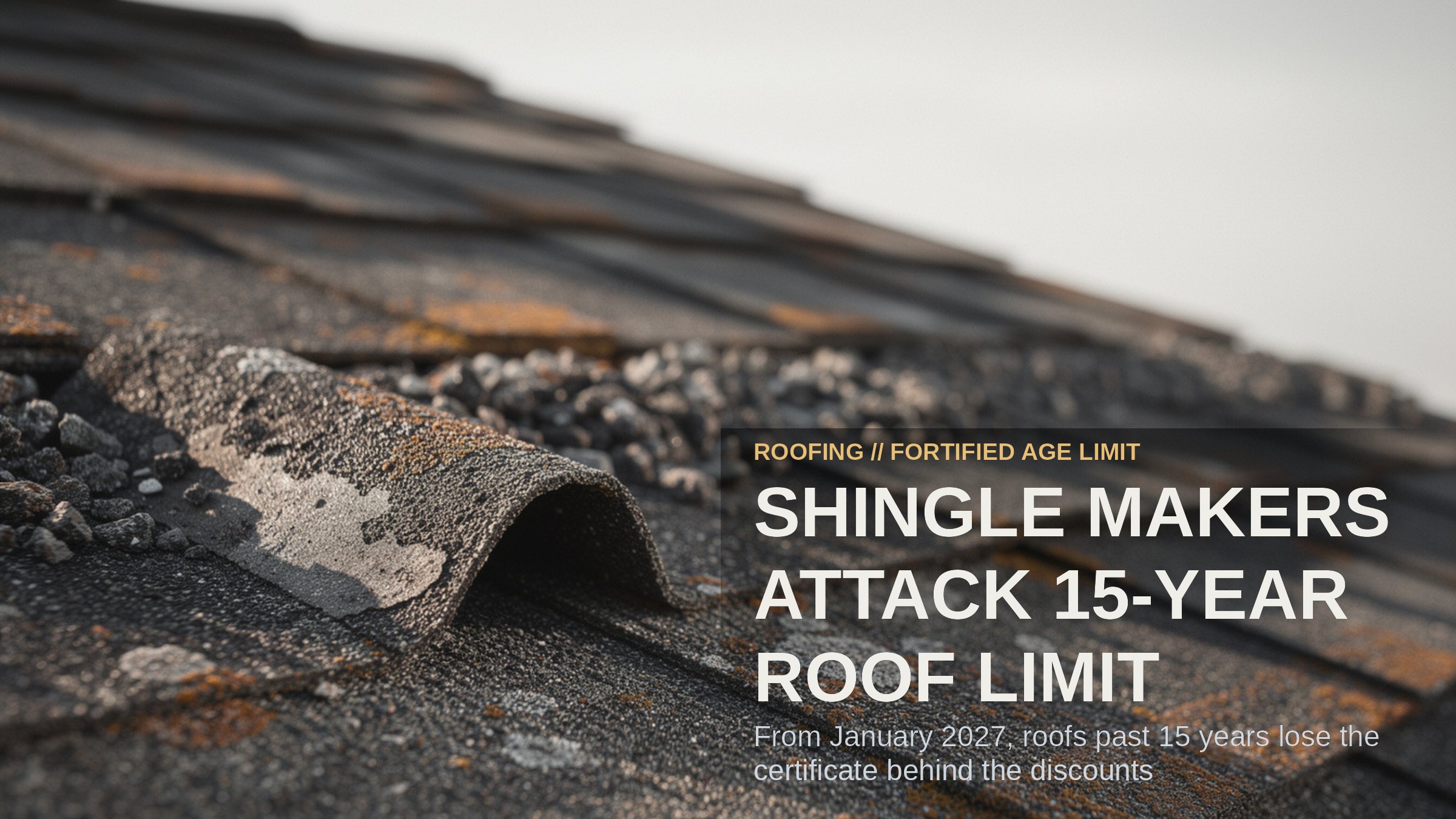
The shingle makers have accused their insurers’ own research arm of bad science. The Asphalt Roofing Manufacturers Association (ARMA) said the study behind a new 15-year limit rests on “non-standard testing protocols, unrepresentative grab-sampling, and incomplete probabilistic modeling,” as reported by Insurance Journal [4]. The limit takes effect on January 1, 2027. After that, an asphalt roof past 15 years cannot hold the FORTIFIED designation — the certificate behind discounts where states reward it. The certificate expires, not the roof.
At a glance
This piece covers the roofing industry’s public attack on the institute behind the FORTIFIED standard, and the new 15-year age limit. It matters to homeowners whose discounts ride on it. The rule forces no roof replacement — but Florida shows what insurers do with age rules anyway.
Narrow rule, wide fear
The sequence runs one way. The bulletin comes from the Insurance Institute for Business & Home Safety (IBHS), a research group funded by carriers. It was issued on September 29, 2026. The words are plain: “designation eligibility is limited to 15 years from the initial FORTIFIED designation date” for a new roof, or from the recorded install date for an existing one [1]. The limit applies only to applications filed on or after that day. It does not shorten any term issued before that date [1].
ARMA answered in public on November 9. The trade group called the conclusions “fundamentally compromised.” It urged carriers not to use the bulletin for broad screening rules [4].
That gap is the whole story. IBHS insists the limit “does not establish asphalt shingle service life” and requires no replacement at any age [1]. The program’s own page says the upgrades “remain in place” even after a home ages out [2]. ARMA is not reacting to what the bulletin says. It is reacting to what carriers do with documents like it. Florida is the precedent both sides carry.
Florida carriers began dropping roofs past ten years for age alone in the early 2000s. Some shingle warranties ran 30 years [4].
Lawmakers answered in 2022. A law now bars carriers from dropping roofs under 15 years old for age alone. It keeps coverage going if an inspection finds five years of life left [4]. Only a few states, Texas and Virginia among them, have similar rules [4].
I read that history twice before the fight made sense to me. The shingle makers watched carriers turn an age number into a drop letter once already. No law in most states would stop them from doing it again.
By the numbers
- 15 years: the age limit on FORTIFIED asphalt roofs in the September bulletin [1].
- 100,000 designations: what IBHS announced in May, over half earned in the prior three years [3].
Where this bites
The people in the fight are blunt about the stakes. Security First, one of Florida’s largest property carriers, prices on roof age and upkeep. Its president, Melissa Burt DeVriese, called age “the single-largest rate factor.” Her company offers no discount for FORTIFIED homes [4]. The reason is the building code. FORTIFIED work is close to what Florida’s code already asks for on roof decks and coverings. The certificate buys little where the code carries the load [4].
For a homeowner with an aging asphalt roof, the rule couples two clocks. The discount lasts only as long as the designation. The designation now has an age ceiling. The paperwork can bite harder than the date. A roof with no recorded install date gets one term of up to five years. Renewal stays closed until the shingles are replaced [1].
The install invoice is the document that keeps the clock honest. The discount math behind your 49% discount isn’t all roof already showed a state rule that looks like a windfall is partly a reinsurance story. This limit is the same discount, now with an expiry.
What I am watching next is whether any carrier cites the bulletin in a rate rule, the way Florida carriers once cited age alone. In most states nothing bars it. ARMA’s public letter is, in effect, a record that the industry expects someone to try.
The catch
Both sides are arguing past the certificate. IBHS is right that the bulletin mandates nothing. No roof must come off at the age limit, and metal or tile roofs face no limit [1]. ARMA is right that the split may not survive contact with carriers. It did not in Florida. It works for those same carriers. The shingle makers are arguing with their biggest customers. One Florida contractor made the case in a sentence. His own 32-year-old shingles rode out Hurricane Milton, losing a few pieces at most. He wants shingle quality, not age, to drive the risk question [4]. My reading, held loosely: the first test is not a storm but a certificate expiry. The fight gets settled in the carriers’ rate manuals, not in either side’s press releases.
Related reading
- Your Class 4 Roof: Ten Times Riskier — more on Energy & Efficiency
- Your Roof Claim’s Hidden Second Check — more on Energy & Efficiency
- Energy & Efficiency — more on Energy & Efficiency
Sources
- [1] Insurance Institute for Business & Home Safety, “TB FH 2026-03: Re-designation Eligibility Requirements for Homes with Asphalt Shingle Roof Systems”, 2026-09-29 — https://fortifiedhome.org/wp-content/uploads/FH-2026-03-Redesignation-Eligibility-1.pdf
- [2] IBHS FORTIFIED, “FORTIFIED Redesignation” (program page, observed 2026-11-27) — https://fortifiedhome.org/designations
- [3] Insurance Institute for Business & Home Safety, “IBHS’s FORTIFIED Program Surpasses 100,000 Designations”, 2026-05-20 — https://ibhs.org/ibhs-news-releases/ibhss-fortified-program-surpasses-100000-designations
- [4] Insurance Journal, “Manufacturers Hammer IBHS Over 15-Year Roof Age Limit for Fortified Designation”, 2026-11-09 — https://www.insurancejournal.com/news/southeast/2026/11/09/891911.htm