Blog

  • Your Basement Lease Risks $500,000

    Your Basement Lease Risks $500,000

    A $60,000 basement conversion stops being just a home improvement the day it is rented, because the tax code starts treating that space as a business asset. Divide the spend by the 27.5-year schedule and the yearly write-off is $2,182 [1]. The rules a rental calculator leaves out are the ones that matter after the lease is signed. The Internal Revenue Service (IRS) taxes that depreciation back when the house sells [4], and it shrinks the home-sale exclusion by the same amount [3]. On a joint return the exclusion covers $500,000 of gain, and a lease that runs past three years puts it at risk.

    The big picture:

    The tax code treats a rented dwelling as a business asset, so it spreads the cost across a useful life. For residential rental property that life is 27.5 years, longer than the appliances, the carpet or the tenant stay [1][5]. That schedule is the one place where a house’s wear is written down as a set number, and it reaches a single owner: the one who rents the space out.

    What I find hardest to square is how small that split makes the benefit. A dollar spent on a kitchen you cook in is never deducted. The same kitchen above a rented unit becomes a deduction of a few cents on the dollar each year. The tax code is not rewarding a landlord. It is saying that a building wears out, and that wear on a business asset is a cost of earning the rent.

    The timing matters more than the size. The write-off arrives slowly, it is often unusable in the years it builds up, and it is reversed at the sale. A homeowner who signs a lease to capture a tax break is buying the smallest part of the deal first.

    By the numbers

    • 3.64 percent — Annual slice: One divided by 27.5 is the share of a conversion the tax code lets an owner deduct each year, so that is $2,182 on a $60,000 build and $1,091 on a $30,000 one [1].
    • $150,000 — Where the loss stops counting: A special $25,000 allowance for rental real estate falls by half of modified adjusted gross income above $100,000, hitting zero at $150,000. Above that line, the loss carries forward instead of lowering income [2].
    • 25 percent — The rate on the way back: Depreciation taken on a dwelling is taxed at up to 25 percent on sale, not at the long-term capital gains rate [4].

    What I’d watch:

    I keep circling the horizon, because it decides more than the deduction does. The exclusion needs the owner to have lived in the home for 2 of the last 5 years [3], which leaves roughly three years of renting before the test fails. Rent longer and the exclusion goes, and the rented years cut it even when the test still passes [3].

    • Three years — The exclusion’s fuse: A lease that outlasts the residence test turns a gain that would have been tax-free into a taxable long-term gain [3].
    • Five years — The parts inside the walls: Appliances and carpet in a rental run on five-year schedules while the building runs on 27.5, so a conversion quoted as one number is not one asset [1].
    • Fair market value — The basis you actually get: At conversion the depreciable basis — the tax-cost number used to figure gain — is the lesser of fair market value or adjusted basis [1], so a soft market lowers the base you write off, not the price you paid.
    • The $25,000 allowance — Who can use it: Above the income line the paper loss is suspended, so the deduction works against collected rent and never against a salary [2].

    The build-versus-buy case for adding the unit already rested on a tenant, and that tenancy is what starts this clock. Nothing about the schedule changes the rent. It changes what the rent costs you later.

    The catch

    My read is that the deduction is close to a wash for most owners who chase it. At a 24 percent marginal rate the write-off saves $14,400 across the full schedule, and the recapture takes back a quarter of the same base at the sale, or $15,000 at the top rate. At 35 percent the owner keeps the gap, which comes to $6,000, or about $218 a year.

    That is the honest size of the prize. The conversion should be justified by the rent, the space or the resale; the schedule changes timing rather than the verdict. Where it does change the verdict is at the exit. An owner who rents for a decade and then sells has turned a tax-free gain into a taxable one and paid the recapture in the same transaction.

    Nothing here replaces an accountant reading the return. The rules above come from the 2025 editions of the IRS publications, so a reader filing later should check the current ones. The arithmetic is mine; the rules are theirs. The real decision is how long the lease runs, not how large the deduction looks.

    At a glance

    The shift: Renting a converted space turns a house into a business asset, and the write-off is smaller than the exclusion it endangers. The number: $2,182 a year, before it is taxed back at the sale. The risk: A lease past three years ends the residence test, and the exclusion goes.

    Related reading

    Sources

    [1] Internal Revenue Service — Publication 527 (2025), Residential Rental Property (residential rental property depreciated over 27.5 years; appliances and carpet on five-year schedules; basis of property changed to rental use is the lesser of fair market value or adjusted basis): https://www.irs.gov/publications/p527 [2] Internal Revenue Service — Publication 925 (2025), Passive Activity and At-Risk Rules (special $25,000 allowance reduced by 50 percent of modified adjusted gross income above $100,000 and unavailable at $150,000 or more): https://www.irs.gov/publications/p925 [3] Internal Revenue Service — Publication 523 (2025), Selling Your Home (exclusion of $250,000, or $500,000 on a joint return; ownership and residence for 2 of the last 5 years; exclusion reduced to the extent of depreciation adjustments and cut for nonqualified use): https://www.irs.gov/publications/p523 [4] Cornell Law School, Legal Information Institute — 26 U.S.C. § 1(h)(1)(E), 25 percent rate on unrecaptured section 1250 gain: https://www.law.cornell.edu/uscode/text/26/1 [5] Cornell Law School, Legal Information Institute — 26 U.S.C. § 168(c), applicable recovery periods (residential rental property, 27.5 years): https://www.law.cornell.edu/uscode/text/26/168
  • Your Heat Pump Cuts Everyone 13%

    Your Heat Pump Cuts Everyone 13%

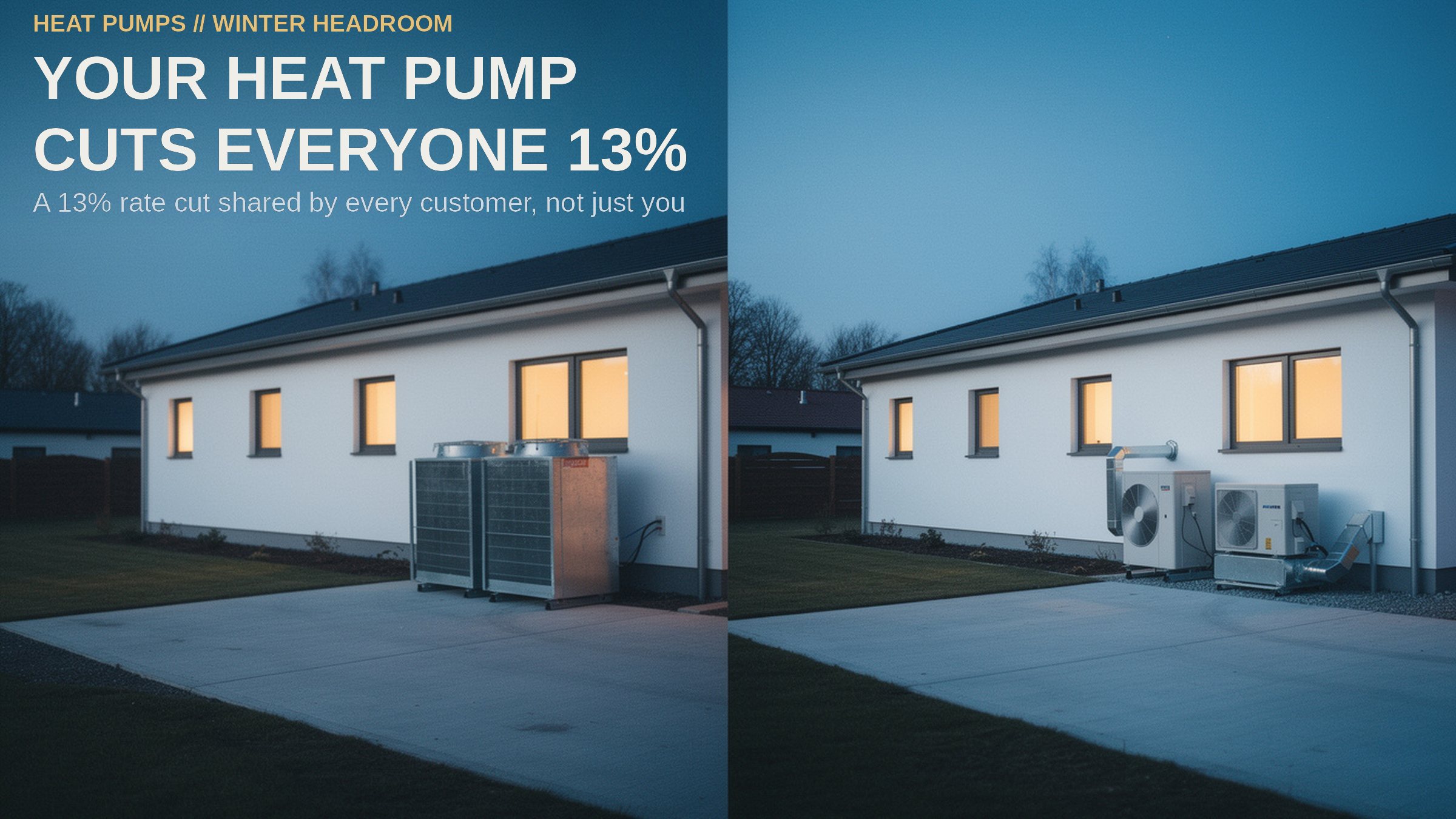
    Your heat pump cuts home electric rates by 13% in states where the grid peaks in summer, because it fills winter headroom that would otherwise sit idle. [1] Every customer on the wires shares the saving, including the neighbor who never bought one, and the average household collects about $200 a year of it. [1] That headroom is the spare capacity left after reserve margins, above the coldest demand a system expects. RMI (the energy research nonprofit) modeled how filling it sets the price of a unit of power. [1]

    The buyer still pays for the equipment. The saving lands on every meter, so what a buyer sees depends on a rate case — where a utility asks regulators to set prices — and that case has nothing to do with the machine in the basement. [1]

    The bill driving the purchase keeps climbing. The average monthly electric bill reached $188 in the third quarter of 2026, up 5.6% from $178 a year earlier. [2]

    The big picture:

    Most American grids are built for a summer afternoon, not a January night. In the Southwest, the Upper Midwest, and the Northeast, demand peaks in July, so the plants and wires that carry it sit half-idle all winter. That spare room is the winter headroom the model uses, and by RMI’s count it holds 86 million more homes than the 23 million that have a heat pump today. [1]

    Heat pumps fill that room with new use and no new power plant. The grid’s fixed cost then spreads across more units of power, which lowers the average price. What strikes me is how old the pattern is: from 1980 to 2000, demand rose more than 70% while inflation-adjusted rates fell about 26%, as the grid was used 18% more efficiently. [1]

    Which heat pump goes in matters more than the sales sheet suggests. An all-electric unit carries the whole heating load; a hybrid keeps the furnace for the coldest hours. That second shape lets far more homes convert inside the same headroom — about 65% more in the model. Illinois shows the gap: all-electric units alone reach 30% of homes, while a mix reaches all of them, at 21% all-electric and 79% hybrid, on 8.9 gigawatts of spare winter capacity. [1]

    By the numbers

    • 13% — Rate cut, mixed fleet: RMI’s mix of all-electric and hybrid units would cut home electric rates by 13% in summer-peaking states, worth $15.6 billion a year, or $200 per customer. [1]
    • 6% — Rate cut, all-electric only: the same grid, filled only with all-electric units, would cut rates by 6%, worth $6.7 billion a year, or $86 per customer. [1]
    • $188 — Average monthly electric bill: the third-quarter 2026 average, up 5.6% from $178 a year earlier. [2]
    • 23% — Electric customers behind on payment: up from 22% a year earlier, with 22% of gas customers and 21% of water customers also owing a balance. [2]

    What I’d watch:

    I read the quote in front of a homeowner differently: it runs on other math. A contractor prices savings from the household’s own use and its own rate, which is right for a bill and wrong for a system gain. RMI’s third piece of advice is a rate redesign, not a bigger rebate, which says where the report thinks the value leaks away. [1]

    The sizing choice is where the two meet. A hybrid often avoids the service upgrade an all-electric unit can force, and the capacity test behind that choice costs far less than the panel it may save. I worked through the 80% test before, and it is the math I would want in hand before signing.

    Two signals would show whether the rate effect is real money or a quirk of the model. The first is whether state rate cases start crediting winter heat pump use when they set the fixed charge. A utility that recovers more cost in a monthly fee can cut the per-unit price and leave the buyer’s bill flat. [1]

    The second signal is the bill: home electric rates have risen more than 8% in two years, and the share of customers behind on payment went from 22% to 23% in twelve months, which says the problem is arriving faster than the equipment. [1][2]

    The catch

    I keep circling how soft the central number is. The rate relief is an average from a model of whole states, and the report says its results are rough guides, not forecasts for any one utility. [1]

    Who gets paid is the harder part. The buyer captures one customer’s share of a gain that the buyer paid the whole cost to create, and the neighbors capture the same for nothing. That is not a case against buying one, since comfort, cooling, and a hedge against the gas bill still belong to the household. It is a case against trusting a savings line that treats a public gain as a private one.

    Timing is the last piece. The households already behind on the bill are the least able to fund the equipment that would lower everyone’s rate, so the help reaches them last. A hybrid still burns gas, and the report’s climate totals describe the whole system, not anything one home can claim.

    At a glance

    The shift: Heat pumps now count as grid capacity, not just a home appliance. The number: 13% — the modeled rate cut in summer-peaking states, at $200 per customer a year. The risk: Every customer shares the saving; the buyer carries the capital, on a rough model.

    Related reading

    Sources

    [1] RMI, “The Opportunity for Heat Pumps to Put Downward Pressure on Electricity Rates”, 2026-10-15 — https://rmi.org/resources/the-opportunity-for-heat-pumps-to-put-downward-pressure-on-electricity-rates [2] J.D. Power, “Quarterly Share of Wallet Tracker: U.S. Utilities – October 2026” (Q3 2026 wave) — https://www.jdpower.com/business/news/quarterly-share-of-wallet-tracker-u-s-utilities-october-2026

  • Insurance Bill Beats Property Tax 14%

    Insurance Bill Beats Property Tax 14%

    Home insurance now beats the property-tax bill in two-thirds of U.S. counties, by 14% on average, according to a Bloomberg Intelligence study published on October 19. [1] Tomorrow, voters in seven states decide 12 property-tax measures. Florida’s Amendment 3 and Oklahoma’s State Question 847 are the big ones. None of those ballot questions touches the insurance premium. [2] [3]

    Both bills land on one household budget, but only one has kept pace with the cost of living. Property taxes rose only slightly more than inflation since 2020, the Lincoln Institute of Land Policy reported on October 21, even as home prices climbed more than 50%. [4]

    The big picture:

    The revolt is real, and it is aimed at the slower of the two lines. Over a decade, homeowner policies are up 45% in real terms, and the national tax bill has done little more than track prices. [1] [4]

    Weather, not a vote, moved the premium: hail and winter storms are pushing rates up across Colorado, Utah and Minnesota, and in the Southeast the premium now runs 2.5 to 4 times the tax levy. That is a risk bill, and no ballot item reprices it. [1]

    The ballot offers a transfer, not a cut. When a town shields part of one home’s value, the rest of the bill moves to renters, shops and second homes. The levy is set by the revenue the town needs. The Tax Foundation says the same about this year’s batch: a higher shield or a tighter cap makes other properties carry more. [2]

    Florida is the cleanest test of that logic. Amendment 3 lifts the homestead exemption for non-school taxes to $150,000 next year and $250,000 in 2028, while the $25,000 school tax break stays put. A $275,000 home would owe city or county tax on only $25,000 of value. [2] [4]

    The state’s current break tops out at $50,000. Adam Langley of the Lincoln Institute puts a workable statewide figure at $20,000 to $40,000. Florida’s version is odd in one way: it mandates the high figure with no state money to make towns whole. [2] [4]

    I keep coming back to the mismatch: a voter can move the tax, while the premium is the line that answers to risk and has no ballot.

    By the numbers

    • 14% — Insurance over tax: Owners pay 14% more for home insurance than for property tax at the county level; adding auto cover lifts the gap to 30%. [1]
    • 75% — Counties where the pair wins: With car cover added, the combined insurance bill tops the property tax in 75% of U.S. counties. [1]
    • 79% — Nebraska’s decade: Homeowner policies there rose 79% in real terms, against 45% nationally. [1]
    • 1.75% — Oklahoma’s new cap: State Question 847 cuts the yearly cap on assessed homestead value from 3% to 1.75%, and on other property from 5% to 4%. [2]

    What I’d watch:

    Three things decide whether the relief shows up as money.

    • The county, not the country. Two-thirds of counties is an average of averages. The 14% gap is small where taxes are high and wide where they are low, which is why the Southeast looks nothing like New Jersey. [1] [4]
    • The levy behind the break. A bigger break changes who pays, not how much the town must spend. Property taxes fund 28.4% of local spending, more than half of it in New Hampshire, Connecticut, New Jersey and Maine, and under 15% in Arkansas, Alabama and Nevada. [4]
    • The repair backlog. A LendingTree survey published on October 26 found 34% of owners delayed a repair in the past two years. Of those still needing work, 32% cannot afford it, 23% say quotes are too high and 3% blame the difficulty of getting a loan. The median job costs $2,113 in real terms, up 76.1% since 2015. A professional job runs $4,103; the same work by the owner runs $845. [5] [6]

    I want to know whether insurers credit that work. A roof and a water shut-off are the two items that turn up in claims, and the average water-damage claim is $15,400.

    The catch

    The comparison is a county average, and averages hide the two cases that matter. In a high-tax Northeast county, the tax bill still dwarfs the premium. In the Southeast, the premium can run 2.5 to 4 times the tax, and no exemption closes that gap. [1] [4]

    There is also a timing problem: all 12 measures are still undecided as of today. An exemption that passes in Florida does not lower a levy; it moves one. If town budgets hold, the relief for a $275,000 home arrives as a smaller share of a bill that keeps growing. The owner who expected a cut sees a smaller increase. That is the arithmetic of a transfer, not a cut. [2] [4]

    Property taxes are the one housing cost a voter can move, and 45 of 58 such measures passed from 2020 through 2025. Where I’ve landed: people wanted a lever they could control more than a bill they could lower. [3]

    At a glance

    The shift: Twelve property-tax measures reach ballots tomorrow; insurance, now the larger bill in two-thirds of counties, is on none of them. The number: 14% — the average insurance premium’s lead over property tax. The risk: A homestead exemption moves a levy rather than cutting it.

    Related reading

    Sources

    [1] Bloomberg, “Home Insurance Tops Property Taxes in Squeeze for US Households” (2026-10-20, Bloomberg Intelligence analysis published 2026-10-19) — https://www.bloomberg.com/news/articles/2026-10-20/home-insurance-tops-property-taxes-in-squeeze-for-us-households [2] Tax Foundation, “Property Tax Relief on the Ballot: Three Approaches, One Clear Winner” (2026-10-30) — https://taxfoundation.org/blog/property-tax-ballot-measures-2026 [3] Ballotpedia, “Ballot measures related to property taxes, 2026” (observed 2026-11-02; measures vote 2026-11-03) — https://ballotpedia.org/Ballot_measures_related_to_property_taxes,_2026 [4] Lincoln Institute of Land Policy, “Understanding Property Tax Revolts: An Explainer” (2026-10-21) — https://www.lincolninst.edu/publications/land-lines-magazine/articles/understanding-property-tax-revolts-an-explainer [5] LendingTree, “1 in 3 Homeowners Put Off Needed Repairs” (survey fielded 2026-09-02 to 2026-09-07; published 2026-10-26) — https://www.lendingtree.com/home/mortgage/putting-off-repairs-survey [6] USA Today, “Home repair costs jump 76% in a decade” (2026-10-19) — https://www.usatoday.com/story/money/economy/housing/2026/10/19/home-improvement-costs-rise/92264080007

  • Your $149.99 Scope Blinds Past 3.94

    Your $149.99 Scope Blinds Past 3.94

    Inside your finished wall the camera has about three and a half inches of cavity before the far face, and past 3.94 inches it blinds you, because the lens runs out of focus long before the bay runs out of wall. That limit is published only by the $149.99 Teslong TD450S, the one scope here whose maker states a working distance at all. The Klein ET16 costs $40.58 and the Klein ET19 costs $169.99, and neither page carries a focus range anywhere in its table [1][2][4][5]. Only the Teslong can be aimed once it is inside the wall, and that aim decides whether the hole you cut tells you anything.

    Product Price (2026-11-01) What the listing says
    Klein ET16 borescope $40.58 0.35 in camera head, 10 ft armored gooseneck, phone as the display, 640 x 480 [1][5]
    Teslong TD450S dual lens $149.99 0.33 in dual-lens probe, 210 degree articulation, 4.5 in screen, published focus range [3]
    Klein ET19 pro borescope $169.99 0.22 in dual-lens head, 9.8 ft armored snake, 4.3 in screen, no articulation [2][4]

    The big picture:

    My read starts with the shape of the problem rather than the shopping list, because these three cameras fail at different distances and for different reasons.

    A head thin enough for the hole is useless if its lens cannot focus on what sits beyond it. Focus range is the number a maker prints when the lens is fixed, and its absence carries information too [3][4][5]. The TD450S holds focus from 0.79 to 3.94 inches straight ahead and from 0.4 to 2.76 inches on its side lens [3]. A bay between two-by-four studs at sixteen inches on centre is about fourteen and a half inches wide, so most of what is in there sits past the point where the image holds detail.

    Then the hole. The heads measure 0.22 in on the ET19, 0.33 in on the TD450S and 0.35 in on the ET16 [3][4][5]. A quarter-inch bit is 6.35 mm, which passes the ET19’s head and nothing else here. A three-eighths bit at 9.53 mm passes all three.

    And steering. Only the TD450S moves its head, through 210 degrees on a lever beside the grip [3]. The other two bend at the cable and look wherever the bend points them.

    By the numbers

    • $149.99 — The middle price, the only stated focus range: The TD450S costs $20.00 less than the Klein ET19 and $109.41 more than the ET16, and it is the one camera here whose table says where its lens focuses [1][2][3].
    • 3.94 inches — The far edge of the view: Straight ahead the TD450S holds focus from 0.79 to 3.94 inches; on the side lens the range runs 0.4 to 2.76 inches, so the sideways look is the shorter of the two [3].
    • 0.22 in — The smallest head: The ET19’s 5.5 mm head is the only one of the three that passes a quarter-inch hole, which is the hole a homeowner can patch from a tub of filler [4].
    • $75 — The patch under the tool: A professional charges at least $75 for small holes up to 4 inches across, and $200 to $550 for several in one room, so the camera is the cheap half of this decision [6].

    What I’d watch:

    What strikes me is that none of these three failures is about price.

    • Focus against the bay: The TD450S loses the far stud at 3.94 inches, while neither Klein table lists a working distance at all [3][4][5]. That silence leaves a buyer guessing whether a $169.99 camera focuses at one inch or at ten.
    • A display claim that contradicts itself: The ET19 description promises a 1920 x1080 monitor, and the same page’s table prints 480p for that display and 720p for the camera [4]. The TD450S prints 854×480 for its 4.5-inch screen while capturing 1920 x1080 stills from a 1.0 megapixel sensor, so the pixel number measures the chip rather than the view [3].
    • A phone doing the work of a screen: The ET16 has no display and no battery of its own. It draws power from an Android phone’s port and shows 640 x 480 there [5]. That is the whole $109.41 gap to the TD450S, and it is also the reason to buy one for a job you will do once.

    I keep coming back to the hole, because it is the part the reader controls. A camera that needs a three-eighths opening can go through a baseboard gap, a coaxial plate or the ceiling of the room below. One that needs a quarter-inch opening can go almost anywhere and still cannot be pointed once it arrives.

    The catch

    My view is that the winner is narrower than the price table makes it look. The TD450S wins because it is the only camera here that can be aimed after it is inside the wall. Its published focus range is also the one number a buyer can check against the depth of an actual cavity. It still cannot see the far end of a bay, and it still asks for a three-eighths hole.

    The situation What I would buy
    A stain on a ceiling with the wall intact The TD450S, aimed through a three-eighths hole at the joist bay above
    A draft you cannot trace in a finished exterior wall The TD450S, because the side view reaches the top plate without a second hole
    Lath and plaster, or a wall you will not repaint The ET19, whose 0.22 in head passes a quarter-inch hole, accepting a fixed view
    An already open cavity, or one straight look The ET16, phone on one end and probe on the other, for $40.58
    A duct run longer than five feet None of these three; the TD450S probe is 5.08 ft and the ET19’s 9.8 ft cannot be aimed

    The shared trap is the patch, not the camera. A professional charges at least $75 for small holes up to four inches, so a quarter-inch hole and a three-eighths hole cost the same to close [6]. Both land in the same band. What changes is whether you were allowed to make the hole in the first place, and no focus range or articulation angle answers that for you.

    What we did not test

    This comparison is built from three manufacturers’ specification tables, three price pages and one published repair-cost guide. The cameras were not handled for this article, no wall was opened for it, and no independent measured test of any of the three is cited here. For the spend that sits behind the choice, the desk’s ownership cost model prices the repair and the tool together, and the home diagnostics hub carries the rest of the beat.

    At a glance

    • The shift: Focus range, not pixel count, decides whether a wall camera shows you anything.
    • The number: 3.94 inches, the published far focus of the $149.99 Teslong TD450S.
    • The risk: None of these three sees the far side of a bay, and each one needs a hole.

    Sources

    1. Haus of Tools — Klein Tools ET16 Borescope for Android Devices (price and feature list): https://hausoftools.com/products/klein-tools-et16-borescope-for-android%C2%AE-devices
    2. Haus of Tools — Klein Tools ET19 Pro Borescope (price and feature list): https://hausoftools.com/products/klein-tools-et19-pro-borescope
    3. Teslong — TD450S Articulating 8.5 mm Dual Lens Inspection Camera, product page and technical specifications: https://teslong.com/products/td450s-articulating-8-5mm-dual-lens-inspection-camera
    4. Klein Tools — ET19 Pro Borescope, specification table: https://www.kleintools.com/catalog/borescopes/pro-borescope
    5. Klein Tools — ET16 Borescope for Android Devices, specification table: https://www.kleintools.com/catalog/borescopes/borescope-android-devices
    6. Bob Vila — “How Much Does Drywall Repair Cost?”, quoting Fixr: https://www.bobvila.com/articles/drywall-repair-cost/
  • Your 3,000-PSI Washer’s 1.1 GPM Trap

    Your 3,000-PSI Washer’s 1.1 GPM Trap

    Greenworks sells its 3,000-PSI pressure washer with two numbers that never meet: 3,000 pounds per square inch (PSI) at 1.1 gallons per minute (GPM), and 2.0 GPM at 100 PSI [1]. Your 3,000-PSI washer’s 1.1 GPM trap sits in that second clause, because a narrowing nozzle trades flow for pressure and the maker quotes each number at its own end. The 2,300-PSI Gen 2 at $312.99 moves 1.2 GPM at its own top pressure on the same 14-amp motor, so it is the better driveway buy for most houses [2]. The 3,000-PSI Gen 2 at $349.99 is the one to take if stained concrete is the job and a second pass is acceptable [1].

    Product Price, 2026-11-01 What the maker’s page says
    Greenworks 2,300 PSI 1.2 GPM, Gen 2 $312.99 2,300 PSI at 1.2 GPM; 2.3 GPM at 100 PSI; 14-amp brushless; 25 ft hose [2]
    Greenworks 2,700 PSI 1.2 GPM $379.99 2,700 PSI at 1.2 GPM; 2.3 GPM at 100 PSI; 14-amp brushless; 25 ft hose [3]
    Greenworks 3,000 PSI 2.0 GPM, Gen 2 $349.99 3,000 PSI at 1.1 GPM; 2.0 GPM at 100 PSI; 14-amp brushless; 25 ft hose [1]

    The big picture:

    Pressure and flow do different jobs, and only one sets how long a surface takes. Pressure is what lifts a stain off concrete or strips a film of algae off siding, while flow is the volume of water carrying that loosened dirt away [1][6]. A nozzle that narrows the spray raises pressure and cuts flow at the same time, so the two headline numbers sit at opposite ends of one setting, not side by side in the middle.

    Greenworks writes the condition into the feature list on all three pages, in the same sentence that carries the claim. The 3,000-PSI model reads 3,000 PSI at 1.1 GPM, then adds 2.0 GPM at 100 PSI in brackets, and the two smaller machines do the same with their own figures [1][2][3]. DeWalt prints the same condition in the footnotes of a rival unit: top pressure at the 15-degree nozzle, top flow at the soap nozzle [5]. What I take from that pair of clauses is that each number is true on its own setting, and neither is true of the other.

    What moves up the ladder is pressure, from 2,300 to 3,000, while the flow at that pressure stays at 1.2 gallons a minute and then falls to 1.1 at the top [1][2]. All three machines carry a 14-amp brushless motor, a 25-foot hose, a 35-foot cord and five nozzles [1][2][3]. A buyer comparing the three is choosing how hard the water hits, not how fast the work goes.

    Popular Mechanics shows how the wording travels. Its review lists the 2,700-PSI Greenworks at 2,700 psi and 2.3 GPM with no condition attached to either, and the same page prices it at $379 [6]. That is not a slip in the review, which also says a 1 GPM machine leaves a big patio or long siding taking a little longer [6]. It is the same pair of numbers the maker prints, minus the clause that explains them.

    By the numbers

    • $260.83 — Cost per gallon a minute at pressure: the 2,300-PSI machine’s price divided by the 1.2 GPM it delivers at 2,300 PSI, against $316.66 for the 2,700 and $318.17 for the 3,000 at 1.1 GPM [1][2][3].
    • $0.117 — Cost per rated PSI: the 3,000-PSI unit is the cheapest per pound of pressure at $0.117, sitting against $0.136 for the 2,300 and $0.141 for the 2,700, because of the deepest markdown in the range [1][2][3].
    • 8.3% — Water the top rung gives up: the drop from 1.2 GPM to 1.1 GPM at working pressure, a fall that runs backward against the 30.4% rise in pressure across the ladder [1][2].
    • $37.00 — The step that buys less flow: the price gap between the 2,300 and the 3,000, paying for 700 more PSI while losing a tenth of a gallon a minute of water at pressure [1][2].

    What I’d watch:

    The three machines differ on three points that change the buy, and none is the number on the box. The first is what the water strips: a driveway head and the cheapest machine are matched to each other, since 2,300 PSI is the rating of the brand’s own 12-inch rotating surface cleaner [2][4]. The second is the pace across a surface, where the 2,300 and the 2,700 deliver the same 1.2 GPM and the 3,000 gives up a tenth of a gallon [1][2][3]. The third is what the extra pressure does to soft wood, where a narrower, harder stream marks a deck faster than it cleans it.

    I have been watching the sale tags rearrange a lineup that the spec sheet puts in a different order. The 3,000 sits $30.00 below the 2,700 today, and the 2,300 sits $37.00 below the 3,000, so cheapest to dearest reads 2,300, 3,000, 2,700 [1][2][3]. A reader who ranks the boxes by PSI and takes the middle one pays most for the same flow as the cheapest, an inversion that holds only while the sales last. The rest of this vertical’s equipment math sits in outdoor power equipment.

    The storefront also sells a second 3,000-PSI listing under an older model number, and that number is what to check at checkout rather than the series name. An older 3,000-PSI listing on the same store sits at $424.99 with the same headline numbers, $75.00 above the Gen 2, and the 2,700 also ships as a bundle with a 15-inch cleaner and a wand extension for $479.98 [1][7].

    The situation The pick
    A wood deck, siding and a one-car concrete driveway The 2,300-PSI Gen 2, the cheapest of the three and the flow match for the surface cleaner [2][4]
    Stained or heavily weathered concrete, and patience The 3,000-PSI Gen 2 at its current markdown, run on the narrow nozzle [1]
    A big patio cleaned in one pass, budget secondary The 2,700, which holds 1.2 GPM at the highest pressure in that flow band [3]

    The catch

    The accessory is the part that breaks the logic of the ladder. Greenworks sells a universal 12-inch rotating surface cleaner for $39.99, and its spec sheet gives the top pressure as 2,300 PSI [4]. That rating matches the cheapest machine exactly and sits 700 PSI below the top rung, so a buyer who wants both has to run the 3,000 at part pressure or accept a head working past its stated limit.

    I could be wrong about how much a missing tenth of a gallon matters on a sloped driveway, where water pools and a pass takes longer anyway. What the pages never print is the one number that would settle it: the flow each machine gives through the 15-degree nozzle itself. The maker prints flow at peak pressure and flow at 100 PSI, and nothing in between, so the middle of the curve stays a guess for every buyer, of every brand here.

    What we did not test

    This review is built from three maker product pages, one rival’s spec page and one publisher’s review roundup; no unit was handled here, nothing was run, and no pressure or flow was measured by this desk. Every PSI and GPM figure belongs to the maker that printed it, under its own stated condition, and the one measured observation in the piece is Popular Mechanics’, attributed to that review. For the cost side of the decision, the true cost of ownership calculator takes a purchase price and a service life, and the outdoor power equipment hub carries the rest of the field.

    At a glance

    The shift: The manufacturer’s specification separates peak pressure from peak flow, attaching the high flow rate to a low-pressure rinse. The number: 1.1 GPM at 3,000 PSI, trailing the 1.2 GPM delivered by the $312.99 machine below it. The risk: The surface cleaner built for driveway work is rated to 2,300 PSI, leaving it unmatched for the top two machines.

    Sources

    [1] Greenworks — 3,000 PSI 2.0 GPM Cold Water Electric Pressure Washer (Gen 2), SKU 5128802 / GPW3002A: sale price $349.99 against a $499.99 standing price, “3000 Max PSI at 1.1 GPM water flow (2.0 GPM flow at 100 PSI)”, 14-amp brushless motor, 25 ft hose, 35 ft cord, five nozzles, and the $424.99 prior-generation 5113902 listing card. https://www.greenworkstools.com/products/3000-psi-2-0-gpm-cold-water-electric-pressure-washer (retrieved 2026-11-01)

    [2] Greenworks — 2,300 PSI 1.2 GPM Cold Water Electric Pressure Washer (Gen 2), SKU 5128502 / GPW2303A: sale price $312.99, “2300 Max PSI at 1.2 GPM water flow (2.3 GPM flow at 100 PSI)”, 14-amp brushless motor, 25 ft hose, 35 ft cord, five nozzles. https://www.greenworkstools.com/products/2300-psi-1-2-gpm-cold-water-electric-pressure-washer (retrieved 2026-11-01)

    [3] Greenworks — 2,700 PSI 1.2 GPM Cold Water Electric Pressure Washer, SKU 5128402 / GPW2702A: sale price $379.99 against a $449.99 standing price, “2700 Max PSI at 1.2 GPM water flow (2.3 GPM flow at 100 PSI)”, 14-amp brushless motor, 25 ft hose, 35 ft cord, five nozzles. https://www.greenworkstools.com/products/2700-psi-2-3-gpm-cold-water-electric-pressure-washer (retrieved 2026-11-01)

    [4] Greenworks — Universal 12″ Rotating Surface Cleaner: $39.99, maximum pressure 2,300 PSI, 1/4″ quick connect, dual-nozzle head. https://www.greenworkstools.com/products/12-inch-pressure-washer-surface-cleaner-5207402vt (retrieved 2026-11-01)

    [5] DEWALT — DWPW2400 2400 PSI 1.1 GPM Electric Pressure Washer: headline “2400 MAX PSI and 1.1 gpm”, with the footnotes “Maximum psi when used with 15-degree nozzle” and “Maximum GPM when used with soap nozzle”. https://www.dewalt.com/product/dwpw2400/2400-psi-electric-pressure-washer (retrieved 2026-11-01)

    [6] Popular Mechanics — The 7 Best Electric Pressure Washers of 2026: the Greenworks 2,700-psi pick listed at $379, its key specs given as 2,700 psi and 2.3 GPM, and the reviewer’s note that a 1 GPM machine leaves a large patio or long siding taking a little longer; page updated 18 August 2026. https://www.popularmechanics.com/home/outdoor-projects/a43931284/best-electric-pressure-washers (retrieved 2026-11-01)

    [7] Greenworks — 2700 PSI Pressure Washer, 15″ Surface Cleaner and Extension Combo Kit: $479.98. https://www.greenworkstools.com/products/2700-psi-pressure-washer-w-15-surface-cleaner (retrieved 2026-11-01)

  • Your Half-Acre Mower’s $450 Gap

    Your Half-Acre Mower’s $450 Gap

    The Kress KR172 lists at $1,699.99 through a dealer sale that ends on 31 December 2026, and $450 less on the model page that sells the same mower [1][3]. That gap decides your half-acre buy more than any spec row does. The lower number is the one worth quoting, and it takes a written record to secure it. The Mammotion Luba mini 2 1500, at $1,799.00 for 0.37 acre, wins only on a shaded lot or one past a 40% slope [4].

    Product Price (2026-11-01) What the listing says
    Kress KR172, half-acre $1,249.99 $2,499.99 regular; 0.5 acre recommended, 0.7 acre maximum at a 72-hour cadence [1]
    Kress KR161, quarter-acre $1,050.99 $2,099.99 regular; 0.25 acre maximum [2]
    Mammotion Luba mini 2 1500 $1,799.00 $1,999.00 regular; 0.37 acre; onboard Light Detection and Ranging (LiDAR) plus camera vision [4]

    The big picture:

    Kress runs two price lists for one machine, and the sale page leads with the higher one. That page marks $3,199.98 down to $1,699.99 and calls it a saving of $1,499.99 [3]. The model page for the same mower marks $2,499.99 down to $1,249.99, and its only call to action is a dealer locator [1]. The gap between the two regular prices is $699.99, which is also the value the sale page puts on the real-time kinematic (RTK) mapping cart it throws in [3].

    I read the two pages side by side to confirm they sell identical hardware. Neither number comes from a direct marketplace checkout. Both pages belong to Kress, both were live the same afternoon, and the spread dictates where a buyer starts the conversation.

    By the numbers

    • $2,499.98 — Cost per rated acre: the KR172’s half-acre price over its half-acre rating, against $4,203.96 for the quarter-acre KR161 and $4,862.16 for the Luba mini 2 [1][2][4].
    • $199.00 — The half-acre step: the half-acre Kress lists $199 above the quarter-acre one, so on this sale the bigger machine is the cheaper buy per acre [1][2].
    • 3.1 charges — One pass at rated area: Mammotion claims 0.12 acre of cutting per charge on a 6.1 ampere-hour (Ah) pack, so its 0.37 acre rating needs about three charges, not one [4].
    • 40% — The slope ceiling: the KR172’s top slope against Mammotion’s claimed 80%, the one row where the smaller machine is the stronger one [1][4].

    What I’d watch:

    The acreage numbers measure different things. Kress prints area by cadence, 0.5 acre if the machine cuts every 48 hours and 0.7 acre if it runs every 72 [1]. Mammotion prints area per charge instead, and calls 0.37 acre the lawn it suits [4]. Both read as ceilings, which is the rating-versus-usable-acreage trap this desk has written up before: the number assumes the machine gets the weather and daylight it wants.

    Steering depends on something the buyer does not own. Kress sells “No antennas. No beacons. No boundary wires”, then lists “Dead reckoning for mowing even undershade (weak satellite signal)” in the same feature block, and its box holds an RTK antenna [1]. The brand tells buyers to verify network coverage at a dealer before relying on the signal [1]. Mammotion answers the same problem with onboard sensing and sells “No Wire, No Antenna: 360° LiDAR + Dual Camera AI Vision” [4].

    The physical limits are not close. The KR172 is rated to a 40% slope, 59 decibels perceived and 26.48 pounds. The Luba mini 2 is rated to 80% and gives a ceiling below 65 decibels [1][4]. A ceiling is not a measured figure, and a perceived level is not a sound-lab reading, so both stay claims.

    The model page’s call to action is a dealer locator rather than a checkout, which makes the lower figure a number to argue from. One authorized dealer listed it at the model page’s figure and had none in stock, and a second listed it at the sale price [5][6]. The offer also says “while supplies last”, and it closes on 31 December 2026 [3].

    The situation The pick
    Half an acre or less, open sky, price first Kress KR172 at the lower quote, in writing [1]
    A small lot that needs a compact machine Kress KR161, the quarter-acre model [2]
    Heavy canopy, a slope past 40%, no dealer near Mammotion Luba mini 2 [4]

    The catch

    What I find hard to square is the premium. The Luba mini 2 asks $549.01 more than the KR172 and rates 0.13 acre less. That money buys onboard sensing and the steeper slope rating, not more lawn [1][4]. A roundup by another publisher puts the tested end of this class at $1,099 for a 0.3-acre LiDAR unit, so the Kress sale sits mid-market rather than cheap [7].

    The one cost a buyer controls is the 36% spread between the sale page and the model page, and closing it takes a written quote rather than a screenshot. I am watching how these brands handle battery replacements next, as neither maker lists a spare pack price on these pages. The year-four cost in any payback sum stays missing on both.

    What we did not test

    This review rests on maker spec and price pages, two dealer listings and one roundup. Neither unit was handled here, nothing was installed, and no cutting, noise or steering was measured by this desk. Every acre, slope and sound claim belongs to the maker or to the reviewer named beside it. For the payback side of the decision, the true cost of ownership calculator takes the numbers above, and the yard robotics coverage carries the rest of the field.

    At a glance

    The shift: Off-season sales now put two prices on one robot mower, on the maker’s own pages, $450 apart. The number: $2,499.98 an acre for the Kress KR172, against $4,862.16 for the Mammotion Luba mini 2. The risk: The cheaper figure is a dealer’s quote rather than a cart price, and the offer closes on 31 December 2026.

    Sources

    [1] Kress — Kress RTKⁿ ½-acre robotic lawn mower (KR172): price $1,249.99 against $2,499.99 regular, cadence-based area, slope, weight, sound level, feature list, box contents, dealer locator. https://www.kress.com/en-us/kress-rtk%E2%81%BF-%C2%BD-acre-robotic-lawn-mower-kr172 (retrieved 2026-11-01) [2] Kress — Kress RTKⁿ ¼-acre robotic lawn mower (KR161): price $1,050.99 against $2,099.99 regular, 0.25 acre maximum. https://www.kress.com/en-us/kress-rtk%E2%81%BF-%C2%BC-acre-robotic-lawn-mower-kr161 (retrieved 2026-11-01) [3] Kress — Robotic lawn mowers dealer sale: KR172 at $1,699.99 against $3,199.98, the $699.99 mapping cart, dealer-only terms and the 31 December 2026 end date. https://www.kress.com/en-us/robotic-mowers (retrieved 2026-11-01) [4] Mammotion — LUBA mini 2 AWD Robot Lawn Mower 1500/1500H: $1,799.00 against $1,999.00 regular, 0.37 acre, 0.12 acre per charge on 6.1 Ah, 80% slope, under 65 dB, LiDAR and dual-camera sensing. https://us.mammotion.com/products/luba-mini-2-awd-robot-lawn-mower (retrieved 2026-11-01) [5] TurfCloud Store — authorized Kress dealer listing for the KR172: $1,249.99 against $2,499.99 regular, unit out of stock. https://store.turfcloud.com/products/kr172-kress-rtk%E2%81%BF-acre-robotic-lawn-mower (retrieved 2026-11-01) [6] SmartYard Northwest — authorized Kress dealer, model and price table: KR172 at $1,699.99. https://smartyardnw.com/kress-robotic-mowers-review (retrieved 2026-11-01) [7] PCMag — The Best Robot Lawn Mowers: tested picks, and the $1,099 0.3-acre LiDAR unit at the low end of the field. https://www.pcmag.com/picks/the-best-robot-lawn-mowers (retrieved 2026-11-01)

  • Your Radon Test: 3.9 Isn’t a Pass

    Your Radon Test: 3.9 Isn’t a Pass

    A radon kit that reads 3.9 picocuries per liter (pCi/L) is not a pass, even though it sits just under the federal action line of 4 pCi/L [2][6]. The rules that set that line say a house reading between 2 and 4 pCi/L should look into a fix. That band is tighter than the swing in a two-day test, which is why the way you took the sample matters more than the number on the slip. New York State sells a lab-checked kit for $12.25, and its steps start with sealing the house, because the test measures a time average [3].

    The big picture:

    My read starts with the measurement itself. Radon is soil gas that seeps into the lowest part of a house, and the indoor level is a tug of war between how much gas gets in and how much fresh air thins it out.

    Fresh air moves the number easily. The drop dies the moment you close the doors: New York’s fix guide notes that once windows and vents are shut, radon levels mostly return to past marks within about 12 hours [4]. A test run with a cracked window is not a low reading of your house. It is a reading of a different space, and it will not happen again next winter.

    This is the same lesson as an imager that needs a 15-degree spread. The tool is not the problem, the setup is. The published guidance agrees on the shape of the test but differs on the exact clock: New York’s consumer page needs doors and windows closed 24 hours before and during the test [3], while the Lung Association’s kit steps start a closed house at least 12 hours early [7]. Pick the stricter clock and every rule is met.

    By the numbers

    • 2,900 — Non-smoker deaths: The Environmental Protection Agency (EPA) says radon causes roughly 21,000 lung-cancer deaths a year, and about 2,900 of those are people who never smoked [1].
    • 1.3 pCi/L — Risk under the line: At a third of the action mark, a never-smoker faces a lifetime lung-cancer risk of about 2 in 1,000, against 20 in 1,000 for a smoker [1].
    • Two to seven days — Short-term sample: A standard short test runs for two to seven days, and the device must sit in the lowest space the family uses [7].
    • Less than $1,000 — Quote floor: Minnesota’s health office warns that fix rates under $1,000 are often too good to be true, and the cheap jobs behind them usually bring poor work [5].

    What I’d watch:

    The choice made in a kitchen is usually between a mail-in kit and a digital screen, but the test rules settle the debate before the gear does. What I keep circling is how little the brand changes the answer. A passive test sent to a lab returns a time average, and that is what the action line was written to match.

    • What a lab offers: The $12.25 state kit collects gas on its own and comes back fully checked [3], so the number covers the whole time window rather than one point on a counter.
    • The clock in the steps: State rules require sealing the house for 24 hours before and during the test [3], which also meets the shorter 12-hour start listed in published kit guides [7].
    • Where the device sits: Testing means placing the unit in the lowest floor regularly used, kept away from drafts and bumps [7]. A basement you never enter is not the floor the family breathes.
    • The install clock: After a system goes in, the retest happens within 30 days but no sooner than 24 hours with the fan running [4], then every two years, or every five years without a system [3].

    The catch:

    The honest limit is that one short test captures a single season. Both the state guide and the Lung Association treat a short sample as a sign of whether to test again, not as a final word on the level the house holds all year [7]. A long test takes at least three months to finish. Most people will not wait that long.

    I also cannot price the fix for you, and neither reference page offers a firm number. The health offices give a floor below which a quote should act as a warning [5], but no set dollar range for a proper install. Three bids remains the only safe path, since a single average cost figure is a guess wearing a number.

    The last thing worth sitting with is what a sloppy test buys. A reading taken with the house open is bold and wrong, and it will happen again every time someone reruns the test the same way.

    At a glance

    The shift: A radon number is wrongly read as a final house verdict instead of a short test result. The number: 4 pCi/L is the fix line, and 2 to 4 means consider fixing. The risk: An open-air test reads low, but levels return within 12 hours of closing up.

    Sources

    [1] U.S. Environmental Protection Agency, “Health Risk of Radon” — https://www.epa.gov/radon/health-risk-radon [2] U.S. Environmental Protection Agency, “Radon Publications” — https://www.epa.gov/radon/radon-publications [3] New York State Department of Health, Radon Program — https://www.health.ny.gov/environmental/radon/ [4] New York State Department of Health, “Radon Mitigation” — https://www.health.ny.gov/environmental/radon/mitigation.htm [5] Minnesota Department of Health, “Radon Mitigation” — https://www.health.state.mn.us/communities/environment/air/radon/mitigation.html [6] Minnesota Department of Health, Radon Program — https://www.health.state.mn.us/communities/environment/air/radon/index.html [7] American Lung Association, “Radon” — https://www.lung.org/clean-air/indoor-air/indoor-air-pollutants/radon

  • Your Pack Halves at -18°C

    Your Pack Halves at -18°C

    Your pack delivers about half its rated capacity at -18°C, and the shortfall comes from the cold cells rather than the machine. A pack rated at 100 percent capacity at 27°C (80°F) usually gives only 50 percent at -18°C (0°F) [1]. Cold slows the chemistry inside the cell, which cuts the energy it can hand over. EGO (the outdoor power equipment brand) builds its 24-inch two-stage around two recommended 7.5 amp-hour packs [2]. Together they hold 840 watt-hours in mild air and roughly 420 when the packs are cold. The blower that clears a wide driveway in December is the same machine in January, but it runs on less than half the energy it was sold with.

    The big picture:

    Makers rate packs at a warm 27°C because the numbers look best there, and the label never says how far the run time falls in winter air [1]. Heat beyond that level costs longevity. A pack run at 40°C loses 40 percent of its cycle life against one kept near room temperature [1].

    Cold adds a second effect that a fuel gauge cannot show. The extra internal resistance drops voltage when the motor pulls hard, so the tool shuts off early before the charge is gone [1]. Electric vehicles (EVs) show the same thing on a larger scale. Cold cuts their fuel economy about 39 percent in mixed driving and their range by 41 percent [4]. About two-thirds of that extra energy goes to heating the cabin [4].

    What I keep circling is that the fix here is heat, not capacity. Some advanced chargers refuse to charge a lithium pack below freezing [3], which is the cell setting the limit rather than the motor.

    By the numbers

    • 27°C — the rating temperature: every run-time figure on the box is measured at 80°F, and the label never says how far the number moves in colder air [1].
    • 0.02C — the charge rate at -30°C: the rate research allows at that temperature is so low that one charge would stretch past 50 hours, a wait the source calls impractical [3].
    • 12 to 15 years — pack life in a mild climate: modeling from the National Laboratory of the Rockies puts the same packs at 8 to 12 years in an extreme climate, which covers heat as well as cold [5].
    • 40 percent — the cycle-life cost of heat: a pack run at 40°C instead of room temperature loses 40 percent of its cycle life, so where it is stored matters too [1].

    What I’d watch:

    The garage is the failure point, not the driveway. A pack left in an unheated shed or an attached garage sits at air temperature, and a January cold snap holds it below freezing for weeks [3]. Charging it there is the expensive move. Below 0°C a consumer lithium-ion pack cannot take a charge without plating metallic lithium onto the anode [3]. The pack looks like it is charging normally the whole time.

    • The charge window: the best range is 10°C to 30°C, so a pack that comes in from the cold needs an hour indoors first [3].
    • The pack in the machine: a warm pack carried out to a cold blower gives back some of what the label promised, then cools toward the air temperature while the machine sits between passes [1].
    • The spare: rotating two packs through an indoor charge beats running one down and topping it up in a cold garage, and it keeps the spare away from the temperature that shortens its life [1].

    What I am watching next is whether winter equipment brands start printing a cold-capacity number beside the run time. The rest of the desk’s coverage of these machines sits under outdoor power and snow equipment.

    The catch

    The half-capacity figure is a lab discharge at one rate on one chemistry, and the source says the momentary capacity decrease differs by chemistry [1]. A reader whose storms run warmer than -18°C loses less, though the source gives no figure for a specific temperature. The arithmetic here is about the pack, not a guarantee for one specific driveway.

    The climate band is extreme climates, which includes heat, and it is predictive modeling rather than a warranty term [5]. A bigger pack does buy more cold run time, and that is not wrong. It just buys that time at the pack’s cold efficiency instead of its label rating, a poor trade if an hour indoors solves the same problem.

    My view is that the two things worth keeping apart are the temporary half and the permanent damage. A pack charged below freezing suffers permanent degradation, and nothing on the charger tells you it happened [3].

    At a glance

    • The shift: winter run time is a pack-temperature problem before it is a capacity problem.
    • The number: a pack rated at 100 percent in mild air gives about 50 percent at -18°C (0°F).
    • The risk: charging a frozen pack plates lithium on the anode, and the charger shows nothing wrong.

    Sources

    [1] Battery University, BU-502 — Discharging at High and Low Temperatures: the 27°C rating, the 50 percent at -18°C, the momentary decrease by chemistry, the cycle-life loss at 30°C and 40°C, and internal resistance rising when cold. https://batteryuniversity.com/article/bu-502-discharging-at-high-and-low-temperatures (retrieved 2026-10-31)

    [2] EGO POWER+ — 24 in. Self-Propelled 2-Stage Snow Blower SNT2400, product page: “Powered by 2 (7.5ah) ARC Lithium Batteries (recommended)” on the 56-volt platform. https://www.egopowerplus.com/two-stage-snow-blower-snt2400 (retrieved 2026-10-31)

    [3] Battery University, BU-410 — Charging at High and Low Temperatures: no charging of consumer lithium-ion below 0°C, lithium plating during a sub-freezing charge, the 0.02C rate and 50-hour charge at -30°C, the 10°C to 30°C window, and chargers that prevent charging below freezing. https://batteryuniversity.com/article/bu-410-charging-at-high-and-low-temperatures (retrieved 2026-10-31)

    [4] U.S. Department of Energy and Environmental Protection Agency, FuelEconomy.gov — Cold Weather: fuel economy down roughly 39 percent and range down 41 percent for electric vehicles in mixed driving, with about two-thirds of the extra energy heating the cabin. https://www.fueleconomy.gov/feg/coldweather.shtml (retrieved 2026-10-31)

    [5] U.S. Department of Energy, Alternative Fuels Data Center — Batteries: predictive modeling by the National Laboratory of the Rockies indicates 12 to 15 years in moderate climates and 8 to 12 years in extreme climates. https://afdc.energy.gov/fuels/electricity-benefits (retrieved 2026-10-31)

  • Your Mower’s 2.4-Year Payback Trap

    Your Mower’s 2.4-Year Payback Trap

    A robot mower’s payback traps buyers because the math rests on local seasons instead of flat monthly fees. The same $2,799.98 quarter-acre machine takes 2.4 years to earn out against a 24-week Northeast mowing plan, but pays for itself in 0.86 years down South [1]. Payback is just one division step, and the number you divide by is your local calendar.

    Region Mowing season Weekly visit Annual total
    Northeast ~24 weeks $49–$77 $1,176–$1,848
    Midwest ~26 weeks $48–$70 $1,248–$1,820
    West / Northwest ~34 weeks $45–$68 $1,530–$2,312
    Southeast ~45 weeks $46–$72 $2,070–$3,240
    Southwest ~46 weeks $42–$64 $1,932–$2,944

    These published quotes cover a standard quarter-acre lawn, drawn from service bookings made between September 2025 and September 2026 [1]. Mowing runs $45 to $75 a visit across these regions, and most homes pay $60 [1]. Anyone pricing a robot against that bill is weighing a one-time buy against a seasonal service, which makes the machine look like a steal in Georgia and a hard sell in Maine.

    The big picture:

    Mowing is sold by the visit and budgeted by the year, which makes standard payback claims wrong.

    My read is that the math in those brand write-ups works fine, but the calendar they use is wrong. A one-year payback built on twelve months of constant mowing stretches close to two and a half years in the Northeast. That distance is the whole gap between buying the machine and leaving it on the shelf.

    The monthly average makes this error harder to spot. Booking sites post a per-month lawn care figure that folds in feeding, leaf removal, and bed weeding [1]. Spreading that big sum over a full year gives a number much larger than a northern mowing bill, but a robot only cuts the grass.

    The base pay explains why the visit price stays firm. The federal labor survey puts median pay for yard and grounds workers at $18.82 an hour in its 2025 data [2]. At that rate, a $60 visit covers about 3.2 hours of a worker’s time before adding fuel, gear, or the drive between jobs.

    By the numbers

    • 2.8× — One mower, two seasons: The quarter-acre machine’s payback runs 2.38 years against the lowest Northeast bill and 0.86 years against the highest Southeast one, a spread set only by how many weeks the grass grows [1].
    • $451.68 — A season of your own mowing: That is 24 weeks at the source’s own “1+ hour per mow” estimate, paid at the median worker wage [1][2]; the same sum over a 45-week season gives $846.90.
    • 6.2 — Seasons of northern labor: The quarter-acre list price equals 6.2 Northeast seasons of doing the work yourself at that wage, next to 3.3 Southeast seasons [1][2].
    • 3.2 hours — What one visit buys: Dividing a $60 visit by the median hourly wage shows the time covered at the base line, while a $75 visit covers 4.0 hours [1][2].

    What I’d watch:

    The quotes that hold up arrive with a visit count attached, and that count is the first detail worth reading.

    • The season line: Yard crews who quote a flat rate usually know their local season to the week, so the annual bill flows right from it.
    • The quarter-acre scope: Published per-visit prices apply to a quarter-acre lawn [1], while the machines in this class — the ones the yard robots hub sorts by rated area — start at a quarter acre and climb. On a bigger lot, the service bill grows with the visit price while the hardware price barely moves.
    • The sale window: Kress offered its quarter-acre KR161 at $1,499.99 against a $2,799.98 list price, in a sale dated to 31 December 2026 [3]. A discount like that halves every payback number here, so the price in any comparison is a dated input rather than a fixed trait.

    The catch:

    The data behind these figures belongs to a single booking site built to sell yard visits [1]. A local crew who mows four lawns on one street may bill quite differently, and no broad survey of private contract prices is checked here.

    These totals also cover mowing only. Feeding, aerating, and leaf cleanup sit outside them, and a robot does not do that heavy work. The full-service monthly average that payback claims quote makes the savings look much bigger than the pure mowing line does [1]. I find it hard to square a test that subtracts a full-service bill from a machine that only cuts grass.

    There is also a hardware cost the service contract avoids: blade sets, and in time a new battery. I could not find a clear battery price or cycle count for either machine, so that cost is left out of the math rather than guessed. A true lifetime cost model needs those upkeep lines.

    Scope is the final limit. The one-acre machines in this class are being priced against a bill for a quarter of their rated area, so the northern payback figures are the cautious end of the range rather than a national number [1][4]. On a lot that is sloped, gated or cut into zones, the machine may not cover the area at all.

    At a glance

    The shift: Payback claims now rest on the exact weeks a region’s grass grows, not on a twelve-month contract. The number: 2.8× separates the shortest and longest U.S. mowing seasons. The risk: Published visit prices assume a quarter-acre lot, so a larger yard moves the answer more than the machine does.

    Related reading

    Sources

    [1] Lawn Love, “How Much Does Lawn Mowing Cost in 2026?” — guide dated 26 October 2026, data September 2025 to September 2026 — https://lawnlove.com/blog/lawn-mowing-cost/ [2] O*NET OnLine, Landscaping and Groundskeeping Workers (37-3011.00), 2025 wage data — https://www.onetonline.org/link/summary/37-3011.00 [3] Kress, robotic mowers range page and dealer list prices, read 31 October 2026 — https://www.kress.com/en-us/robotic-mowers [4] Husqvarna, Automower 420 iQ product page, price and rated capacity, read 31 October 2026 — https://www.husqvarna.com/us/robotic-lawn-mowers/automower-420-iq/

  • 4,726 Boilers, 51,825 Silent Alarms

    4,726 Boilers, 51,825 Silent Alarms

    On 2026-10-29, the Consumer Product Safety Commission (CPSC) recalled 4,726 gas boilers because a cracked part inside the cabinet can let unburned gas collect until the front cover detaches. The same day, it issued an alert that 51,825 combination smoke and carbon monoxide (CO) alarms sold online may never sound. The joint recall record tells anyone still running the boiler to keep a working smoke and CO alarm in the house until a technician fits the repair kit [1][2]. Read side by side, the two documents describe one chain: an appliance can fill its own cabinet with gas, and a batch of silent alarms was sold to announce it.

    The big picture:

    An alarm is a measuring instrument, yet most homes treat it like a fixture. It carries a standard number — Underwriters Laboratories (UL) 2034 for CO, UL 217 for smoke — and the sensor inside it is a part the standard treats as limited-life [5]. Underwriters Laboratories began requiring an end-of-life signal in 2009 for one reason. The sensor wears out while the plastic still looks new.

    The makers do not agree on how long it lasts, which is a tell of its own. Kidde puts its alarms at seven to ten years. First Alert says five to seven, adding that an alarm at the end of that window should be replaced [5][9]. Kidde is blunt about the result on its own support page. Once an alarm reaches the end of its life, it cannot sense CO at all.

    I read both releases twice before the timing landed. The regulator needed an alarm to stand in for a boiler it could not fix on the spot, while warning that one batch of the alarms people bought for that job might stay silent [2][3]. That is the same gap an imager leaves when it reads a wall’s skin instead of the cavity behind it — what a cheap imager can and cannot prove.

    By the numbers

    • 34 — Cracked condensate dishes: the number of times that dish had broken by 2026-10-16, with one reported injury in Canada and one reported incident in the United States [2].
    • 7 — Reports of silence: the agency’s count of reports that those alarms failed to alert in the presence of smoke or fire [3].
    • $11 to $107 — Sold price band: what those alarm models fetched on Amazon and eBay between November 2023 and October 2026 [3].
    • 36.4% to 50% — Homes with a CO detector: the spread CPSC carried in a lab report published in March 2014, drawn from surveys taken in 2011 and 2009 [7].

    What I’d watch:

    The boiler side has a clock on it. The affected units went into homes from May 2021 to August 2025, the fix is an upgrade kit fitted by a certified technician, and heating season has already started across most of the country [1][2]. One of the reported injuries went to a technician servicing a unit, according to the trade press [8].

    • Where the repair queue lands: a free kit still has to be booked. Until it is, the notice says the boiler that keeps running needs a working alarm beside it.
    • Whether the flagged models keep selling: the regulator says not to sell or give the units away, and both were sold on large open marketplaces [3][4].
    • What the box says: the agency line is to buy only units that meet UL 2034 and UL 217, which is printed on the package rather than proved by the price [3].
    • What the second alert leaves out: the other same-day notice publishes no unit count, so its reach is still unknown [4].

    What I am watching next is how owners test the alarms they already own. The check most people do — pressing the test button once a month — verifies the electronics and the sounder [6]. It never puts CO in front of the sensor.

    The catch:

    The documented fault in both warnings is smoke and fire, not CO. CPSC writes that the units “fail to alarm in the presence of hazardous smoke and fire.” Neither warning says the carbon monoxide side was tested and failed [3][4]. That gap matters, because the easy read is that CO sensing is broken across a whole category of imports.

    The scale of the problem is softer than it looks. The estimate that 36.4 to 50 percent of homes had a CO alarm rests on surveys from 2011 and 2009 inside a lab report published in March 2014 [7]. I could be wrong, but the honest read is a slow measurement gap rather than a fresh collapse.

    A certified alarm is no absolute guarantee either. Chamber tests by the agency found units firing outside the required time windows in some cases. That is a gap a standard tries to limit rather than remove [7]. The recall and the warnings describe the tails, and the tails are where the deaths sit.

    At a glance

    The shift: A safety agency leaned on home alarms to cover a boiler it could not fix that day, while warning that 51,825 of those alarms may never sound. The number: 4,726 boilers recalled on 2026-10-29, with 34 cracked dishes known by 2026-10-16. The risk: The monthly test button checks the siren, not the sensor, and the sensor is the part with an expiry.

    Sources

    [1] U.S. Consumer Product Safety Commission, “NTI and HTP Brand Gas Boilers Recalled Due to Risk of Serious Injury or Death from Fire, Carbon Monoxide (CO) Poisoning and Impact Hazards,” recall dated 2026-10-29 — https://www.cpsc.gov/Recalls/2027/NTI-and-HTP-Brand-Gas-Boilers-Recalled-Due-to-Risk-of-Serious-Injury-or-Death-from-Fire-Carbon-Monoxide-CO-Poisoning-and-Impact-Hazards-Manufactured-by-Ariston-formerly-NTI-Boilers [2] Health Canada / CPSC joint recall, “Residential Gas Boilers recalled due to impact, carbon monoxide poisoning and fire hazards,” 2026-10-29 — https://recalls-rappels.canada.ca/en/alert-recall/residential-gas-boilers-recalled-due-impact-carbon-monoxide-poisoning-and-fire-hazards [3] U.S. Consumer Product Safety Commission, “CPSC Warns Consumers to Stop Using Yfwsrecinoe Smoke and Carbon Monoxide Detectors Immediately,” warning 27-052, 2026-10-29 — https://www.cpsc.gov/Warnings/2027/CPSC-Warns-Consumers-to-Stop-Using-Yfwsrecinoe-Smoke-and-Carbon-Monoxide-Detectors-Immediately-Due-to-Risk-of-Serious-Injury-or-Death-from-Fire-Hazard [4] U.S. Consumer Product Safety Commission, “CPSC Warns Consumers to Stop Using GuardianSense/KLTseanife Combination Smoke and Carbon Monoxide Detectors Immediately,” warning 27-057, 2026-10-29 — https://www.cpsc.gov/Warnings/2027/CPSC-Warns-Consumers-to-Stop-Using-GuardianSense-KLTseanife-Combination-Smoke-and-Carbon-Monoxide-Detectors-Immediately-Due-to-Risk-of-Serious-Injury-or-Death-from-Fire-Hazard [5] Kidde, “When Should I Replace My Carbon Monoxide Alarm?” — https://www.kidde.com/support/carbon-monoxide-alarms/replacement [6] First Alert, “How Often to Test CO Detectors and How to Test Them” — https://www.firstalertstore.com/store/product-support/how-often-to-test-carbon-monoxide-detectors.htm [7] U.S. Consumer Product Safety Commission, “Carbon Monoxide Alarm Conformance Testing to UL 2034: Phase I FY 2012 Test Results,” March 2014 — https://www.cpsc.gov/s3fs-public/pdfs/COAlarmConformanceReportPhaseI.pdf [8] HPAC Magazine, “Recall Alert: Condensate dish on NTI boiler,” 2026-10-29 — https://www.hpacmag.com/hydronics/recall-alert-condensate-dish-on-nti-boiler/1004149570 [9] First Alert, “7 Things to Know About Carbon Monoxide Alarms” — https://www.firstalert.com/blogs/safety-corner/7-things-to-know-about-carbon-monoxide-alarms